Editor's note: All opinions, columns and letters reflect the views of the individual writer and not necessarily those of the IDS or its staffers.
Hey sport. It’s me, your dad. I think it’s time you and I have a little chat. I know this is probably a very confusing time for you, a time where a lot of things about you are changing, and I want to answer any questions you might have. Someday, you’ll have offspring of your own. But before that, something very special has to happen: You have to create a unique lure that will summon a creature to transport some of your gametes.
Sorry kid, I’m just the messenger. And when the creature has some of your reproductive material, it needs to go find someone else’s lure. That’s another thing to remember. And if that isn’t romantic enough for you, my dear sprout, you can always fling your genetic material into the air at random — maybe a bit will land on that special someone.
***
As bizarre as that sounds, it’s not far off from how many plants reproduce. Right now, all across campus, that strange and elaborate process is in full swing — responsible for the beautiful blossoms around campus, the bees appearing in droves and the symphony of sniffles echoing around your lecture hall.
The name of plants’ sexually reproductive game, as it were, is mostly unchanged from the rest of the animal kingdom. Get some sperm to an egg to create a zygote, which develops into a new organism. Plant sperm is carried on pollen grains — microscopic, insulated sperm producers which are hearty enough to remain viable in the surrounding environment. Hopefully, the pollen makes its way to an egg, either in the ovary of flowering plants (angiosperms) or the cones of non-flowering ones (gymnosperms), to begin the genesis of new life.
The only question is how the pollen gets there. Every plant likes to do that part a little differently. In flowering plants, reproduction is mostly a team effort. The plant must trick, motivate or otherwise encourage a pollinator to rub against the pollen-producing part of one flower to transport the pollen to another.
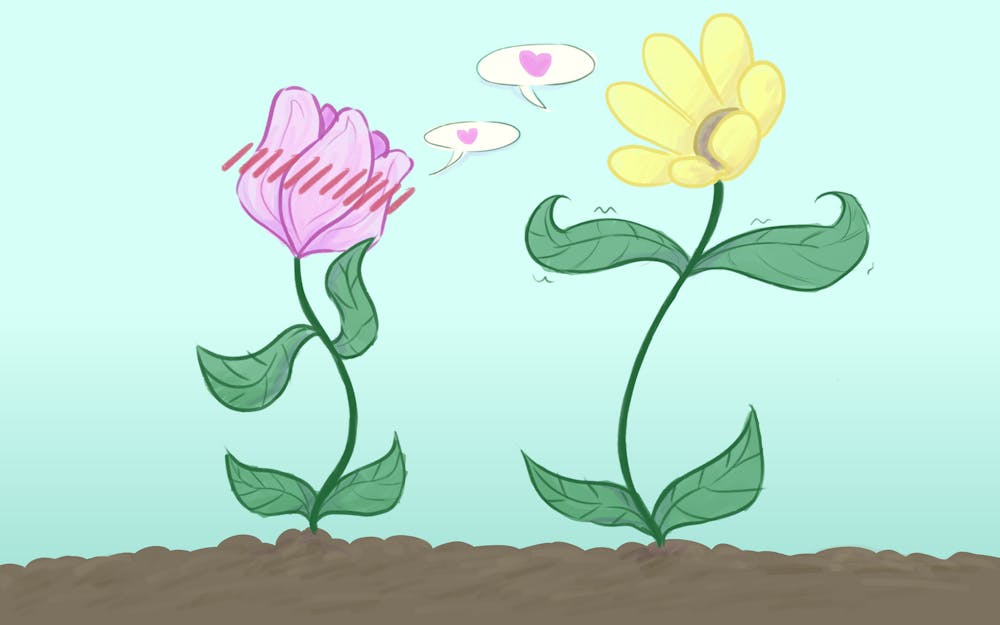
So, sorry to pluck your petals, but those beautiful flowers aren't blooming with your ogling in mind — they’re crafted to appeal to the senses of a pollinator. They’re basically giant billboards screaming “Touch me! Smell me! Drink me!” on the side of the pollinator interstate.
Specific flowers attract specific pollinators, too. Colored, strong-smelling flowers attract certain insects like bees and flies, sometimes using colors only those creatures can see. White flowers, which are more visible at night, draw the pollination of nocturnal creatures like moths. Bright and odorless flowers entice birds’ pollination, who can’t smell very well. Even some mammals get in on the action — bats and squirrels are also certified pollinators.
A flower may even mimic the appearance or smell of a specific species of pollinator — as the bee orchid does — to attract only that species. The more specific a plant’s appeal, the more efficiently it can pollinate, since it wastes less time attracting animals that carry pollen from an incompatible plant.
There’s a catch to the specificity strategy, however. As the relationship between a plant and a pollinator becomes more exclusive, the survival of both species become increasingly intertwined. If the species of insect you’ve been unilaterally relying on to reproduce suddenly goes extinct, that’s not good news for your future.
Some plants go all-in on one species, while others try to appeal to a broader crowd. Every plant’s flower has a unique balance of specificity according to its ecological niche. However, not all flowering plants require a pollinator to reproduce — some can self-pollinate if their male and female reproductive organs are in close proximity.
While the complex love life of flowering plants clarifies the source of our blossoming campus and the bees that have appeared en masse, it does not explain the barrage of airborne pollen assaulting our nasal passages. For that allergic nightmare, we have grasses and non-flowering plants to thank.
Gymnosperms, non-flowering plants, rely less on other organisms — and more on dumb luck — to reproduce. Without needing to create flowers, these plants can divert their energy into producing way, way more pollen, which they release into the wind at random. This method might be inefficient, but with far more darts to hurl at the reproductive dartboard, accuracy per projectile is less important.
If you’ve ever wondered about the purpose of that silky stuff on an ear of corn, wonder no more. Each strand of silk connects to an undeveloped kernel, so each individual strand has to be pollinated to create a full, juicy ear. The length and sheer number of strands creates a bigger target for wind-blown pollen and translates to better reproductive success for the plant.
The plague of springtime allergies comes as a direct result of the windborne pollination tactic used by most grasses (which are technically angiosperms) and evergreen trees on campus. When some pollen inevitably enters your body, your immune system can overreact and attack it, which produces the handful of symptoms we call hay fever.
The production, transportation and collection of pollen is a complex system that unites the birds, bees and trees alike. The next time you’re blowing your endlessly runny nose or drinking in the sights and smells of a campus in bloom, consider how lucky you are to be smack-dab in the season of plant matchmaking.
Spencer Schaberg (he/him) is a sophomore studying microbiology.