Editor's note: All opinions, columns and letters reflect the views of the individual writer and not necessarily those of the IDS or its staffers.
In 1967, members of Students for a Democratic Society, a left-wing student activist organization, gathered in Dunn Meadow to protest the Vietnam War draft, armed with replica rifles. Without police or other protection, then-Chancellor Herman B Wells walked onto the meadow and talked to the protestors.
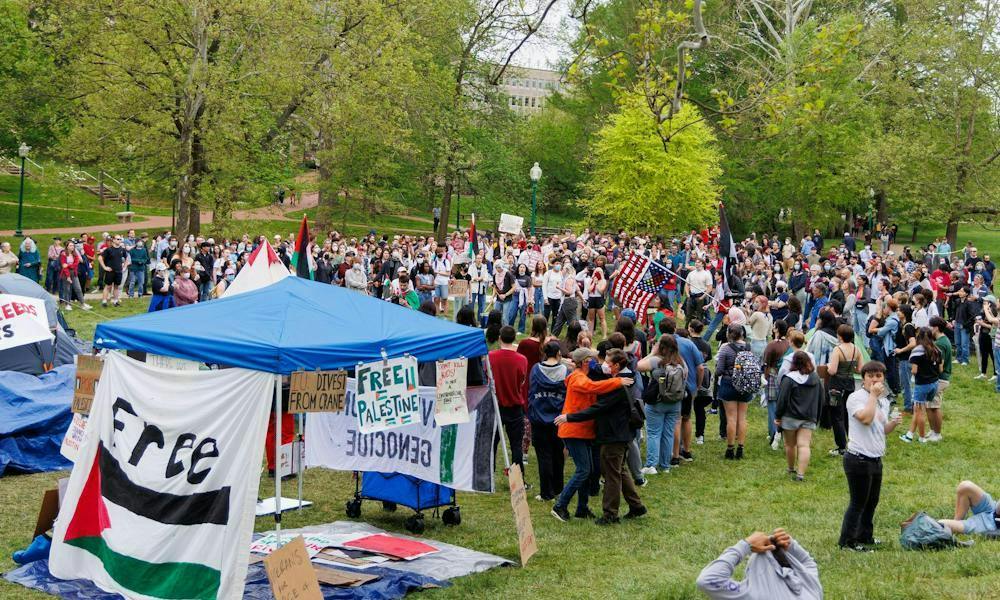
Half a century later, the Indiana University Police Department and State Police, donning riot gear, arrested 57 protestors protesting the War in Gaza in the same meadow.
No greater comparison exists to show the degradation and complete disregard for free speech IU students have witnessed over the past few years. From the firing of the former student media director Jim Rodenbush to the suspension of the Palestine Solidarity Committee as an extracurricular group, Hoosiers continue to witness more attacks on free speech.
According to the Foundation for Individual Rights and Expression, IU is ranked 256 out of 261 universities for free speech, one spot lower than last year.
Plausibly, then, one should be pleased, or even excited to learn, that the Board of Trustees adopted the Chicago Principles in February. These principles are a guide, first developed by the University of Chicago in 2015, for universities across the country to commit themselves to free speech and academic freedom.
But with such little history of this administration’s willingness to protect these principles, one should instead ask whether the adoption of the principles represents the turning of the page or if they are simply empty words to dam the flood of outrage.
Adoption of the Chicago Principles does not automatically equate to an open intellectual community dedicated to the spread of knowledge and discourse. It remains the responsibility of the university to demonstrate commitment to these principles rather than expecting the student body to continue to bear these burdens.
In fact, even as more universities adopt the Chicago Principles, free speech and expression continue to decline on campuses across the country. In some cases, this happens even at universities that have already adopted the principles.
Columbia University became the second Ivy League college to adopt the Chicago Principles in 2016. Despite its longstanding commitment to the principles, the university became part of national headlines due to its harsh crackdowns on pro-Palestine protests similar to IU. In 2024, over 100 protestors were arrested after the New York City Police Department cleared encampments, with another 22 facing disciplinary sanctions for their participation.
Columbia is ranked 246 out of 261 on the same FIRE report, 10 spots above IU. Although FIRE did state that IU’s adoption of the Chicago Principles was a step in the right direction, the report still cited several instances of controversy for IU.
This included Rodenbush’s firing as an incident of “scholars under fire.” The suspension of the Palestine Solidarity Committee and temporary suspension of all 27 fraternity chapters were included as incidents of “students under fire.” Finally, the cancellation of the LGBTQ+ Health Care Conference, postponement of Mosab Hassan Yousef’s speaking event at IU Hillel and the cancellation of Samia Habey’s art exhibit were all considered incidents of “deplatforming.”
Additionally, the FIRE report recommended the University adopt a stronger statement on institutional neutrality. The Board of Trustees adopted a Statement on Institutional Neutrality in 2024, but the current policy doesn’t meet FIRE’s criteria, as it isn’t clear whether the University itself can take political positions. Even then, issues still exist with the framework.
For example, the policy states that students and alumni, referred to as community members, are free to express their views as long as they do not purport to be representing the university. Afterwards, however, the policy states that all community members should assume they are representing the university in any university context, on social media or public forums.
The policy then goes on to state that community members should use “due diligence” to separate their own views from those of the university. Essentially, if this policy were to be taken literally, any student would have to state that their opinions were not the views of the university before speaking.
The Chicago Principles themselves will not protect free speech unless the university administration demonstrates that it will do so, not just say it will. I have doubts whether this administration would ever do so, and according to the FIRE report, so does much of the student body. Much of the same leadership remains in place while the University defends the decisions it’s made, whether in court or in public. Until they actively create an environment where open discourse is encouraged and are willing to defend the rights of all members of the community, the adoption of the Chicago Principles will never be enough.
So what will be enough? First and foremost, the University must revise regressive student policies, such as the Expressive Activity Policy, and commit to an institutional neutrality policy that doesn’t burden students. Finally, the University must defend speech and academic autonomy. If students and even professors feel the need to self-censor in classes on a regular basis, then the culture fostered at this university is clearly a culture that sets us up to fail in a marketplace of ideas.
Jackson Lythgoe (he/him) is a freshman studying Law and Public Policy.