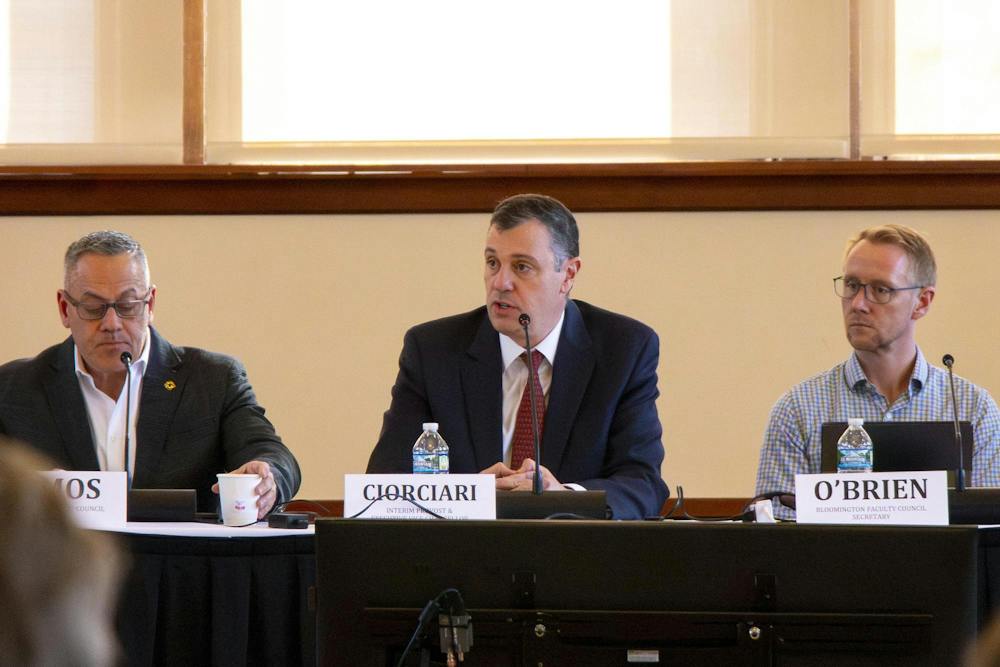
John Ciorciari, interim provost for Indiana University Bloomington, is a finalist to continue in the role permanently.
Over 100 people attended a town hall with Ciorciari on Monday in person and over Zoom. Ciorciari has served as interim provost since previous Provost Rahul Shrivastav left the position in February to become the interim vice president for student success, enrollment and institutional effectiveness, a university-wide role he still serves in.
Ciorciari is the only finalist announced for the position. The provost and executive vice chancellor role includes overseeing all academic units and coordinating faculty research and professional development initiatives. It also oversees graduate and undergraduate education and reports directly to the chancellor.
Before his appointment as interim provost, Ciorciari spent two years as dean of the Hamilton Lugar School of Global and International Studies and 15 years teaching at the University of Michigan before that. He also previously worked for the U.S. Department of the Treasury’s Office of International Affairs, helping create economic policy on Afghanistan and South and Southeast Asia.
Ciorciari said in his opening statement that his priorities as permanent provost included using the university’s money and resources to support research and “creative activity.”
Another one of his priorities is to provide students with skills needed to succeed by adding experiential learning opportunities and creating new degrees. He also wants to demonstrate IU’s value to the state by building on rural and urban partnerships.
Ciorciari said he already has experience working with the president and chancellor on faculty hiring, renovations and general education curriculum as interim provost.
Ciorciari then answered questions from audience members. One asked what issue he had honed in on since becoming interim provost. Ciorciari said he focused on revising IU’s general education curriculum.
The new 29-30 credit curriculum focuses on six categories: arts and humanities, social and historical studies, natural and mathematical sciences, English composition, mathematical reasoning and world languages. The new curriculum, approved by campus leadership in April, removes IU’s “Shared Goals” requirements, which vary by degree program but include intensive writing, information literacy, sustainability literacy, diversity in the United States and enriching educational experiences classes.
“We want it to come together in a coherent whole to ensure that every student is coming out with this range of competencies,” Ciorciari said. “For example, we want citizens, and we want workers, and we want neighbors who have all engaged in some serious ethical reasoning.”
Another audience member asked how Ciorciari would serve as a voice for faculty and students when working with IU President Pamela Whitten and the IU Board of Trustees.
Ciorciari said a crucial part of a campus leader’s job was to communicate the priorities and vision of faculty, staff and students to upper leadership and to maintain good relationships with administration.
He said for the eight months he has held the position, he’s had a good experience building relationships with Whitten, vice presidents and leaders on other campuses.
Another audience member asked how his success could be measured as a provost. Ciorciari said it would be reflected in the number of books, articles and creative works produced within the university, as well as research grants and citations.
He also pointed to student achievement, such as students getting into graduate programs, fellowships or winning awards for their work, as another metric of his success.
When asked how he would protect free speech and academic freedom on campus, Ciorciari mentioned his role as co-chair of a task force involved in implementing the Chicago Principles, a set of free-speech values adopted by the university in February.
Ciorciari said the task force recommended promoting free speech in syllabus language, faculty workshops and reading lists, while appointing “campus leads” to organize activities relevant to free speech. He said the university plans to have an annual symposium related to free speech.
“Right now, we are, I think, in a position where we’ve got a lot of opportunity to improve both the substance of what we do, but also our, sort of, national rankings and reputations around free speech,” Ciorciari said. “And we’re committed to doing it.”
One audience member asked how Ciorciari would help create a more equitable experience for students across all majors, especially regarding the allocation of building space between different departments. Ciorciari said he would want the university to be strategic in investing in the places “where they’re going to have the best bang for the buck.”
No other candidates have been announced for the position yet. Applications closed in late August, and 27 faculty members, administrators and students made up the search committee.