
More than a week after Indiana University placed the Palestine Solidarity Committee of IU on cease and desist, much remains unclear about the reasoning behind the sanction and what comes next.
IU ordered the group to immediately suspend operations, citing in a letter conduct it called “dangerous and disruptive to the university community.”
But the group is reorganizing. Here’s what we know:
What is the Palestine Solidarity Committee?
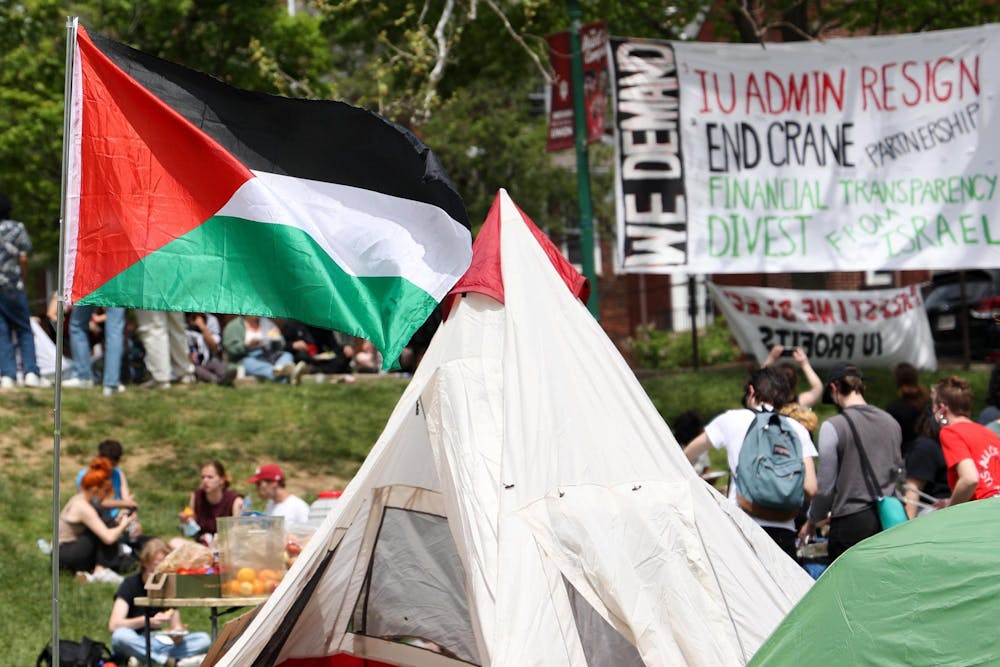
The PSC was one of the main organizers of the pro-Palestinian encampment that took place on Dunn Meadow in April last year. More than 50 protesters were arrested during the first three days, with many receiving trespass citations that were later rescinded.
The encampment lasted 100 days, remaining largely unimpeded following the arrests, until IU cleared the encampment Aug. 2 last year.
The PSC organized several demonstrations throughout the 2024-25 academic year, including appearing at candlelight vigils defending free speech and demonstrations raising awareness for violence in Gaza and elsewhere in the Middle East.
The organization cites three main demands on its social media accounts:
- IU to cancel or reject all partnerships, investments and other affiliations with Israel, and its partnership with Naval Surface Warfare Center Crane Division.
- IU to disclose all such partnerships between affiliated organizations and Israel or the military industrial complex.
- The resignations of President Pamela Whitten, Provost Rahul Shrivastav and Vice Provost for Faculty and Academic Affairs Carrie Docherty.
After its suspension, the organization’s Instagram rebranded to the PSC of Bloomington.
“This account is no longer affiliated with the Palestine Solidarity Committee at Indiana University,” the group said in a post Aug. 19.
Letter from IU
In a letter sent to PSC leadership, first obtained by Indiana Public Media, the Office of Student Conduct ordered the group to cease all organizational activities immediately.
The letter cited alleged violations of the code of conduct, including “the material and substantial disruption of university operations and damage to university property.”
In the letter, IU also requested a roster including all current and former members of the organization. An IU spokesperson did not immediately respond to requests for comment on whether requesting a full roster of students is standard process.
IU Divestment Coalition spokesperson and frequent protester Bryce Greene said the reasoning behind the suspension lacked clarity.
“They have failed to cite any specific action that the organization did wrong,” he wrote in a text to the IDS.
IUPD investigated a PSC organizer last fall in connection with vandalism of the Herman B Wells statue in Dunn’s Woods. In a post on the PSC’s Instagram account, the organizer issued a statement saying they were intentionally targeted as a figurehead in the group.
The organizer didn’t confirm or deny their involvement with the vandalism in an email to the IDS last fall.
The case, which resulted in two charges of criminal mischief, is scheduled for a jury trial in October.
Expressive activity questions
IU’s letter did not explicitly state what policies were violated, referring only to allegations of disruptive behavior during the 2023-24 and 2024-25 academic years, including “the material and substantial disruption of university operations and damage to university property.” It did not include any specific incidents.
Much of the clash between IU and the PSC has stemmed from alleged violations of university expressive activity policies.
The policy’s first draft — introduced the night before the encampment began — was used as the basis for the arrests of protesters at the encampment and trespass citations that were later rescinded.
The Board of Trustees introduced a more comprehensive version of the policy in July that year, including a controversial provision banning “expressive activity” — which covered most forms of protest — between 11 p.m. and 6 a.m.
The Board of Trustees approved amendments to the policy in June of this year following a judge ruling the time restrictions to be unconstitutional.
The board removed the time restrictions, revising the rule to read “IU Community Members may spontaneously and contemporaneously assemble and distribute literature without any prior notice or application requirement, and regardless of group size.”
What’s next?
The PSC has not posted anything to social media or its Substack account since announcing the change to PSC of Bloomington.
College Democrats at IU released a statement Aug. 20 denouncing the university’s decision to sanction the PSC.
“This level of disciplinary action has traditionally been used by OSC as a response to student endangerment, hazing, or the use of substances; in other words, measurable harm to the well-being and safety of IU students,” the statement read. “PSC has not conducted any such behavior.”
IUDC also released a statement implying PSC organizers are attempting to regroup and continue action.
“Organizers are working to resolve the situation, but the fight for a free Palestine continues,” the post read.
Editor’s note: Bryce Greene formerly worked as an opinion writer at the Indiana Daily Student.


