
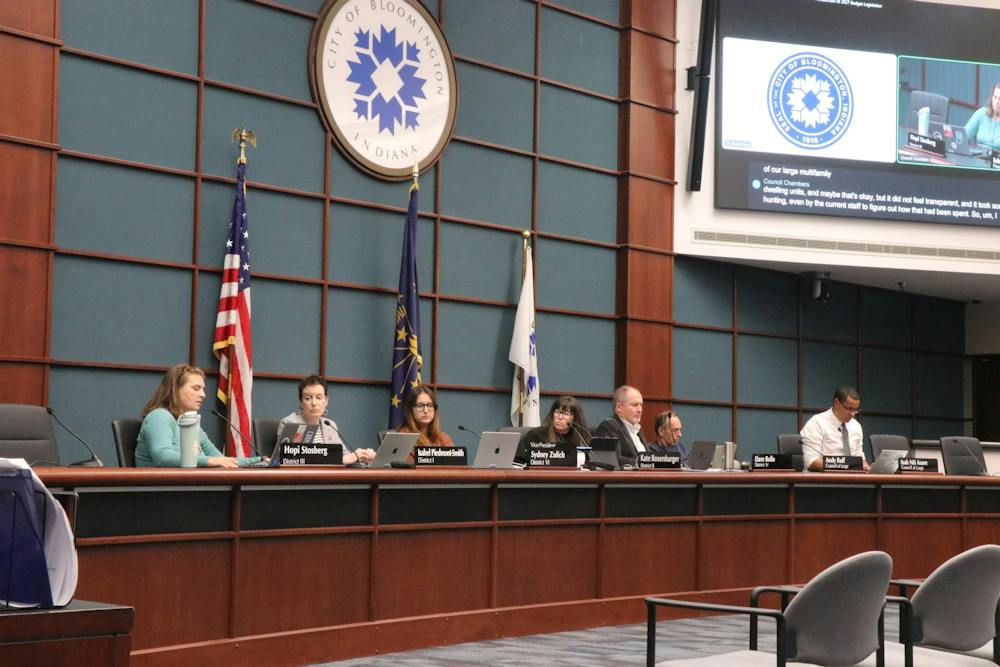
The Bloomington City Council discussed the proposed 2027 civil budget, transit budget and employee salaries during its Wednesday meeting.
Five of the council’s seven members voted against recommending the presented budget ordinance. The body is currently set to adopt a final budget at its special session meeting Oct. 7.
According to the meeting packet, Indiana law requires appropriations to be formally adopted by Nov. 1 of every year, and no less than 10 days after Wednesday’s meeting, allowing the public time to evaluate and object before the budget is finalized.
The proposed 2027 civil city budget totals about $171 million, with property tax levies rising from $46.1 million in 2026 to $49.5 million. The city would spend about $6 million more than it makes in revenue in the general fund — its primary financial account — but maintain roughly $53.5 million in estimated operating balance, showing expenditures for the current period.
According to a memorandum from Bloomington Controller Geoff McKim, the proposed 2027 budget included a 2.7% cost of living adjustment to help wages keep pace with rising prices for civil city employees under the budget’s Ordinance 2026-26.
McKim’s memorandum also included a 3% cost of living adjustment for police, fire and members of the American Federation of State, County and Municipal Employees collective bargaining units — public union workers who negotiate contracts for public service jobs — under its Ordinance 2026-25.
The state has set the maximum amount the city can raise property tax levies at $43.7 million, a 6% increase from 2026, based on changes in Indiana personal income.
Under the proposed budget, roughly $30 million from that property tax increase will go toward the city’s general fund, $1.1 million to the motor vehicle highway fund, $9.9 million to the parks and recreation department operations fund and about $2.7 million to the cumulative capital development fund, a local property tax fund.
These distribution levies will be reduced by about $1.3 million due to tax caps, which are legal limits on property taxes.
The Indiana Department of Local Government Finance also released its estimates for Bloomington’s 2027 local income tax revenue.
The revenue is projected to include $17.2 million in certified shares — a portion of the city’s local income tax revenue — $4.9 million in public safety and $19.1 million in economic development, all of which increased since last year.
Councilmembers Hopi Stosberg, Isak Nti Asare, Isabel Piedmont-Smith, Dave Rollo and Sydney Zulich shared concerns about the budget and discussed potential amendments, though none were formally introduced.
Asare said he is preparing amendments that would cut about $7 million across the budget, including a 25% decrease to non-required city travel, reducing the number of printed park guides and eliminating vacant positions, among other concerns.
Zulich said she could not support the budget without addressing the concerns raised by the councilmembers.
“This is not about us saying ‘No,’” Zulich said. “Many of these cuts are intended to bring us to a point where we make decisions more publicly about how our tax dollars are being spent, and what the return is on that money.”
Councilmember Kate Rosenbarger said it is uncommon to discuss holding back funds when budgeting, but that the council has the power to do so, saying it made sense in some areas to “to wait for projects to be more fully developed before we appropriate that money.”
Five members voted against recommending the ordinance, with councilmembers Rollo and Andy Ruff abstaining. The ordinance will be discussed further at a work session Sept. 30 and at the Oct. 7 special session, which are open to the public.
The council also introduced an ordinance nearly doubling the Bloomington Public Transit Corporation’s capital budget from last year's $19.4 million budget to $37.6 million.
Bloomington Transit Corporation’s operating costs for the upcoming fiscal year rose to about $15 million, with some of the largest increases being administrative staff salaries and employee insurance. The new budget recommendation accommodates for both operating costs and capital expenditures.
The council unanimously recommended the ordinance.
Late in the meeting, the discussion turned to outcome-based budgeting, an approach the council voted 9-0 to rank programs based on how well they match community goals.
Asare said he is "disappointed” by the lack of progress toward that goal. Piedmont-Smith said the council shares responsibility for the that.
Piedmont-Smith said a memo of priorities the council sent the administration ahead of the 2027 budget process “was not outcome based” with its goals like strengthening food security networks and keeping air quality high.
“I think it was very vague,” Piedmont-Smith said. “I think there are some council members who prefer to keep things vague because it’s easier."
She said council members and city staff never sat down with the people who “crunch the numbers” and deliver services to define measurable outcomes.
The council will meet for a public working session at the McCloskey Conference Room at 6:30 p.m. Sept. 30 to discuss potential amendments and concerns.


