Editor's note: All opinions, columns and letters reflect the views of the individual writer and not necessarily those of the IDS or its staffers.
Last week, the American public received two major blows.
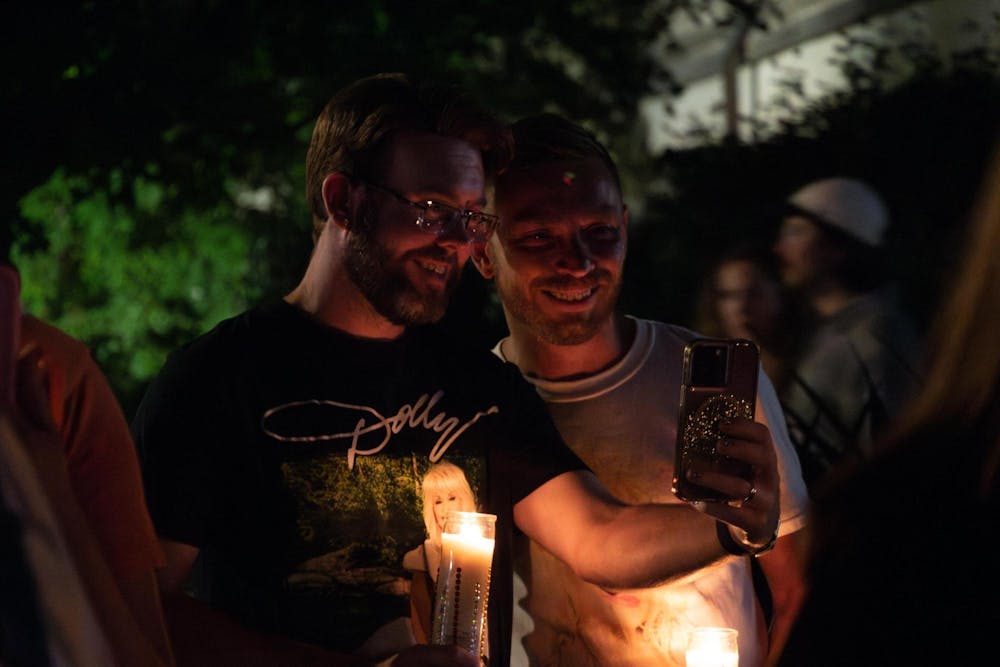
Country music megastar Dolly Parton died Aug. 25 at 80 years old and was followed in death by the iconic “The Rocky Horror Picture Show” actor, Tim Curry, the next day. Heartbroken by the loss of the two legendary performers, fans around the world might recall when and where they were when the news broke.
How did you find out?
Was it the buzz of a news app alerting you of the breaking story? A distraught text from a group chat? Or, perhaps you first saw it on your friend’s Instagram note. Maybe even through a meme.
While I was initially informed by The New York Times, many internet users weren’t given a traditional briefing. Some found out through rather bizarre means. BikiniBottomNews, a SpongeBob-inspired Instagram creator, delivered the news of Parton’s passing to dismayed viewers. Indeed, they received devastating news from an animated fish. This is just one of many news updates frequently posted by the account, which boasts around 1.3 million followers.
This phenomenon is not limited to the case of the beloved “9 to 5” singer. At the The Harvard Crimson, columnist Wyatt Meyer has argued that the “meme-ification of news” has desensitized our culture to tragedy. He noted a recent change in his exposure to news, revealing he learned the United States bombed Iran through a soccer-related meme account.
Discovering major world events via memes and other forms of social media posting is becoming increasingly normalized. While our grandparents might have attentively huddled around a cabinet radio for the nightly news broadcast, we’re now passively scrolling through masses of commentary from infinite sources.
According to the Reuters Institute 2026 Digital News Report, social media and video networks account for 54% of our news consumption, overtaking traditional sources like news websites and apps. In a study the Pew Research Center conducted this March, 31% of Americans under 30 indicated they turn to social media first for information on breaking news.
It seems only natural that we would do so. Social media is accessible, constantly updated and you can find just about everything in one place. From lazy girl dinner recipes to tarot readings, your feed seems to have all interests at the ready. Why should the news be any different?
When you see a post on your feed, it's intentional. Social media platforms are all businesses with the primary goal of making a profit, so whatever makes it rain goes into the mix and onto your screen. By contrast, the free press is an institution tasked with serving the public.
The press, in theory, intends to provide a wide array of information for audiences to analyze. Our expectations for the free press today originate with the nation’s founders, who believed that it was necessary for self-governance.
James Madison wrote, "A popular government, without popular information, or the means of acquiring it, is but a Prologue to a Farce or a Tragedy; or, perhaps both.”
For a functional democracy, the people need access to context to inform their decision-making. To ensure the public has as many perspectives as possible, journalists must collect information from a variety of sources and present it fairly. In the “marketplace of ideas,” we can use that variety to make our own judgements.
Social media platforms do not have those same intentions. Hyper-personalized algorithms distort our own individual perceptions of the world around us. Because platforms like Instagram and Facebook are free to use, they profit by selling users’ data to advertisers. To do so, the platforms use algorithms to note our interests and recommend us content individually.
This is what creates echo chambers, which are our own personalized bubbles within the internet.
“As our feeds are personalised, we become more disconnected,” Adele Zeynep Walton, a journalist and social media activist, wrote, “...divided into a groupthink environment and severed from unity, nuance and room for debate.”
When our feeds become so individualized, to Walton’s point, we are barred from a true marketplace of ideas, limiting our capacity for critical thinking and well-informed civic engagement. In the process, our feeds become more radicalized, prioritizing outrage and absurdity to capture our attention.
Absurdity attracts eyes. A fish revealing the loss of an adored celebrity definitely attracted mine. But when oddity is used as a tool to generate clicks, the important facts of news get lost in theatrics. To Wyatt Meyer’s point, the gravity of the situation at hand is diluted into a stream of wacky online content.
Think about our own lions-on-the-loose fiasco here in Hoosierland. Would a loose pig in Indiana bring in the bacon? Probably not. But the prospect of Mufasa lurking in a nearby cornfield certainly did.
Undoubtedly, the press uses social media as a tool. Many news outlets, including this one, post content online. It’s free and available for all users, unlike the typical pay-to-play newspaper. Sure, the internet attempts to provide a public forum for debate. But the business-oriented nature of social media and its algorithms directly oppose the ideas behind a reliable free press.
Fortunately for us students, Indiana University grants access to a variety of online news sources. As for free resources, I highly recommend PBS programming and the pretty fantastic paper you’re reading right now. Social media will always have something to say about the latest news. We can’t be expected to always ignore it, but it can’t be your end-all-be-all either.
Because let’s be honest: the tuna fish newscaster isn’t going to cut it.
Emma Howard (she/her) is a junior studying journalism.