
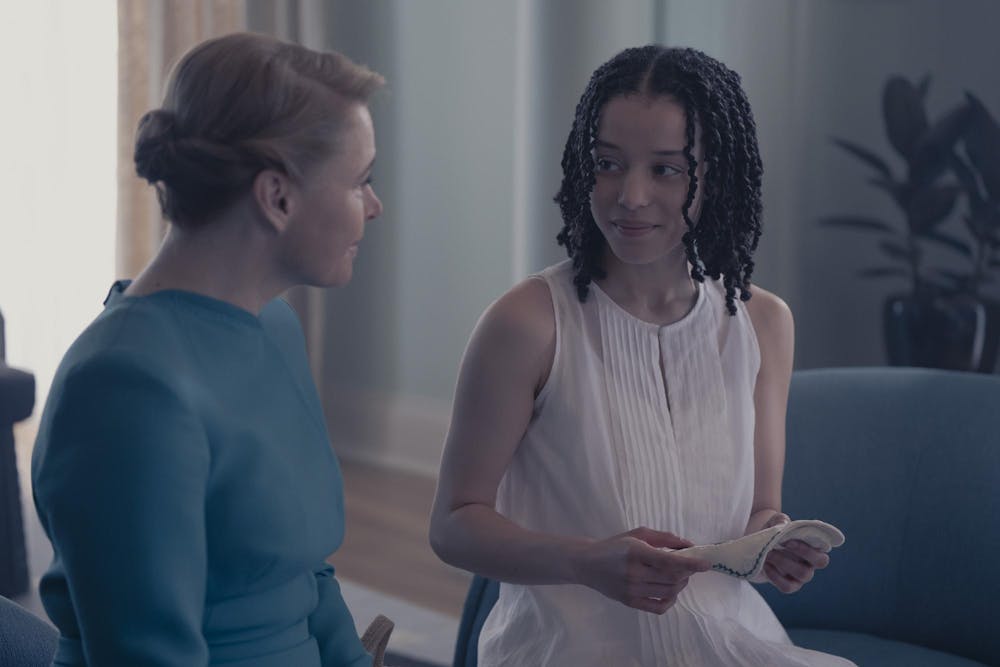
For fans of “The Handmaid’s Tale,” its highly anticipated sequel “The Testaments” premiered its first three episodes on Hulu on April 8. Like its predecessor, the series is based on Margaret Atwood’s novel of the same name. Despite not reading either series and only seeing part of “The Handmaid’s Tale,” I decided to check out the show because its focus on teenagers appealed to me.
From its first three episodes, I found “The Testaments” to be a compelling and easy-to-follow continuation of “The Handmaid’s Tale” that offers a different perspective.
"The Testaments” builds on the story established in “The Handmaid’s Tale,” which is set in the Republic of Gilead, a dystopian patriarchal theocracy ruled by an authoritarian regime of commanders.
Episode 1 opens with an internal monologue by Agnes (Chase Infiniti), a privileged young girl and the daughter of a commander. Alongside Agnes and Shunammite (Rowan Blanchard), viewers also meet Daisy, (Lucy Halliday), who is a recent convert from Canada. The 44-minute-long episode provides some helpful context for the series. For viewers like me who do not have much context for the series, Episode 1 is easy to follow and draws you into the show right away.
The first episode also includes two notable cameos. The first is one more obvious, with Elisabeth Moss continuing the story of “The Handmaid’s Tale,” and the other is more subtle with Stephen Colbert in a voice cameo. I found Episode 1 to be an effective and relatively light introduction back into the world of Gilead, especially because it eases new viewers into the story.
Episode 2 further explores Agnes’ friendships with her peers and shows that even in a restrictive and unconventional society like Gilead, young girls still share familiar experiences, which makes the show more relatable. At the same time, the darker side of Gilead remains, as two scenes with the commanders and Agnes alone in particular are extremely uncomfortable to watch and underscore just how restrictive and deeply patriarchal the society is.
The episode also continues to build Agnes’ character by giving viewers more insight into her inner thoughts. I found this episode to be the most interesting of the three because it features a twist and several moments that make Gilead’s darkness impossible to ignore.
Episode 3 shifts the perspective from Agnes to Daisy, giving viewers more insight into Daisy’s backstory and how she ended up in Gilead. It is also where the action starts to build, and the show’s tone moves from a lighter teenage story into a darker, more political drama. At the same time, the episode functions largely as a backstory, revealing Daisy’s purpose in Gilead. Some of the flashback scenes drag a bit in my opinion. I prefer when a show keeps viewers a little in the dark because it creates a more anxious feeling as it builds toward a larger reveal.
The acting in this show is incredibly strong, especially Halliday’s performance, which portrays the teenage experience both outside Gilead and within it in a believable way. She moves effortlessly between playing a carefree teenager and a restrained, rule-following girl. Each actor portraying a teenager fully inhabits her character, making the relationships feel convincing and the girls feel true to their age.
At the same time, the actors portraying the adults in Gilead bring a sense of intimidation and unease that heightens the contrast with the young girls and makes the society even more disturbing.
The soundtrack is another aspect of the show that stood out to me. The creators clearly chose it with care as it matches the tone of key moments and feels well suited to a younger audience, with many of the songs being popular with Gen Z. The soundtrack also carries a somewhat nostalgic quality, with older tracks such as “Dreams” by The Cranberries and a cover of “California Dreamin” by Scala & Kolacny Brothers drawing viewers into a false sense of safety about Gilead. At the same time, the soundtrack adds a lighter, more fun element to the show with newer artists such as Tabitha Meeks and her song “Cherry on Top” and Remy Bond with “Summer Song.”
Lastly, I found the fashion in Gilead visually appealing and similar to what I remember from “The Handmaid’s Tale.” The sleek jackets, especially those worn by the Aunts, stand out, as do the headbands worn by the young girls. In contrast, the fashion outside Gilead in Canada feels more modern and closer to everyday life.
So far, the first three episodes have delivered a captivating start. From my limited experience with “The Handmaid’s Tale,” “The Testaments” appears to carry the same level of detail and thoughtfulness while offering a different perspective to continue the story and, hopefully, provide a satisfying ending. I am looking forward to seeing where the story goes as the action continues to build.
The first three episodes of “The Testaments” are now streaming on Hulu, with the remaining seven episodes set to roll out weekly on Wednesdays.


