
Editor’s note: Some quotes in this story were translated from Spanish into English.
Leer la versión en español aquí: El hombre de música: Un hombre de Seymour crea communidad para migrantes con música
Thirteen-year-old Joshua Bo Jose will soon be Beethoven.
He wears a blue button up, a silver tie and a black suit jacket just slightly too big. His teacher nudges him towards the small black upright piano. Hands on the keys he begins to play.
His music teacher, Jacobo Arma José Felipe, nods his head and returns to his other students. This is José Felipe’s world every Wednesday night.
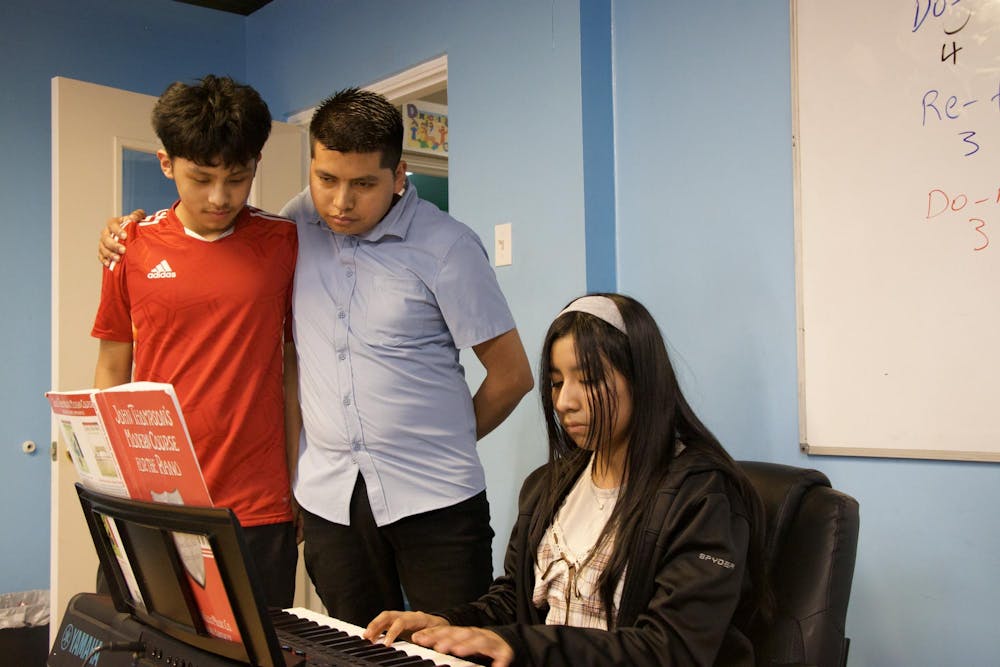
In a bright blue classroom in a simple grey church right off a central street in Seymour, Indiana, over 2,000 miles from his homeland, Guatemala, José Felipe shares his love of music.
José Felipe launched the class in 2023 at his church Iglesia Evangélica Ríos de Agua Viva. He originally began teaching the students as a volunteer. Now it’s his full-time job.
When he first came to the church, it had no live music services, José Felipe said. Now they have a 60-person choir and music classes for children and adults all led by José Felipe.
José Felipe said churches with music “look very pretty, very happy, more alive.”
When he first started, José Felipe said he struggled with discipline. He said he remembers the children making fun of him in English, which he couldn’t understand. Now, students laugh and joke with José Felipe while others quietly fill out their homework.
“I get along well with them,” José Felipe said. “I know that they respect me. I’ve tried to teach them these types of values.”
Even Johan Nicolás, wearing a cherry red soccer jersey and dreaming of being on the field instead of the classroom, smiled and said José Felipe was his favorite part of classes.
Every class starts with a lesson on music theory, then students give a presentation on the stories behind famous hymns like “It is Well with My Soul,” composed by Philip P. Bliss.
With these lessons, José Felipe said he hopes his students will appreciate the meaning behind the music.
“It’s not only the music but also the message,” José Felipe said, “And the lessons that they leave us is what encouraged me to want to learn and also teach.”
After presentations, students work on music theory worksheets and José Felipe spends around 10 minutes with each student. He listens to them talk about the songs they worked on for homework that week.
José Felipe’s love of music began in Guatemala, where he learned to play the piano through lessons at his church. There, as a child he remembers seeing a group of singers.
“I watched them and I said I wanted one day to become a musician, to sing, to play an instrument,” José Felipe said.
But he never imagined it would happen beyond Guatemala.
“I came here because I’m crazy,” José Felipe said. “I didn’t think ‘I’m going to go to teach music,’ no, I simply thought, ‘Well, I’m going to go.’”
While a field worker in California, José Felipe’s brother told him to move to Seymour to work a factory job there.
He started working at Aisin U.S.A. Manufacturing, Inc., a Japanese-owned company that produces various car parts.
José Felipe said the community attracted him to Seymour. He said he found many other Guatemalans that speak his native language of Chuj, a Mayan language, there.
In 2021, National Geographic found there were around 2,000 Chuj speakers in Seymour, making up to 10% of the population. The majority are from José Felipe’s hometown, San Sebastián Coatán.
The 2020 census found that 14.9% of Seymour’s population was foreign-born and 17.5% speak Spanish at home.
Yesica Gaspar, a member of Iglesia Evangélica Ríos de Agua Viva, said she noticed an increase of non-Chuj speaking migrants. Because of this, the church, originally founded using Chuj, decided to switch its services and classes to entirely Spanish.
“We want to bring more people, and if we want them to stay obviously, we want to let them hear the sermon all in Spanish too,” Gaspar said.
However, Gaspar said many of the church elders don’t speak much Spanish, making it more difficult for them to address the church on Sunday mornings.
José Felipe agreed that having church services in Spanish has helped grow the community, but he still uses Chuj frequently when not teaching classes. He learned Spanish in school and remembers being embarrassed to speak to the teachers because he didn’t know the language well.
Language barriers are present in his music lessons because there are a few students that speak mostly English, José Felipe said.
Gaspar said she noticed this in her Sunday school classes too, and she tries to come up with ways to mix English and Spanish so everyone can understand.
In the future, José Felipe hopes to add more classes and hold a recital for the Seymour community to come watch.
“I know that not all (of my students) are going to be musicians,” José Felipe said. “But I do know that they are going to be very successful people.”
José Felipe watches Joshua Bo Jose play from the corner of his office.
Bo Jose, José Felipe’s student of three years, plays the last few notes of his song and the room erupts in applause.
Bo Jose smiles. He loves music because it is a challenge. He wants to get better, and one day he’ll be able to play his favorite song, “Moonlight Sonata,” composed by Beethoven.
Elizabeth Schuth covers immigration issues in southern Indiana. Her work is supported by a rural reporting grant from the Hearst Foundation. Edith Morales, also supported by the grant, contributed to this reporting.



