
Editor's note: All opinions, columns and letters reflect the views of the individual writer and not necessarily those of the IDS or its staffers.
There is a version of the First Amendment that exists in courtrooms, in appellate opinions, in the careful reasoning of constitutional scholars. In that version, free speech is nearly absolute — an indiscriminate shield that covers the powerful and the powerless alike.
Then there is the version that exists in practice. That version has a different relationship with power. It protects the people who need protection least and binds those who need it most.
Gabriela Saldana found out on April 16 which version applies to her.
When Saldana, a 23-year-old student at Florida International University, posted in her WhatsApp group chat, “Netanyahu, if you can hear me, drop some bonbons for us Capstone students in Ocean Bank Convocation Center,” she was doing what many students do in group chats, being absurd. The message may as well have been a wish directed at Santa Claus.
FIU police arrested her anyway, charging her with making “a threat to kill or do bodily harm to individuals regarding a scheduled event.”
The State of Florida charged her with a second-degree felony carrying a maximum sentence of 15 years. At arraignment, Judge Mindy Glazer set bail at $5,000 and offered her legal reasoning: “To an objective person, it's not a joke, and it would be enough for probable cause.”
This is not a debatable legal question. Under Watts v. United States (1969), the Supreme Court held that hyperbolic political speech — speech invoking violence and directed at a sitting president — is protected when context makes clear it is not a genuine threat.
The Court tightened that standard further in Counterman v. Colorado (2023), requiring prosecutors to show not just that a reasonable person would find the statement threatening, but that the speaker was at minimum consciously disregarding significant risk that their words could cause harm. A message asking a foreign leader to drop “bonbons” on a graduation venue, sent in a student group chat, fails that test so thoroughly it falls to the level of “Saturday Night Live” parody.
Probable cause requires reasonable belief that a crime occurred. If conduct is constitutionally protected, there is no crime. Glazer’s statement that “to an objective person, it's not a joke” is not a legal finding — it’s Glazer’s opinion and contradicts 50 years of Supreme Court precedent. Saldana is almost certainly going to win her case, but that’s entirely beside the point.
The Foundation for Individual Rights and Expression has already alleged First Amendment violations in an April 23 letter to FIU police. Ongoing legal proceedings will take months or years to reach a conclusion. In the meantime, Saldana has been arrested, publicly charged with a felony, forced to post bail and had her name and face attached to a story about threatening a mass casualty event at a graduation ceremony. She will carry that search result wherever she goes — to job applications, to graduate school admissions or social events — regardless of how the case resolves.
Saldana has a right to freedom of expression, but for someone without institutional protection, resources, or social capital, arrest is the punishment. The Constitution is theoretically available to everyone; the protection it provides in real time is not so evenhanded.
One week before Saldana posted about Netanyahu, President Donald Trump wrote on Truth Social that “a whole civilization will die tonight, never to be brought back again,” in reference to the war in Iran.
Harvard’s Carr Center for Human Rights Policy characterized the statement as a threat of genocide. Trump was not arrested or charged. No judge found that a reasonable person might take his words as a genuine threat — even though, unlike Saldana, Trump commands an actual military, has the authority to order strikes and has exercised both.
Power, it turns out, is an excellent predictor of whose words are treated as protected political speech and whose are treated as criminal threats. The First Amendment, in practice, is strikingly good at protecting the people least likely to need it.
IU students do not need to look toward Miami to understand this asymmetry.
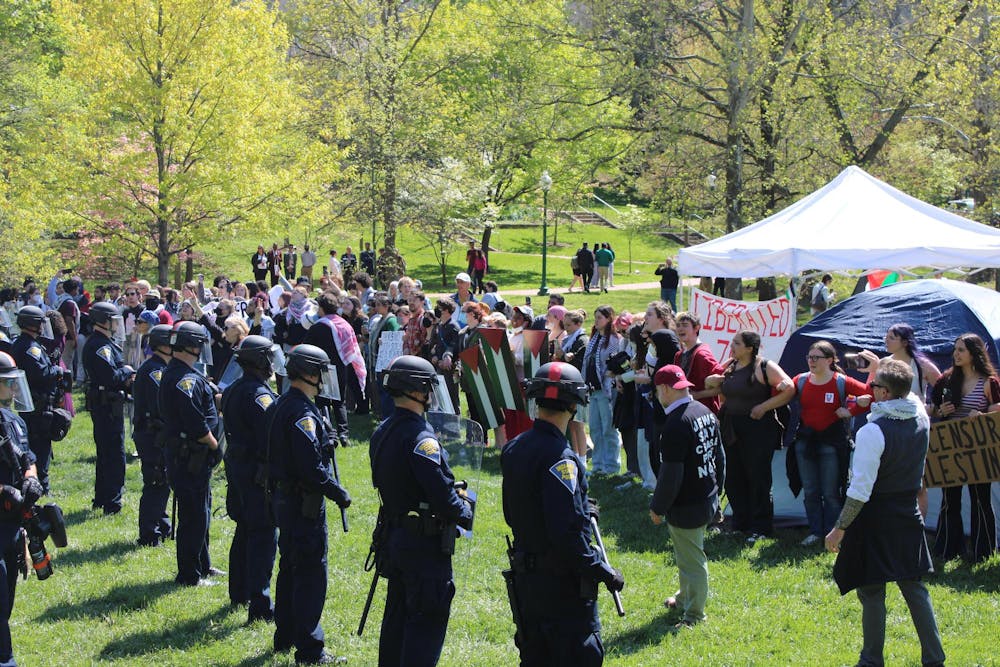
In April 2024, IU administrators changed a 55-year-old policy overnight, which guaranteed broad protest rights in Dunn Meadow. When students arrived the next morning to set up a planned encampment, the administration had already called the Indiana State Police. Troopers arrived in riot gear. Snipers positioned themselves on the roof of the Union with rifles aimed at students. Dozens were arrested, and many received one-year campus bans.
FIRE, the same organization now defending Gabriela Saldana, then named IU the worst public university in the country for free speech. When asked to describe a time they felt they could not express their views on campus, one IU student’s answer was simple: “The president has called snipers on protesters before.”
The administration that deployed those snipers — in the name of safety and order and the protection of the campus community — has spent the past year refusing to release the findings of an independent review it commissioned into plagiarism allegations against university President Pamela Whitten.
In August, The Herald-Times reported what appeared to be an 85-word section of Whitten’s 1996 dissertation that copied almost verbatim from another source, along with several other alleged instances. IU declared the allegations meritless, cited attorney-client privilege to withhold the review and gave Whitten a raise and extended her contract. Legal experts interviewed by the Indiana Daily Student found no legal mandate preventing the university from releasing the report. The question — “why keep it secret?” — is still unanswered.
The pattern arranges itself clearly enough. Integrity standards are enforced downward, against students, with suspensions, expulsions and felony trespass charges. The same standards, when they implicate IU’s president, become confidential legal matters shielded from the public.
A legal system that protects free speech would attach consequences to its violation at every level, not just at the appellate level years after the damage is done. It would not insulate judges who find probable cause for arrests that contradict half a century of constitutional precedent. It would not permit a university president to deploy armed state troopers and snipers against students exercising protected speech in a designated free speech zone, and face no legal consequence for doing so, while those same students are banned from campus for a year on threat of felony prosecution.
The First Amendment found in textbooks states the law cannot be weaponized against speech simply because it is uncomfortable, provocative or politically inconvenient. The First Amendment that exists in practice in Bloomington and Miami, and in every place where power decides which words are threats and which are protected, states something else entirely.
Spencer Robinson (he/him) is a sophomore studying public policy analysis and law and public policy. His commentary can also be found on his Substack.



