
Editor's note: All opinions, columns and letters reflect the views of the individual writer and not necessarily those of the IDS or its staffers.
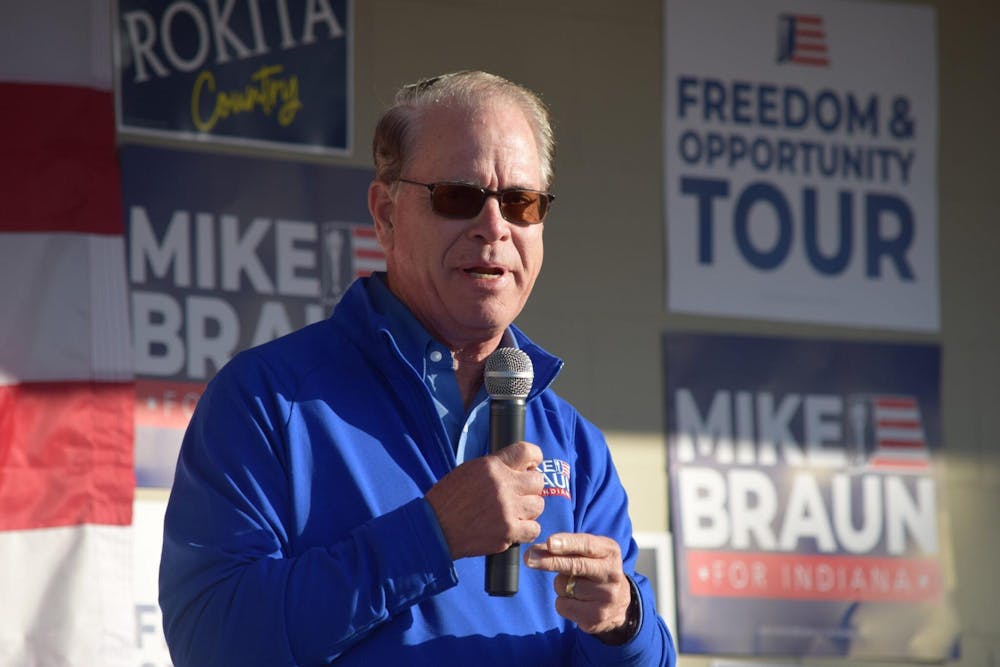
On April 13, Indiana Gov. Mike Braun announced $15 million in state incentives to support Iron Nation, an Israeli venture capital firm founded in direct response to the Oct. 7 attacks.
According to the Indiana Economic Development Corporation, Iron Nation has committed $30 million of its own capital, but the state government has been conspicuously vague on the details of the partnership.
When 13News statehouse reporter Emily Longnecker asked Braun about job creation — the most basic justification for any state economic incentive — his answer was strikingly empty.
“I mean, they're coming here. So it would be going to people that live and work here,” Braun said in an interview with WTHR.
Iron Nation operates in medtech, defense tech and deep tech and said it invested in Indiana because of the state's strong research and manufacturing base. That pitch sounds reasonable on paper, but a closer inspection of the firm's portfolio raises serious questions about what Hoosiers are subsidizing.
One Iron Nation venture, Airwayz, specializes in AI-powered drone traffic management and partners with the Israeli government under the INDI3 National Drone Initiative. The initiative is piloting Airwayz’s tech for use in real-time threat identification, aerial security patrols and urban surveillance, technologies with potential military use. Another, Line5, is a confidential defense tech company with ties to Iron Drone, an Israeli defense contractor. The state has offered no clarity on whether Indiana tax dollars will flow to these companies specifically, which should alarm anyone who believes government spending deserves public accountability.
This is not Indiana’s first financial entanglement with Israel. In 2024, the state treasurer noted that Israeli bonds were among the state's best-performing investments — a talking point that uses fiscal prudence to deflect political and moral concerns. Israeli bonds directly finance the Israeli government's spending, including its ongoing military operations in Gaza. When the state profits from those bonds, Hoosier taxpayers are — whether they know it or not — stakeholders in that spending.
That context matters enormously as public opinion has shifted. Today, 60% of Americans view Israel unfavorably, up from 42% in 2022. The Boycott, Divestment and Sanctions movement — which targets companies and institutions financially complicit in Israel's military occupations and human rights violations — has been especially active at IU, where the student-led Indiana University Divestment Coalition has called on the university to divest from Israeli bonds.
Students have also named Amazon, Microsoft and Alphabet as divestment targets for their investment in AI-powered targeting systems. The political wind is shifting. Braun’s announcement pulls the state in the opposite direction.
That choice is intentional. Indiana's 2016 anti-BDS law, part of a patchwork of state level restrictions, effectively locks the state into its pro-Israel financial posture by prohibiting government agencies from investing in any company that has boycotted, divested from or sanctioned Israel. Anti-BDS laws have faced legal challenges. An IDS column in 2019 called it a restriction on free speech, and several courts have agreed with this interpretation. The National Lawyers Guild also petitioned against the law in 2016— yet it remains on the books.
The effect is that the state government can move money toward Israel but is legally constrained from moving it away. That asymmetry was shaped in large part by the American Israel Public Affairs Committee, the pro-Israel lobbying organization whose electoral influence has itself become a major point of national debate.
Track AIPAC, a transparency website following pro-Israel lobby spending in elections, has made opposition to AIPAC a defining issue in the 2026 Democratic primaries. The organization’s growing reach reflects an erosion of the pro-Israel bipartisan consensus that made AIPAC spending politically costless.
In January, New York Mayor Zohran Mamdani became a symbol of that shift, revoking an executive order his predecessor Eric Adams had issued just weeks before leaving office, which had barred city officials from taking any action against Israel or entities associated with it. Adams, who received significant pro-Israel lobby donations, issued the order in the final stretch of a failed reelection bid. Braun’s $15 million announcement has a similar feeling: a political effort using the language of economic development.
The political nature of the deal becomes clearer when you examine who Braun chose as Indiana's partner for the initiative. Former U.S. Rep. Luke Messer — a man whose career is a masterclass in converting public office into private opportunity — will serve as the state’s liaison for the Iron Nation initiative. Messer has been a fixture in Indiana Republican politics for nearly three decades, beginning as legal aide to State Rep. David McIntosh in 1998. His relationship with Braun is personal as well as professional: Both are alumni of Phi Delta Theta, a social fraternity at Wabash College, though their time there didn’t overlap.
Messer’s record warrants scrutiny. In March 2006, he voted in the Indiana statehouse to approve the sale of the Indiana Toll Road to the Cintra-Macquarie construction consortium for $3.8 billion. One month later, he joined Ice Miller LLP — the firm that represented Cintra-Macquarie in that deal — as a lobbyist. Whether or not that timeline constitutes a legal conflict of interest, it reflects a pattern: Messer has a well-documented habit of blurring the line between public service and private gain.
That pattern continued after his congressional career. Messer represented Indiana's 5th Congressional District from 2012-18, when he lost the Republican Senate primary to Braun himself. Since leaving office, he has cycled through two lobbying firms: Faegre Baker Daniels Consulting and Bose Public Affairs Group. He is a professional insider. Now, he is the public face of Indiana's financial relationship with an Israeli VC firm backed by defense tech companies operating in an active war zone.
Braun’s announcement is a political handout dressed in the language of investment. The $15 million in state incentives, vague partnership terms, a defense tech portfolio, anti-BDS legal architecture and the appointment of a revolving-door lobbyist as Indiana’s point man all point toward the same conclusion: This deal is less about what Iron Nation can do for Indiana than about what Indiana can do for it.
Hoosiers deserve a better answer than “they’re coming here.”
Spencer Robinson (he/him) is a sophomore studying public policy analysis and law and public policy. His commentary can also be found on his Substack.



