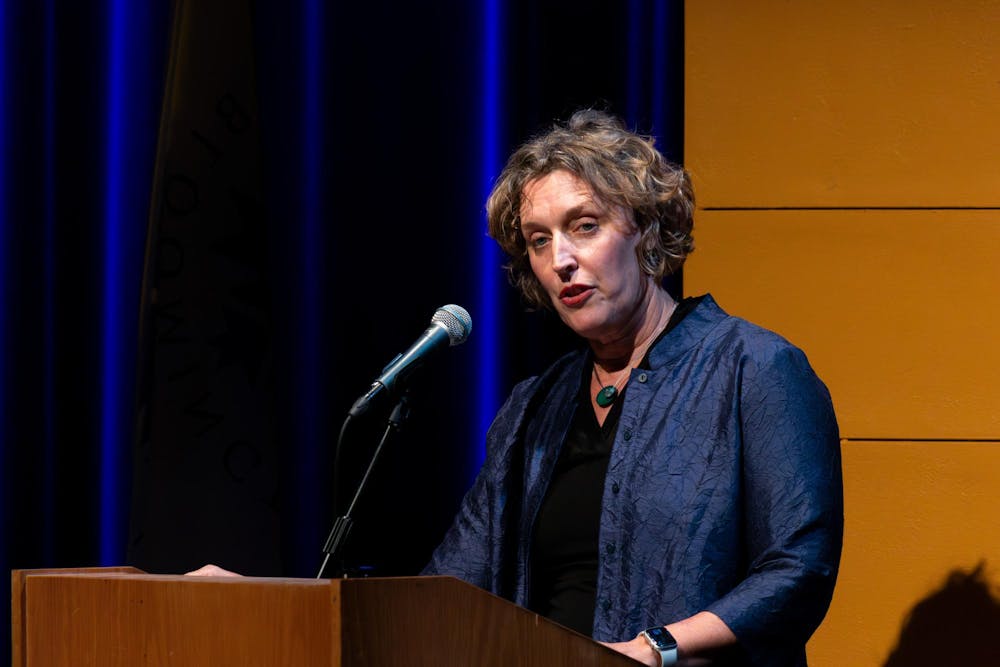
Mayor Kerry Thomson focused on what Bloomington can build together in her third annual State of the City address Tuesday night at the Buskirk-Chumley Theater.
In her speech to a packed house of community members, city officials and local leaders, Thomson framed the evening on what a thriving community looks like, saying it starts with a well-maintained, clean and safe city.
Flock Safety contract
Thomson recently received backlash from citizens over the cities' continued use of Flock surveillance cameras. Residents have raised concerns about privacy and government surveillance, with many alleging its license plate data is being used by U.S. Immigration and Customs Enforcement and other federal agencies.
Residents received multiple heavily redacted versions of the city’s contract with Flock before it released the full contract Jan. 27 after months of requests.
In a City Council meeting March 4, council members passed a Flock limits resolution, requiring the Bloomington Police Department and the mayor’s office to release a report on who can access data from the cameras. Thomson was not present for the Flock discussion. She left the meeting before the discussion began, and, as of March 31, no report had been made.
Thomson addressed the Flock Safety controversy, telling the audience the city is reviewing its contract and will present findings to the council April 15.
Attendees expressed frustration with the city's actions, calling for a “cut to the contract.” Thomson said she is happy to talk to residents and hear feedback.
Housing and homelessness
Since her second State of the City address, Thomson has continued to face pressure over affordable housing and homelessness in Bloomington. The topic was a large portion of the address.
The city moved forward with clearing encampments over the past year, including issuing eviction notices to people living in Brown Woods and in an encampment north of RCA Community Park.
Thomson said only one encampment remains today; however, these evictions came with many concerns over where citizens would go after camps are cleared.
Thomson also said attainable housing has been her top priority since taking office and called Hopewell, the planned development on the former IU Health hospital site, a “once in a generation neighborhood.”
The neighborhood’s development is still under consideration of the city council, despite the mayor urging progress.
City Council President Isak Nti Asare said the relationship between city council and the mayor is collaborative and pointed to Hopewell as the most immediate shared goal.
Thomson also acknowledged Senate Enrolled Act 285, which prohibits public camping beginning July 1. She said it was not a law her administration supported but one she intends to use as a deadline to move people into housing and services.
“We cannot arrest our way out of homelessness,” Thomson said. “We prioritize housing, treatment, support and connection because that is how people stabilize and begin to rebuild.”
She called on other jurisdictions to stop transferring people to Bloomington without a local connection or follow-up plan.
Economic development
Construction for the new Bloomington Convention Center began in June. This led to many commercial and residential leases south of the convention center to not be extended.
Outside the theater, Bloomington resident T Randall said residents in Seminary Pointe apartments are facing displacement within months.
“For someone who says they’re very interested in affordable housing, this choice seems very strange and seems to counter it,” Randall said.
In October, city council approved a $163 million budget for 2026. Two council members voted against the decision, citing a lack of trust in mayor Thomson and the administration's handling of priorities, according to the B Square Bulletin.
In her address, Thomson pointed to the convention center expansion as a nearly 20-year community effort now becoming reality.
“The expanded convention center is expected to bring millions of dollars in new spending from outside Bloomington each year,” Thomson said.
Thomson closed by acknowledging financial pressure created by the Senate Enrolled Act 1, which offers tax credits to homesteads that reduce their property tax bill by 10% and increases exemptions for personal property taxes for businesses. She said the city will have to prioritize essential services and capital projects in the years ahead.
“The state of the city is strong and moving forward,” Thomson said. “Not without bumps and not without limitations, but with purpose, clarity and community.”