
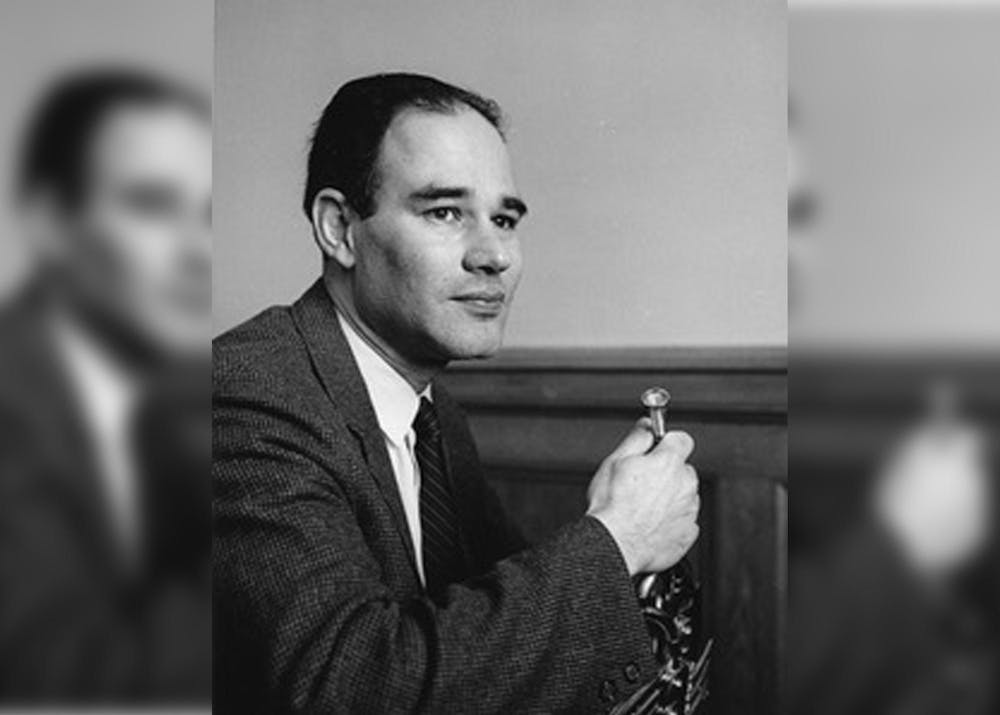
The year is 1938. Benjamin and Emma Bloom take their 12-year-old son, Myron, to a concert in Cleveland featuring cellist Emanuel Feuermann.
Leaving the concert hall, Myron knows exactly what he is going to become in life: a musician.
And a musician he became, swiftly beginning his 81-year-long relationship with the art form. Throughout his long life, Myron Bloom was appointed principle solo horn of the Cleveland Orchestra and later professor of horn within the Jacobs School of Music at IU from 1985 to 2016.
Bloom passed away in 2019, leaving behind a distinguished legacy through his family, recorded music and former students.
Now, seven years later, Bloom’s legacy continues. David Renfro, one of his former students, organized a concert Friday night at Auer Hall in honor of what would have been Bloom’s 100th birthday on April 18. The concert exclusively featured former students and family of Bloom’s, with a few current Jacobs students helping behind the scenes.
“The concert represents generations of his students,” Renfro said. “His legacy as a musician, let alone a horn player, is so large that I hope attendees of the concert walk away with a deeper appreciation of people as a performer, as an educator.”
Renfro said the repertoire featured within the concert naturally came together as more of Bloom’s former students joined the project. He began organizing the concert because he felt there should be more events and honorariums for his mentor.
Contacting Bloom’s former students and sifting through IU’s registrars office dating back to 1985, when Bloom began working there, proved to be a challenge. Records only became digitized in 1994, so Renfro was only able to contact those who studied under Bloom from that year on.
“So, then it was just a matter of tracking them down through Facebook and looking them up online and writing to people to see who would be interested,” Renfro said.
All nine pieces featured throughout the concert included someone closely connected to Bloom, with Bloom’s former student Stacey Eliason beginning the concert with Howard Stoess’ “Sonata, Prelude” (2014). The piece, she said while onstage, was a solemn dedication to his work within the later years of his life.
Between pieces, Bloom’s audio recordings with the Cleveland Orchestra played through Auer Hall, while the projector showcased a slideshow of photos from his life. The recordings featured audio from Franz Schubert’s “Auf dem Strom, D. 943” (1828) and Johannes Brahms’ “Trio in E-Flat Major, Op. 40” (1865).
Additionally, Richard King, a Cleveland Orchestra member and one of Bloom’s former students, took the microphone in the middle of the concert to speak of his late teacher’s legacy.
King is one of Bloom’s successors as the principle solo horn of the Cleveland Orchestra.
“We’re all, like, a culmination of everything that’s come before us,” King said. “I feel very much like his teaching and his spirit lives on in our generation, hopefully from there to come.”
The last piece, David Popper’s “Requiem, Op. 66” (1892), featured Bloom’s widow, Susan Moses Bloom, on the cello accompanied by two other cellists and a pianist.
Before beginning the piece, Susan took to the microphone, telling the story of her relationship with her late husband, recalling when they first met in 1994. The couple were engaged within the year and married in 1996.
“I met him because, during his sabbatical leave here, he wanted to study cello,” Susan said. “And so, we met, and after a very, very short period of time, he said, ‘I waited for you my whole life. Will you marry me?’”
As “Requiem, Op. 66” came to a somber end; the dim house lights of Auer Hall brightened. Audience members began to rise, chatting with one another about Bloom and their relationships with him.
Richard Seraphinoff met Bloom in the mid-1980s, then was working with him in the Jacobs horn department by 2000. The two grew closer, and Seraphinoff eventually chose Bloom to be the best man at his wedding and walk his wife down the aisle in 2003.
Thinking of his colleague and friend, Seraphinoff said he remembered Bloom for his enthusiasm and love for the horn.
“He was very enthusiastic about the true, beautiful sound of French horn music being very physical and not just, you know, making time,” Seraphinoff said. “He really made every note count.”
CORRECTION: This story has been updated to reflect Stacey Eliason was the first to perform in the concert.


