
SPOILERS: This column contains potential spoilers for “Backrooms.”
When I sat down to watch “Backrooms,” released May 29, I expected a journey through multiple levels of labyrinth-like horror mazes filled with the web series’ multitude of strange monsters. What I ended up with was a far different experience that, after my initial disappointment faded, left me with a film that perfectly encapsulated what the Backrooms is through psychologically dense character development.
The concept of the backrooms first came from the website 4chan in 2019, when an anonymous user posted a photo depicting a complex of rooms layered with dingy yellow wallpaper.
Inspired by this internet horror creepypasta, YouTuber and “Backrooms” director Kane Parsons created his own web series of found footage videos. This series, whose first episode “Found Footage” released Jan. 7, 2022, went viral over social media, leading A24 to approach Parson about directing a feature film.
This newly released adaptation focuses on failed architect Clark (Chiwetel Ejiofor), owner of struggling furniture store Cap’n Clark’s Ottoman Empire. His life spirals out of control after his wife kicks him out of his own house for coming home drunk. Clark tries to justify his actions and seek absolution by consulting his therapist Mary (Renate Reinsve) but becomes increasingly frustrated with her perceived judgment of him.
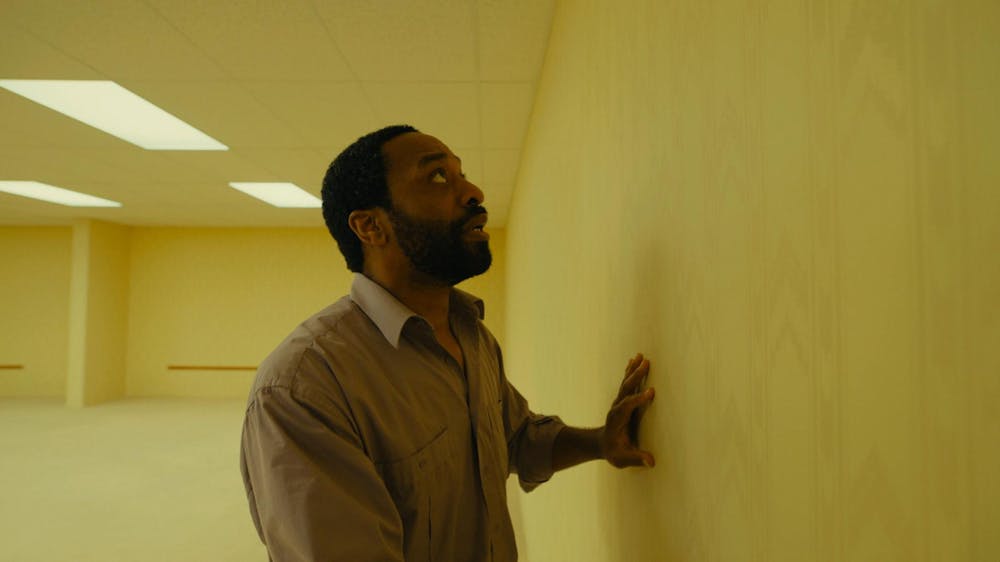
While investigating several unexplained electrical malfunctions, Clark finds a glowing crack in the wall that allows him to phase through into a place called the Backrooms.
The Backrooms in the film greatly resemble the web series’ source, an expansive place with faded yellow wallpaper and nonsensical furniture strewn about. Throughout the film, the metaphor for “describing a dog to someone who’s never seen one” is used to explain how hard describing the labyrinth is to someone who has never seen it themselves.
For Clark, the backrooms become an escape from his sad reality and real-world failures; failures which he believes are not his fault.
Likely influenced by his failed architect career, Clark meticulously maps the labyrinth. It felt like Clark’s decision to stay in this dimension was fueled primarily by his inability to understand the odd floor plan, and he spends a lot of time trying to discover what this completely different reality is and how it formed.
Mary finds the Backrooms while investigating Clark’s disappearance following a cryptic voicemail that leads her to Cap’n Clark’s basement. She finds Clark who knocks her out and ties her up in his makeshift house within the backrooms.
Mary begins reliving her own traumatic childhood while trapped in the Backrooms. Her extremely paranoid mother made Mary a shut-in, causing Mary to feel loneliness and isolation as an adult. These events resurface as Mary is trapped in Clark’s grasp, and he forces her to justify his actions.
Compared to the seat-grabbing horror of the first half, I felt like the film’s second half was moderately weaker.
I think this is in part because the film initially made sure to keep the Backroom’s entities hidden, creating an inescapable dread of the unknown. However, this meant that when the monsters and the true nature of the backrooms are revealed, the tension and claustrophobia felt by the audience were depleted.
Despite its weak narrative, I did appreciate the film’s take on the Backrooms’ true nature: an imperfect reality which copies whatever is inside of it repeatedly, resulting in a disjointed construction of the original figure.
But the fact that these entities are just emotionless copies makes the distorted humans’ and monsters’ realities quite disheartening. Instead of being an inherently scary and expansive unknown dimension, the Backrooms became a space not truly shaped by evil or good forces. It just exists.
After watching the entire film, I sat with this concept for a while.
It wasn’t a perfect movie. Admittedly, the film’s weaker second half featured some wonky dialogue from Clark. As he explains the Backrooms to a tied-up Mary, he becomes almost comedically villainized. His speech to Mary as he forces them to enact that fateful night where his wife kicked him out felt insincere and quite odd as he became humorously enamored with this dimension.
But despite this, the two actors’ performances perfectly developed the psychological horror within the film, establishing an understanding of how each characters’ individual stories shape their discovery of the Backrooms.
Though it initially subverted my predisposed opinions of what the Backrooms would be like — a dingy dimension impossible to escape — I ultimately felt the concept was really unique. Instead of creating a malicious extension of reality, the Backrooms became a sad, jumbled recapturing of it.
While “Backrooms” might not be filled to the brim with menacing creatures, nor is it one of my favorite horror movies, its journey from the internet to the big screen is quite inspiring. And if you are looking for a psychologically dense horror within a liminal space, I suggest giving it a try.


