
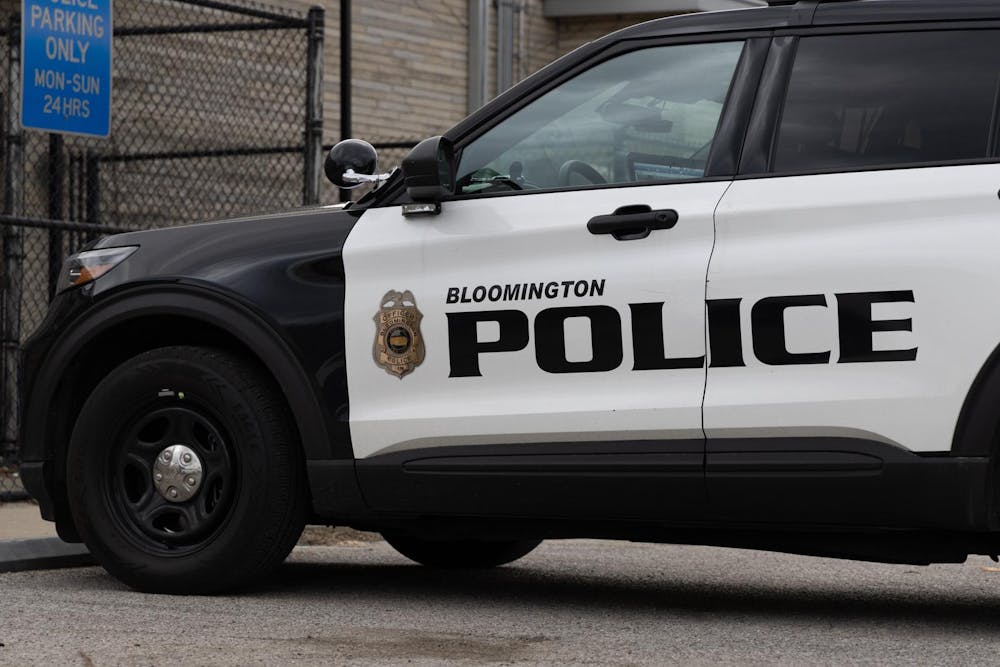
The Bloomington Police Department has a new way to aid communication with drivers with autism spectrum disorder.
The Blue Envelope Program, launched March 23, allows people with autism to put documents like their vehicle registration, driver’s license and insurance information in a blue envelope to provide to police officers if they are pulled over or get in a crash.
The envelopes feature a section to fill in a name, whether someone is non-verbal or not and tips for interacting with the police. Drivers are instructed to say “I have a blue envelope” if approached by the police.
The program was first created in 2020 in Connecticut to “enhance communication” between police officers and drivers with autism, according to the Connecticut Department of Motor Vehicles. Since then, it’s spread to counties in California, Colorado, New York, Ohio and Arizona, among others. In Indiana, Blue Envelope Programs exist in Porter and Marion Counties. The Blue Envelope Program has also been used to aid drivers with dementia, anxiety and Down syndrome.
Autism spectrum disorder describes a variety of symptoms, and each person with autism experiences the disorder differently. According to Mayo Clinic, typical symptoms of the disorder include difficulty communicating with others in social situations, reliance on patterns and routines, sensitivity to loud noises and bright lights and occasional difficulty speaking.
According to a March press release, BPD has four objectives with the program: enhancing understanding, reducing anxiety, streamlining communication and encouraging preparedness.
“Our goal is to make interactions safer, calmer, and more predictable for everyone involved,” BPD Capt. Ryan Pedigo wrote in a press release.
Monroe County Autism Foundation President Ashley Lehman said the program was “really bold.”
“I'm hopeful that the community is welcoming of this initiative because for those of us that actually work in the field, it's long overdue,” Lehman said.
Lehman recounted a recent experience at an airport when she witnessed a man displaying signs of autism while going through airport security. She said security officers became concerned over his behavior and yelled at him.
Lehman saw this as a cautionary tale and said public officials lack training for navigating interactions with neurodivergent people. She sees the Blue Envelope Program as a step in the right direction.
“We have a real opportunity to break down barriers for the neurodivergent community and continue to advocate, but at the end of the day, it's about a partnership and being in constant connection and collaboration with law enforcement and community helpers at large,” Lehman said.
Eli Marti, a sophomore with autism, agreed with Lehman’s concerns about training. Without specialized training included with the Blue Envelope Program, Marti said, they didn’t believe interactions would improve.
The Blue Envelope Program also provides window decals for drivers so police officers and first responders can recognize drivers with autism before they approach the vehicle.
Marti also raised concerns that advertising drivers as having a disability to the public could make them a target. Marti said there should be broader changes to how the police force approaches the public.
“I’m glad we're attempting to move in a positive direction, but in my opinion, there needs to be far more radical change to effectively keep our community safe,” Marti said.
Participation in the program is voluntary and confidential and participants are not required to provide medical information to get an envelope.
Bloomington and Monroe County residents can pick up the blue envelopes free of charge at the Bloomington Police Department at 220 E. Third St. or from the front desk at Bloomington City Hall at 401 N. Morton St.


