
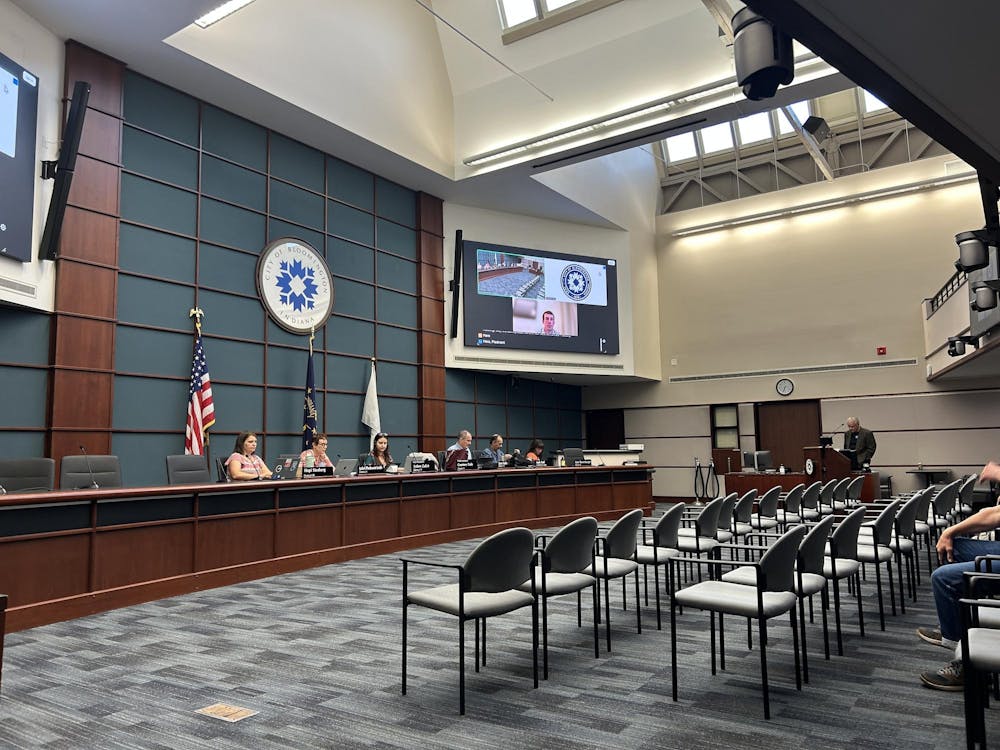
Bloomington’s City Council is calling on the county to keep its jail and justice center within city limits.
The council passed this resolution during its meeting Wednesday, where it also heard about the Bloomington Police Department’s investigation into Flock Safety cameras. After five hours of votes and debate, the council also delayed a vote on the Hopewell development for a fourth time.
Flock cameras
BPD Chief Mike Diekhoff said his department will phase out automated license plate reader systems by this weekend. BPD, he said, is also working to end its contracts for other Flock technology.
The city and BPD’s investigation into Flock started in February, continuing through months of protests and a March city council resolution calling for greater oversight of Flock camera use.
Diekhoff’s report said the department has 11 license plate reader cameras, four video cameras and four mobile trailers the city’s Department of Housing and Neighborhood Development purchased to address complaints about crime at different apartment complexes.
Flock’s license plate reader cameras and its systems have caused public outcry, including a Jan. 30 protest at City Hall over concerns data from the cameras could be used by immigration enforcement. The city announced last Wednesday that it will not renew the contract.
Diekhoff’s written report to the council said Flock’s license plate reader cameras do not take video or use facial recognition. He said the camera search systems do not automatically collect other data specific to a vehicle’s registration, such as the name or address of a vehicle owner. When accessing camera data, officers are only provided with a photo of the back of a vehicle and its license plate.
Diekhoff also said cameras aren’t put near “sensitive” places like reproductive health care sites, churches or mosques.
Councilmember Dave Rollo asked Diekhoff, “where does it stop?” and questioned if law enforcement will seek out alternative surveillance technology that could lead to continued privacy concerns down the line. Diekhoff responded that the previous city council encouraged him to seek out technology that would relieve BPD due to its staffing shortages, and said he isn’t concerned that BPD would misuse surveillance technology.
“I would bet that probably every person in this room has a cellphone, and the information that that cellphone captures is way more than a Flock camera,” Diekhoff said. “That being said, we don't have access to everyone’s cellphones.”
Multiple members of the public expressed concern that the city will replace Flock cameras with other companies that collect similar kinds of data.
“My suggestion to everyone, the police, the mayor, the council, would be just not to have a mass surveillance system at all,” Bloomington resident Sam Nixon said during public comment. “We don't need more cameras, we don’t need to be watched at all times.”
Diekhoff said Flock, along with all outside agencies, no longer has access to BPD’s license plate reader data. However, Diekhoff said BPD still accesses its data from Flock’s platform.
Councilmember Isabel Piedmont-Smith asked if BPD will turn off its Flock cameras that aren’t license plate readers. She pointed to Evanston, Illinois, where the security company reinstalled cameras after the city had previously terminated its contract and removed the cameras. Diekhoff said he and the mayor have yet to decide on that.
The Charlotte Zietlow Justice Center
The council also unanimously adopted a resolution encouraging Monroe County to keep the Charlotte Zietlow Justice Center within city limits. The council resolved to help the county expedite the permitting processes for building a new justice center location within city limits.
The justice center houses the county jail. The ACLU of Indiana has pursued litigation against the county since 2008, when it pursued legal action over alleged unconstitutional conditions at the jail.
The resolution states that moving forward with the North Park location — which the Monroe County Council unanimously voted against funding in October — would disproportionately impact low-income residents, especially those with no mode of transportation to get to locations outside city limits.
Councilmember Courtney Daily said building a larger jail would not be as effective as taking preventative measures to keep people out of jail and said North Park is not the only solution. The current jail has 287 beds. A 2025 design for a new jail had 500 beds, though some Monroe County Councilmembers recommended 400 beds.
“I don’t think we need to settle,” Daily said. “Not only will doing that put us right back in a predicament where we’re unhappy with the results and buyer’s remorse will set in.”
Daily and Council Vice President Sydney Zulich both voiced concern that a larger jail will end up filled, even if that isn’t what the community needs. Piedmont-Smith said empty jail space could lead to U.S. Immigration and Customs Enforcement trying to use the space for detainment.
Monroe County Commissioner Jody Madeira spoke during public comment on the resolution, stating the resolution will force the county into further legal action with the ACLU, which she said isn’t an act of resistance, but a “cash burn.”
“Don’t pass a resolution that deepens division between local governments at the moment unity is most needed,” Madeira said.
County Commissioner Julie Thomas and Monroe County Council President Jennifer Crossley also spoke during public comment. Thomas said if the county doesn’t meet ACLU’s settlement requirements by the end of May, the county could be sued, which she said would be a “burden borne by all Monroe County taxpayers.”
“If you understand the potential risk and costs of a lawsuit are enormous and will impact every resident of Monroe County, I ask you to vote no or continue this motion indefinitely,” Thomas said.
Crossley, however, said choosing the North Park site would lead to more taxes for county residents and echoed councilmember concerns that a location outside city limits could make it difficult to access transportation to a new jail.
The Hopewell development
The city also delayed an ordinance for the fourth time that will create a new planned unit development at the site of the city-led Hopewell development, specifically Hopewell South. The vote to delay was 7-2, with Zulich and Council President Isak Nti Asare voting no.
The development is 24-acres at the site of the former IU Health Bloomington Hospital. The PUD is meant to create specific zoning for the area so developers can build more houses, with the aim of promoting affordability.
Between the mayor and the council, the PUD has caused open contention over the past few months. The council has previously delayed a vote on the PUD three times, and Mayor Kerry Thomson has publicly called for faster decision making.
Many disagreements over the PUD stem from affordability concerns. The PUD proposal stipulates that 15% of the housing be permanently affordable, however six councilmembers called for 25-50% of the development to be permanently affordable ahead of the April 2 council meeting.
During Wednesday’s meeting, the council also passed five reasonable conditions meant to adjust certain parts of the PUD ahead of passing the entire ordinance. The council will reconsider the Hopewell ordinance at its next meeting on May 6.


