
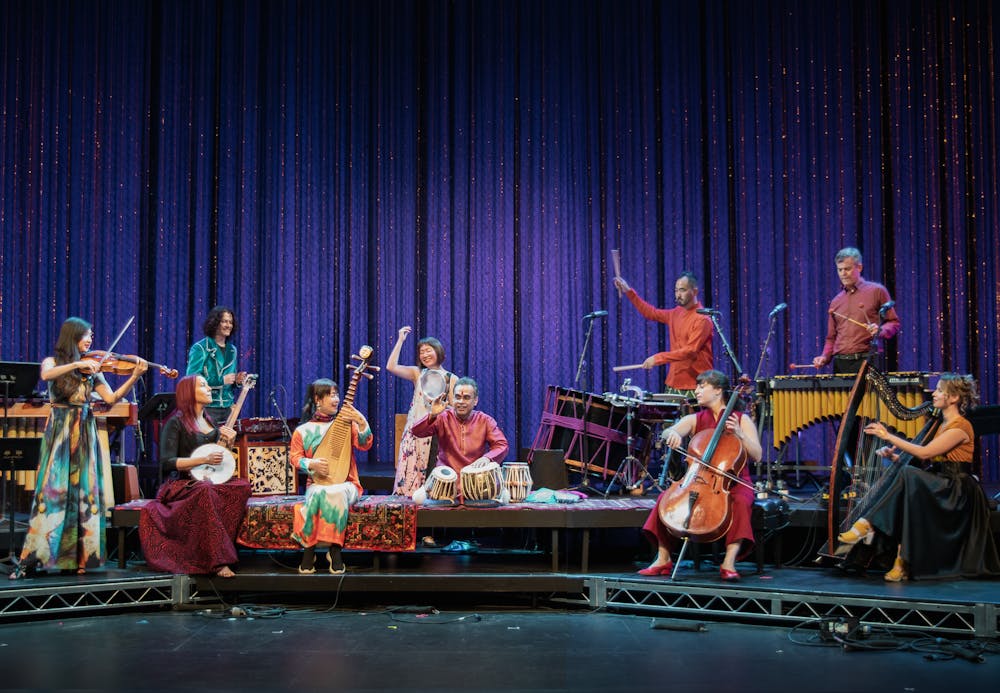
Silkroad Ensemble, a group of performers from all over the world, is coming to Bloomington at 7:30 p.m. March 12 at the IU Auditorium as part of its new flagship program Sanctuary: The Power of Resonance and Ritual, led by artistic director Rhiannon Giddens. Silkroad Ensemble has a mission of highlighting cultural differences as well as collaboration to encourage learning and foster a more inclusive world through music.
Giddens, a Grammy and Pulitzer Prize-winning folk musician, will be taking part in several engagement events before the performance, all of which are free and open to the public.
Starting at 3:15 p.m. March 11 at Auer Hall, Giddens will take part in a discussion with Silkroad performer Francesco Turrisi and Jacobs School of Music dean Abra Bush about their various career paths after graduating from music conservatories.
At 6 p.m. March 11 at Sweeney Hall, Giddens will lead a voice workshop alongside her current vocal instructor Brian Gill, who is a professor of music in voice at Jacobs.
An hour before the March 12 performance, ethnomusicology doctoral student Nia I'Man Smith will host a pre-show talk at the Fine Arts Building where she will discuss the historical and cultural context of Silkroad Ensemble.
Smith said she is particularly interested in approaching the topic from an angle of ancestor veneration, a cultural practice of honoring deceased relatives, specifically within Black music traditions.
“We can think about that as one way to process loss through this idea of memory, or through this idea of celebration and veneration,” Smith said.
The Silkroad Ensemble’s new flagship program will tie together traditional music from Morocco, Italy, India, Japan and the United States to show the power communal music holds in building human connection.
One of these types of communal music will be played by Mehdi Nassouli, a Moroccan guembri player who will perform traditional Moroccan Gnawa trance music.
This music is practiced by descendants of slaves brought from the Sudan region of West Africa to Morocco, professor emeritus of folklore and ethnomusicology Daniel Reed said, and is traditionally used for spirit possession through trance.
The music doesn’t feature chords or harmonic structure typically found in Western music, but rather single lines played in a repetitive manner using variation and improvisation. Reed said this repetition is crucial to the music because it is what leads to a trance-like hypnotic state used to embody spirits.
Reed said Gnawa isn’t traditionally performed with the same division between audience and performer found in typical orchestral performance spaces. Instead, it is common to be performed in a circle, with audience members taking part in call and response vocalizations.
In addition to Nassouli’s Moroccan performance, Italian folk musicians Mauro Durante and Turrisi will perform Sicilian tarantella music.
Sofia Lo Ciacio, a doctoral student in Italian studies at IU, said the name of this type of music comes from the word “tarantola,” meaning tarantula. The music accompanies a lively dance in Italian culture which originated from the belief that the only way to cure a bite from a wolf spider would be to engage in a frenzied dancing ritual.
Ciacio, originally from a town in Sicily, Italy, said the dance is extremely well known in the country, with children learning it in elementary school courses and many people owning traditional tambourines used in the dance. She said the dance is a way for people to collaborate with others at a young age because it is often danced in pairs.
“You can create a relationship between someone that maybe you don't know,” Ciacio said. “Because if you want to start, like, a course of tarantella, of course, you don’t have to know all the people that are taking the course.”
Sandeep Das, a tabla master, will perform Indian classical music, a style of music that may be an unfamiliar sound to most.
Christian Morgan James, a doctoral student in the Department of Folklore and Ethnomusicology who specializes in Hindustani music, said he hopes the songs will feel exciting to audiences because of the cyclical division of beats in Indian classical music.
James said Das uses patterns of beats, called “taal,” often experimenting with the taal “jhaptal,” that sounds distinctive to many North American listeners. While Western music typically uses measures of three or four beats, jhaptal is a cycle of 10 beats.
“It’s something that feels maybe a little funky,” James said. “And for those of us excited by different kinds of sounds, you know, it could be really interesting and engaging.”
Kaoru Watanabe, a Japanese American composer and member of the Silkroad Ensemble, said in an email that the interweaving of cultures and instruments done in Silkroad is a way to celebrate both the shared values but also the idiosyncratic differences of each individual artist.
“Doing your own dance to a different rhythm or vice versa is like seeing yourself through someone else’s eyes,” Watanabe wrote. “It opens up the world like learning a new language or discovering new cuisine.”
Watanabe also emphasized that while the members of Silkroad are performing music from their individual cultures, they all put their own spin on traditional music through their personal artistry.
“This is not a performance of traditional musics in their ‘pure’ forms,” Watanabe wrote. “It’s a group of individual artists that prove in real-time that we can bring together instruments and styles that often aren’t seen on stage together and create incredible music together — an exchange of musical conversations that transcend artificial borders and boundaries.”
Tickets can be purchased both at the IU Auditorium box office and on its website, starting at $34 for the general public and $24 for IU students.


