
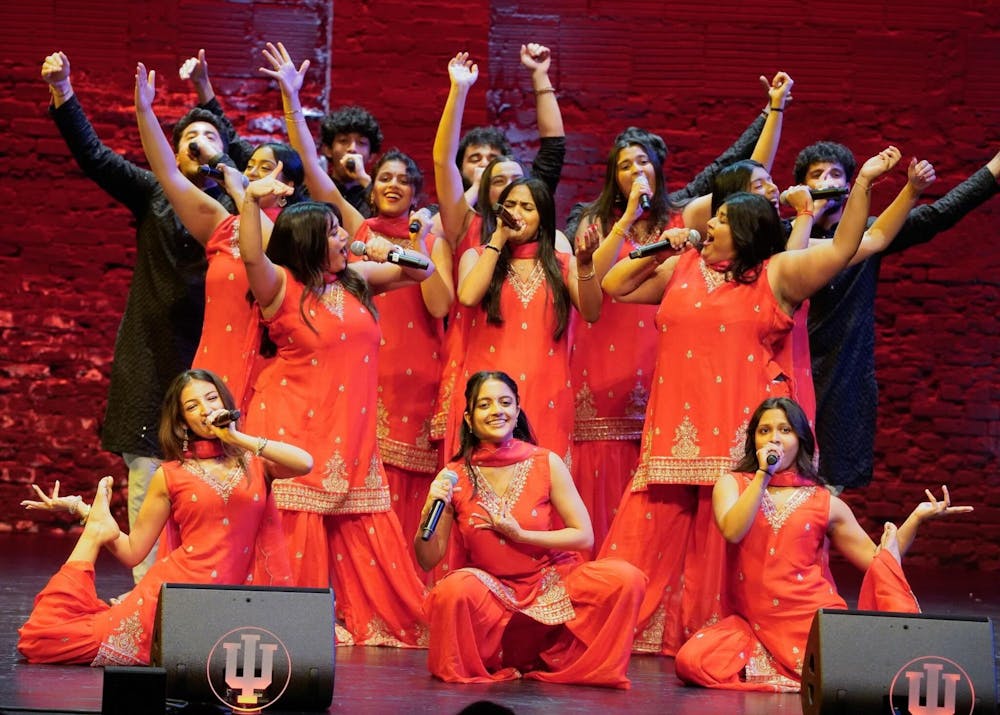
Halfway through their set, the performers of Humraah, IU’s South Asian a cappella group, settled into intricate, traditional Bharatanatyam poses, and their voices hummed with the cacophony of classical ragas. As described by the members who have made the stage their personal canvas for storytelling, the moment was magical.
What distinguishes Humraah, created in 2017, from a typical performance group is its signature South Asian fusion a cappella style, coupled with choreography.
Members said it merges the stoic, ancient traditions of Indian classical music with the rhythms of well-known Bollywood and English songs. Recently, the group won first place at IU Sing on Feb. 28, an annual IU competition among seven a cappella groups. As a competitive team, they travel across the country to showcase their art.
Their most recent win came after a successful competition season at various universities, during which they placed second at Spartan Sitara on Feb. 7 at Michigan State University.
Their competitive spirit is built from their affection for one another, members said, which extends beyond the stage, into their practices and group bonding activities.
“We are known for developing our relationship as team members and friends, before our relationship to the set, and that’s what draws us to success,” senior Sharan Peshin said.
Peshin has been a part of the group for the past four years and served as president last year. Alongside his former co-president Dharini (Dhar) Sriram, they led the team to what they consider their “turning point” season.
Humraah placed third at All American Awaaz on April 12., the national championship hosted in San Francisco for collegiate teams on the South Asian-fusion circuit.
“We started as a team full of people that just loved making music, and we’ve evolved into this bigger entity that celebrates South Asian culture, especially its music, which is so rich in its own way,” Peshin said.
For the 2025-26 season, the group took in a new batch of seven freshmen across various vocal parts and experiences, which created a natural system of mentorship among the 24 members, both competing and non-competing.
Peshin said after this year’s season, he was left feeling like an “accomplished dad.” However, with new talent comes strict expectations and cultural acclimation, which the group described as their “blueprint for success.”
“Keeping attention and discipline to your craft is crucial, especially when you are a full-time student,” Peshin said. “The way our leadership is structured is if you need time, you are given time, but we still ask our members to uphold our ‘Humraah’ standard.”
The groups’ expectations involve a practice schedule of three to four practices a week, often guided by senior members and the Humraah management team. During competition weeks, they typically rehearse daily, and practices consist of learning mixes, developing a comfort level vocally before adding choreography and workshopping the set with continuous feedback and repetition.
Junior Trisha Terala has served as Humraah’s manager since January 2024. She described her roles as booking practice rooms, communicating with the Association of South-Asian A Cappella circuit official, ensuring the team has costumes, filling out tech sheets, coordinating travel logistics and acting as a presiding body over other directors.
Terala said she has been able to transfer the skills she has grown as a manager into various other endeavors.
“In the case of any tension within the team, I can be that neutral perspective,” Terala said. “I’ve been able to learn so much about working with different kinds of people.”
This season’s set unfolded into three movements, each offering a distinct interpretation of their theme, “The Beauty of Scars.” Rather than presenting scars as symbols of damage alone, the set explored markers of resilience, transformation and quiet atonement of coming back to one’s traditional roots.
Their harmonies are layered with dynamic surges and solo elements. Their song choices include devotional classics in Indian music like “Man Mandira” and nostalgic Bollywood tunes like “Guzarish.”
For a lengthy performance of over 10 minutes, it is key that the group includes compelling, unique visual and vocal elements to maintain audience engagement. It is here where directors Kavya Kaushik, Niru Raghuvir and Rishab Jain work closely to weave movement and music into a cohesive presentation that lets the narrative arc of the set stand for itself.
Music directors Raghuvir and Jain were raised with a comprehensive and technical musical background from different traditions in India. Carnatic music has been a part of Raghuvir’s family and greater community for as long as she can remember, and that love was transferred to her from a young age.
Together, Raghuvir and Jain create all the mixes, harmonies and musical choices and assist in teaching the larger group.
“We had an idea of what better teams sounded like, and we had goals on how to get there, Jain said. “This year our job was to continue that.”
Junior choreography director Kaushik has been a part of the group since her freshman year.
She expressed that a new batch of performers brings a unique challenge of developing movement that aligns with their talents and needs.
“The team that we were last year is not the same now in terms of dynamics, music we create, preferences and styles, and that's a good thing in its own way,” she said. “We adapt accordingly.”
Much of Kaushik’s creative choices for the set were inspired by traditional Bharatanatyam poses and formations that offered moments of audience reflection. As both a director and performer, she can see her visions come to life on a professional stage and experience her own moments of magic in between.
“There is a part in the beginning of our performance where I am supposed to be very solemn to set the mood, but when performing at Massachusetts Institute of Technology (MIT), alongside the amazing engineering and sound, the second the beatbox started, I instantly smiled, and it started a new passion in me,” Kaushik said.
This year was both momentous and bittersweet for some, especially senior leaders preparing to pass the torch and further define Humraah’s identity on the ASA circuit stage.
Junior Harsh Mahapatra, Humraah’s current president, has acted as a mentor in ensuring the group's logistical and creative sides merge seamlessly. After spending two years as a general member, he entered leadership with a more grounded understanding of the team’s culture and evolving standards. His role, as he describes it, is fluid by design.
“My role is to fill in when there is a gap in the team, whether it be recruiting, filling in for a director; it keeps changing what I do day to day,” Mahapatra said.
Humraah’s tradition of rotating leadership each year creates fresh visions and places creative autonomy into the hands of a new cohort, Mahapatra said. Although melancholic about stepping down, Mahapatra will continue to compete as a general member in next year’s season, while advising new members on preserving the legacy Humraah has generated over the past few years.
However, Mahapatra said the decision to fill the presidential position transcends a simple administrative duty; it was rooted in gratitude for the community that shaped so much of his college experience.
“I wanted to run for president this year, because this group has given me so much — my friends, my girlfriend, my family, the people I care about the most — and it was time that I gave something measurable back,” he said.
Vocal percussionist and senior Aakash Vasireddy has led rhythmic direction for the past four years he has been in the group. This year, he won “Best Vocal Percussionist” at Spartan Sitara and Boston Bandish, recognitions that cemented what Vasireddy describes as his “proudest year as beatboxer”.
“Sometimes it's a little more isolating, because everyone has their own voice part, but honestly, I think it is what makes the experience more rewarding when the team comes together, and I can offer suggestions,” Vasireddy said.
He closed his final season with a few words of reflection: “You realize there is a reason you care so much and cry about this being your last season, it’s because you had the privilege to be a part of it.”
Humraah will be conducting auditions in September 2026 for their 2026-27 season. To stay updated on events, performances, and auditions, you can follow them on Instagram.
CORRECTION: This story has been updated to correct the year Humraah was formed and the location of the Spartan Sitara.


