Editor's note: All opinions, columns and letters reflect the views of the individual writer and not necessarily those of the IDS or its staffers.
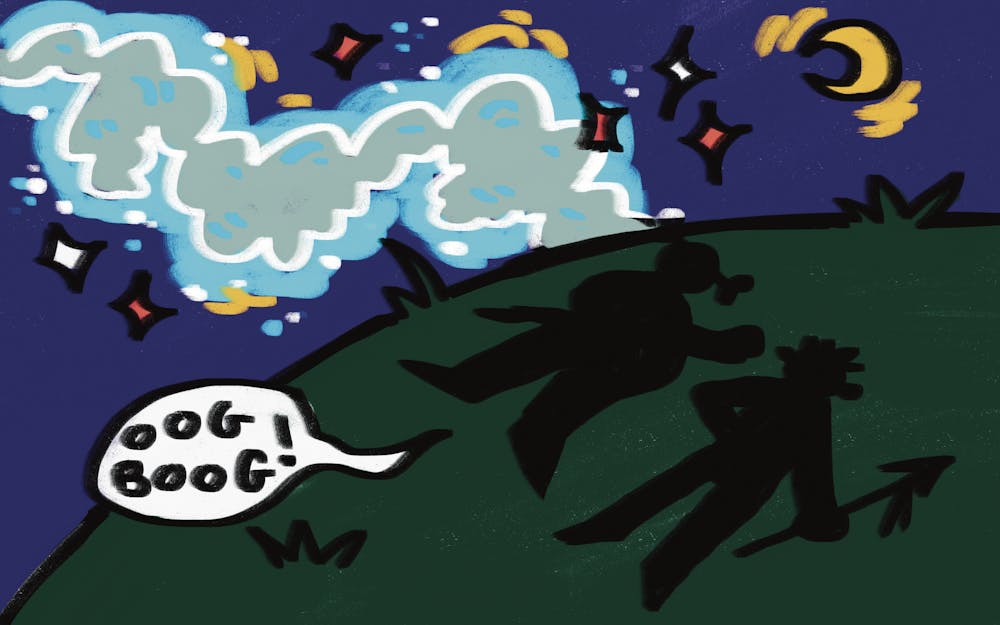
The cool night air tickles your skin. The tall grass around you ripples gently in its breeze. Savory notes of roasting deer carcass waft by, showing Gurg has returned from the hunt. You join him alongside the crackling fire, lay down your paleolithic club and let your thoughts drift to the endless heavens above. As you shut your weary eyes, the milky streak across the middle of the sky fades into darkness.
Two hundred thousand years later, you sit in a crowded room. A pendulum sways rhythmically on the windowsill. Beside it, your bearded Italian friend Galileo peers upward with a rudimentary telescope. He turns to you excitedly to tell you the hazy swath of light in the sky is, in fact, not continuous, but a sea of hundreds of billions of stars too small to discern individually with the naked eye. That will make a great treatise, you think to yourself.
After 400 more years, you trudge out of your midterm to a wintry Bloomington night. You scan expectantly but don’t recognize the same sky your ancestors did. Only a handful of the very brightest stars remain visible, mere freckles of light amid an expanse of vaguely gray sky.
At least, you’re not alone. If you live in North America, there’s an 80% chance you can’t see the Milky Way from where you live. In the United States, the chance of seeing a natural night sky from your home sits at a measly 1%. The culprit, scientists found, is light pollution.
Light pollution refers to the excessive use of artificial lighting. When that light is directed upward or reflects off the ground, it causes a phenomenon called skyglow — an increase in the apparent brightness of the night sky. The effect from a single light fixture is minor, but in well-lit, urban environments, lights add up quickly. The result is a dome of artificial light that blots out the stars by reducing the contrast of the background.
Artificial glow surrounds basically every urban area in the world and can even impact rural stargazers hundreds of miles from the source. The effect becomes more pronounced in areas with air pollution because more tiny particles in the air mean more scattering of the light passing through. One kind of pollution magnifies another.
Make no mistake, we should be thankful for artificial light. It’s among the many technological advancements made throughout the course of industrialization which have redefined human livelihood. The invention of the lightbulb granted businesses the ability to remain open after sunset, allowed people to safely socialize at night and drastically reduced the risk of fire from gas-powered lamps. However, disconnecting ourselves from our archaic past comes at the cost of a timeless human experience — the Milky Way.
Stars guided human exploration for centuries. Ancient Egyptian, viking and Babylonian navigators relied on the stars to determine their location and traverse uncharted waters and lands. Before the invention of the marine chronometer in 1761, any kind of long-distance voyage over the water was possible only under the direction of the night sky.
Stars have served as our cosmic timekeeper since the beginning. Ancient Egyptians used them to predict when the Nile would flood and kickstart the sowing of crops, and Mayans used them to create their famous 260- and 365-day calendars.
Stars are also deeply intertwined with nearly every world religion. In Christianity, the Star of Bethlehem is said to have guided the wise men to the birthplace of Jesus. In Hinduism, a person’s nakshatra, or “lunar mansion,” is determined by the position of the stars at their birth and is believed to predetermine many aspects of their lives. Islam’s holy text, the Quran, uses the light of the stars as a metaphor for the eternal guidance of Allah.
Light pollution isn’t just costing us the wonder of the night sky. We’re losing one of humanity’s oldest and closest companions. But the stars aren’t lost just yet. You can still see them the way they looked thousands of years ago — if you know where to look.
DarkSky International is a nonprofit organization that identifies and designates parks, communities and other areas around the world protected — at least partly — from light pollution as “Dark Sky Places.” These areas serve as the final refuge for the natural night sky as seen from earth, and they’re all a good ways away from ol’ IU. The closest to us, Middle Fork River Forest Preserve, is located nearly three hours away in Penfield, Illinois.
For the ultimate night sky viewing experience, you’ll probably need to leave the Midwest. Big Bend National Park in Texas, Canyonlands National Park in Utah and Wyoming’s Yellowstone National Park are among the clearest preserves from artificial light in the continental United States.
There was a time when you didn’t have to travel hundreds of miles to glimpse an unobstructed sky. Once, you could stare at the same stars generations before you had enjoyed, utilized and worshiped. While that time has come and gone, we can at least appreciate all we’ve gained at the cost of our starry scenery. The next time you wander out of your late-night final, take a look at the few stars that remain visible in the hazy night, along with the glow of the streetlights guiding you home, and remember your place in history.
Spencer Schaberg (he/him) is a sophomore studying microbiology.