
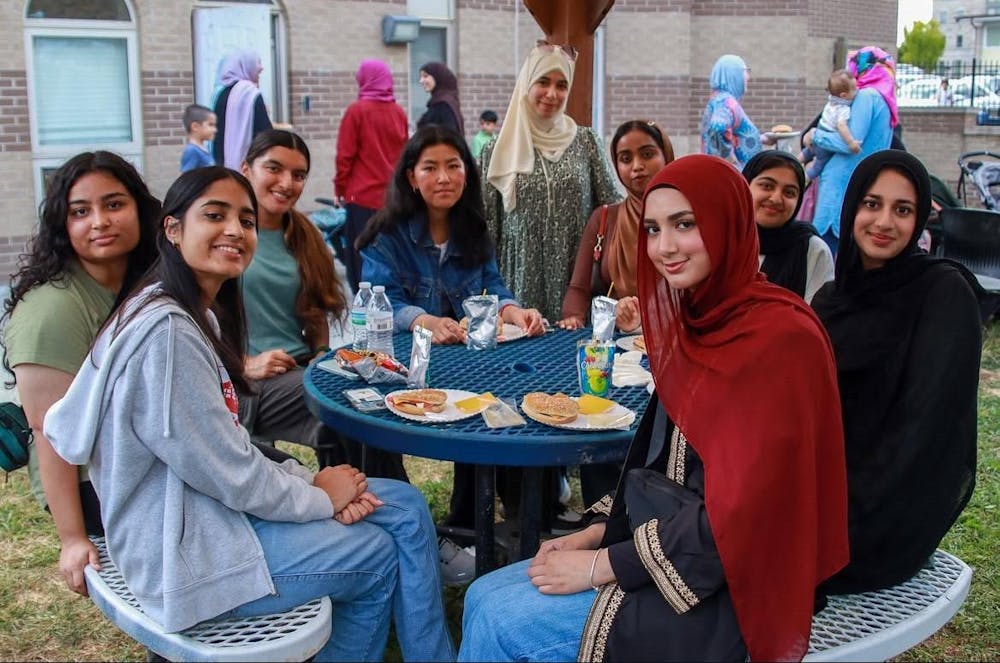
After a Muslim Student Association event Feb. 18, Indiana University sophomore Kaylee Kramer went to a prayer service for Ramadan. Then she received a text.
An X user had posted a photo of her, alongside other Muslim Student Association members, holding a sign saying “Meet a Muslim” outside Wells Library.
“I’m actually all good,” the user wrote.
The post, from an X user with the username “Bennett Fitzpatrick III," had over 150,000 views and 59 comments. The replies included statements like “They would’ve had an explosive conversation with you though,” “We love when non-white people take over our school!” “I can smell this photo through my screen,” and six images or GIFs featuring or mentioning explosions.
Kramer was shocked.
“I in particular had never encountered anything like that, so it was definitely new,” Kramer said.
Kramer and other MSA members held the event Feb. 18 outside the Herman B Wells Library. Its purpose was to answer questions about Islam and teach others about their religion, Kramer said. They set up a table with free English-translation Qurans and mango lassi, a sweet yogurt drink.
“We had a lot of engagement that day,” Kramer said. “Everything, you know, was pretty good.”
In the past, the worst incidents of Islamophobia Kramer experienced were people walking up to previous Meet a Muslim tables in a combative way, attempting to argue with her about her religion.
This incident went further.
Mohamed Khaled Syed, imam of the Islamic Center of Bloomington, has lived in Bloomington for seven years. He said this incident was his first encounter with Islamophobia that threatened violence.
“Could you walk over and spit on them?” one commenter wrote.
“I always tell people that Bloomington is very safe for like Muslims and even people of color and people of differences,” Syed said. “But seeing such a trend and also triggering so many comments and also reactions this for me, was kind of weird and also concerning and scary for the students.”
One comment stood out to him: “Some drunk driver has a chance to do the funniest thing right now. Or some sober driver.”
"How can you respond to that?” Syed said. “How can you ensure the Muslims on campus are safe?"
Syed encouraged Kramer and the other students pictured to file a bias report and get in contact with IU administrators including the chancellor and provost. Still, he said he finds upper IU administration is often unresponsive.
“The high level administration is just like ignoring and heedless about all those kind of complaints and reports,” Syed said.
Kramer, a representative in IU Student Government, raised her concerns at the Feb. 23 IUSG Q&A with Chancellor David Reingold.
Reingold said he hadn’t heard of the situation, and described it as “very disturbing and troubling.” He said he would follow up with other administrators to further investigate the situation.
Kramer’s friend Salima Al Battashi, who was also pictured, filed a bias report to the university. As of Thursday, Kramer said she hasn’t heard back.
“IU does not comment on individual confidential complaints,” Mark Bode, IU executive director of media relations and public affairs, said in phone call with the Indiana Daily Student.
Kramer said she would like to see more acknowledgement from administration and recognition of Muslim students’ experiences.
“I know that people have a lot on their plates, but it's also like, we're people too,” Kramer said.
Syed said he would like IU to add additional prayer rooms around campus. IU has one non-denominational prayer room, the Indiana Memorial Union Interfaith Prayer and Reflection Space, located on the building’s second floor.
Muslims practice daily prayers called the Salah. These prayers, facing Mecca, are done five times a day, beginning at sunrise and ending at nighttime.
Syed said the IMU’s Interfaith Prayer and Reflection Space becomes crowded, and that it’s “not feasible” for students to return to the space while attending multiple classes a day. With more than 25,000 new undergraduate and graduate students in 2025, IU faces record-breaking enrollment. Because of this, Syed said, the Muslim community is growing and needs more spaces on campus.
“I think Muslims just want to feel like there is care and that there is attention being paid to the things that we're experiencing,” Kramer said.



