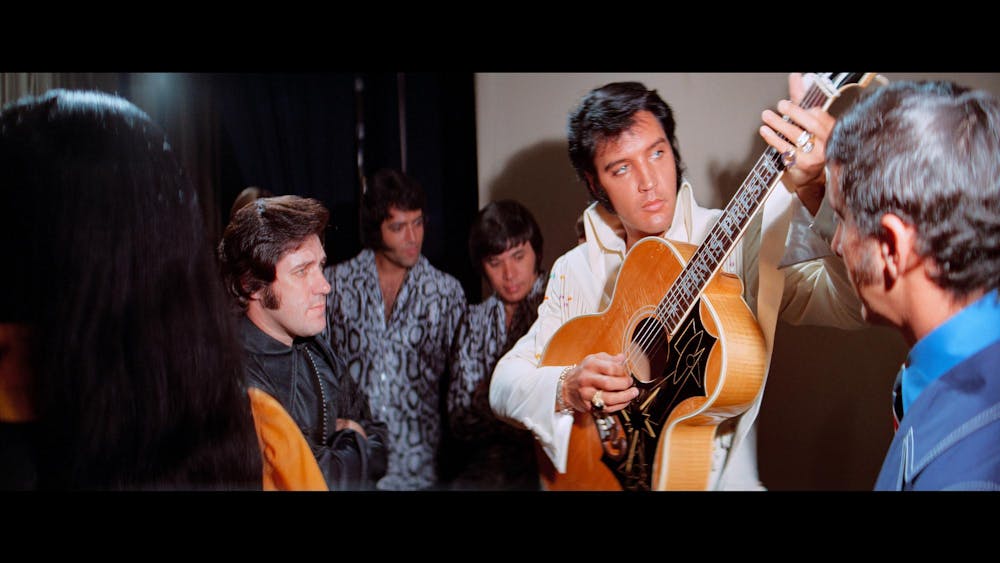
When thinking of Elvis Presley’s 1969-1976 residency in Las Vegas, I would imagine him looking tired and worn out, as most people would be after performing up to three shows a day.
“EPiC: Elvis Presley in Concert,” which had its wide release on Feb. 27, completely shifted my perception of that narrative by giving a closer look at these concerts. The story behind the footage is a movie in and of itself.
When director Baz Luhrmann was looking for B-roll footage for his biopic, “Elvis,” he stumbled across 68 boxes of film inside a salt mine in Kansas, containing never-before-seen footage of Elvis’ Vegas performances, rehearsals and even a 45-minute audio recording of Elvis sharing his life story.
Instead of using these recordings for his biopic, Luhrmann decided the heaps of material deserved their own film. In an interview with Deadline, Luhrmann said his goal for the project was to create “something new in the Elvis canon” and “to bring something to the screen that befits the magnitude of Elvis as a performer but also offers deeper revelations of his humanity and inner life.”
“EPiC” isn’t looking to tell you Elvis’ entire life story; Luhrmann already shared it through his biopic, which offered a full breakdown of Elvis’ career. Instead, this film provides a glimpse of his legendary stage persona that today’s generation may not be familiar with.
The film’s first 30 minutes use Elvis’ self-recorded audio tape to provide a brief telling of his life story. While the story was familiar to me, it was enlightening to hear it coming from Elvis’ firsthand perspective. The biopic whisked right through his acting career and military service, so hearing his own feelings about that chapter in his life felt incredibly refreshing, as if I was hearing the story for the first time.
The documentary style throughout the first 30 minutes was certainly entertaining, but the concert portion of the film is where the energy really picks up. Luhrmann is known for his flashy editing, as seen in “Elvis,” so I had no doubt that he would be able to crank up the intensity of the concert footage to match his bold style.
Jonathan Redmond, who was behind the editing for both Elvis films, cleverly splices in rehearsal footage between each of the songs played in the concert. The rehearsal film showed Elvis’ offstage personality, like moments of joking around with his band members.
With his signature leg shakes, dazzling costumes and a roaring band, each of the concerts felt incredibly energetic, and through Redmond’s interweaving of the various Vegas performances, it was clear that this level of excitement never died down throughout his seven-year residency.
One of my favorite aspects of this film was its frequent cuts to audience members absolutely losing their minds over Elvis. In an era where celebrities are so frequently featured on the internet and social media, it’s easy to forget how much allure they used to have.
Elvis wasn’t ignoring these fans either, as he was often shown interacting with the crowd and even kissing some of his fans. Surely no security guard is letting their artist get that close with their fans these days, but it’s nice to see that Elvis enjoyed the admiration and never became tired of the attention.
Whether you would consider this film a documentary or a concert, it still excels in every aspect. Yet the moment that resonated the strongest with me wasn’t even a part of the film.
As I was walking out of the theater, I couldn’t help but overhear two older women who were reminiscing about the times they saw Elvis perform live. In my mind, I imagined them to be amongst the teenage girls in the film who were screaming their heads off when Elvis sang on stage.
After all these years, their love for Elvis persists, and through this film, they were able to relive such an enthralling era of their lives. The power of cinema is real, and Baz Luhrmann harnessed it to transcend Elvis’ story across generations.