
Emily Esola joined Indiana University Bloomington’s chapter of the American Association of University Professors in summer last year.
Esola, a lecturer at the Kelley School of Business, said she was hoping to make a difference on campus. She said professors have come under attack from many different forces, and through her teaching, she hopes to make her undergraduate students aware of faculty issues.
“I wanted to be in the same room with other people who weren’t pretending like nothing was going on,” Esola said.
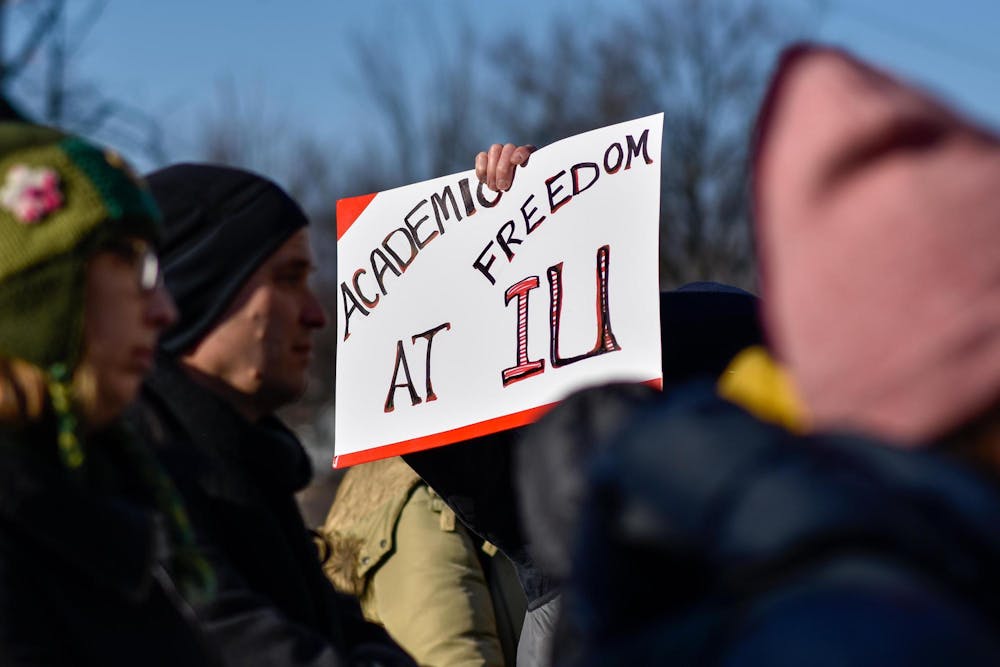
And she’s not alone. IU Bloomington’s AAUP membership has jumped over the past years amid faculty protests against IU administration. Chapter president David McDonald said it’s the fourth largest chapter in the country, with about 370 working and retired faculty members.
Following changes to faculty input on university governance, the Dunn Meadow encampment and the firing of professor Xiaofeng Weng, McDonald said faculty have looked to the Bloomington chapter of the AAUP as a place to voice their concerns.
“Faculty are now seeing the AAUP as the only place where their issues, their interests and their jobs are being protected against the legislature and the IU administration,” McDonald said.
AAUP Senior Messaging and Media Strategist Kelly Benjamin said Bloomington’s chapter was the fastest growing in the country from July to November last year.
The chapter held the second largest number of active members in the country in November, with Harvard having the largest. As of Jan. 29, IUB has the fourth largest chapter in the country.
Germanic Studies professor and AAUP Secretary Chris Sapp said in an email membership has tripled in the past two years.
It exploded, he said, after 57 faculty members and students were arrested in April 2024 at an encampment in Dunn Meadow while protesting the war in Gaza. Some of those arrested, including McDonald, were charged with trespassing and banned from campus.
The IU Bloomington faculty’s April 2024 vote of no confidence in IU President Pamela Whitten, Provost Rahul Shrivastav and Vice Provost for Faculty and Academic Affairs Carrie Docherty was also a contributing factor to the increase in membership.
When IU professor Xiaofeng Wang was terminated the same day the FBI searched his homes in March 2025, computer science faculty members condemned his firing, stating the university did not follow due process. The letter said the firing “eroded faculty trust in IU’s administrative procedures.”
From July to November, IU Bloomington’s membership saw an 88% increase, with the IU system seeing a 91% jump, according to the AAUP.
“Just since I came on as president this year, we’ve really pushed a huge membership drive and it has paid off,” McDonald said.
McDonald, who is also an associate professor in the Department of Folklore and Ethnomusicology, has served as IUB AAUP president since July 2025. That was around the time of another shakeup in university governance.
An IU policy changed in June to ensure compliance with Indiana code has also impacted faculty input on university governance. The new policy, BOT-25, changed who takes part in how university programs are assessed. It also reclassified faculty recommendations — including from the Bloomington Faculty Council and University Faculty Council — to be advisory only.
“The AAUP is therefore attempting to fill a gap that has been left open by the Indiana state legislature,” McDonald said in an email.
In an August release, the AAUP said the policy “does away with any mandatory shared governance with the faculty on matters that pertain to the mission and implementation of our academic activities through specific degrees and programs.”
The AAUP’s mission is to promote academic freedom, shared governance and the economic security of faculty members, according to its website.
Members of the AAUP pay dues, attend meetings and can join various committees or working groups.
Chapter leadership increased recruiting efforts in September by visiting departments around campus to tell faculty about the AAUP, Sapp wrote in an email.
“We are working every day to defend academic freedom on this campus and re-assert the faculty’s role in governance of the university,” Sapp said in an email. “Faculty who are feeling isolated and disempowered will find a sense of community and strength by joining with their colleagues to take action.”



