On the morning of April 25, 2024, David McDonald was teaching a class called Pop Culture and Politics in the Middle East. Less than 12 hours later, he was sitting in the Monroe County Jail.
McDonald was one of over 30 faculty and students arrested by the IU Police Department and Indiana State Police on April 25, the first day protesters set up tents in Dunn Meadow. He was charged with trespassing and banned from campus after standing between a police officer and a student, he told the Indiana Daily Student. Both the trespass charge and ban were dismissed a few weeks after the arrest.
The IU Divestment Coalition organized the Dunn Meadow encampment to protest the war in Gaza and call for IU to divest from Israel months after the beginning of the Israel-Hamas war.
On Oct. 7, 2023, a Hamas-led attack on Israel killed about 1,200 people, mostly civilians, in Israel. Hamas took around 250 hostages. Around 150 hostages have since then been released or rescued alive. According to the Washington Post, 82 hostages have been confirmed killed, and 24 hostages are still in Gaza.
In response to the initial attack, Israel launched a military campaign, and at least 52,000 Palestinians, many of whom were women and children, have been killed during the conflict as of April 27, according to the Gaza Health Ministry. The war has displaced 1.9 million people, or around 90% of Gaza’s population.
Police arrested 23 more protesters on April 27. The encampment was dismantled by IU after 100 days on Aug. 2. IU spent over $265,000 on cleanup, repairs and renovation, and a fence was placed around the space for 136 days during the construction. Dunn Meadow opened again on Dec. 16.
IU established an expressive activity policy in July, which prohibits expressive activity between 11 p.m. to 6 a.m. without prior approval, the installation of temporary structures without approval, camping on university property, blocking access to buildings and impeding vehicular and pedestrian traffic.
The IUDC’s demands from the encampment, which ranged from divestment from Israel to the opening of Muslim and Middle Eastern cultural centers have not been met.
The Monroe County Prosecutor’s Office did not file charges against 55 of the 57 protesters who were arrested, citing IU’s last-minute change to their unauthorized structure policy.
The IDS interviewed IU community members about their experiences during and since the encampment.
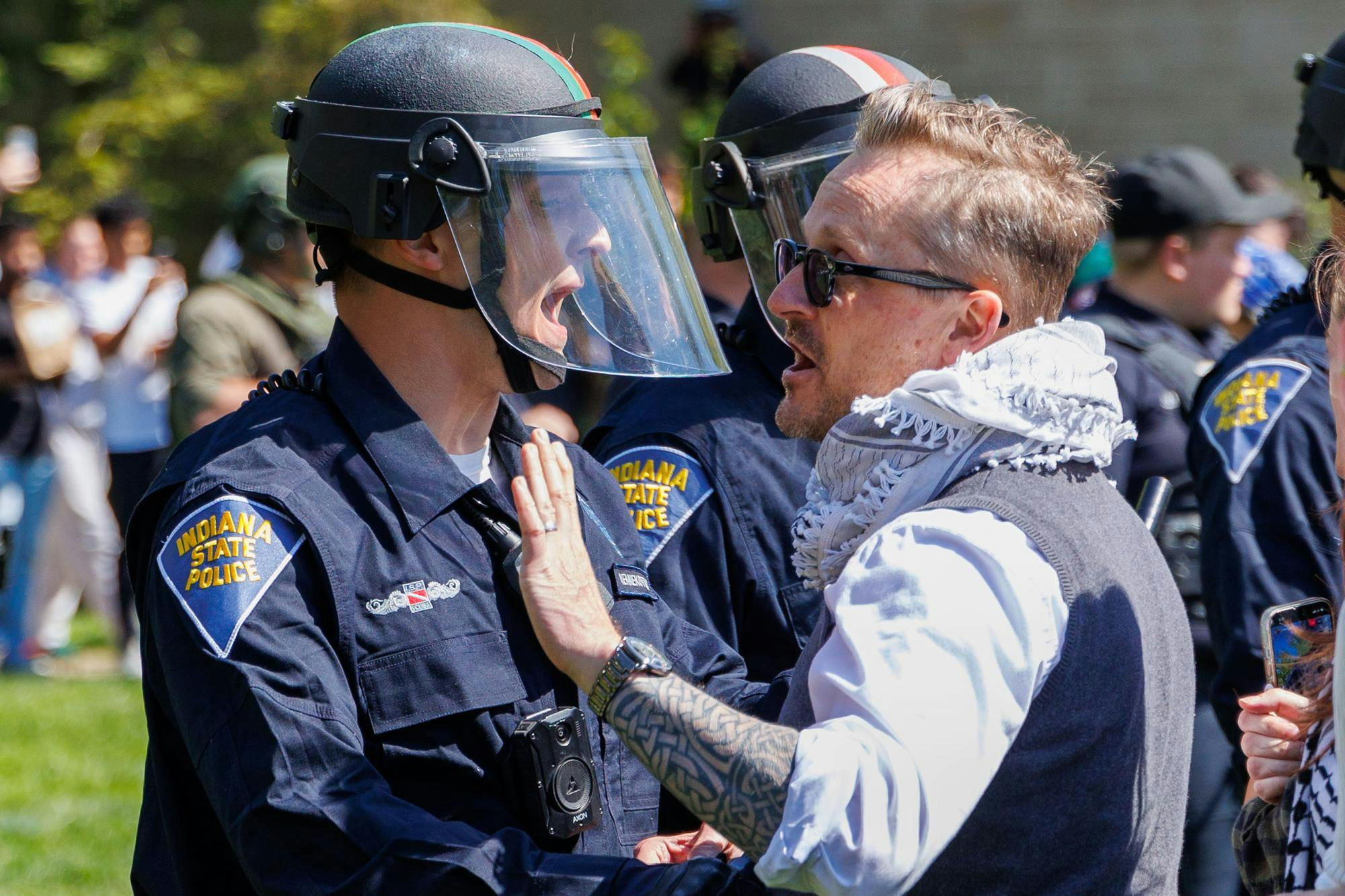
IU professor David McDonald is pictured up against a police officer as the line of officers moves closer to the line of protesters at the IU Divestment Coalition encampment April 25, 2024, at Dunn Meadow in Bloomington. McDonald was arrested and charged with trespassing and banned from campus — both charges would end up being dismissed.
Rise in antisemitism
Bloomington and IU have seen increased antisemitism and hostility towards Jewish students, according to Jeff Linkon, the executive director of the Jewish campus organization Hillel at IU. He was not working at IU during the encampment but said he was attuned to the campus climate leading up to his acceptance of the role last October.
During the hiring process, he said Hillel’s student leaders interviewed him, and campus attitudes toward Jewish students were at the forefront of their conversations.
The Anti-Defamation League, an organization that aims to fight antisemitic bias, reported a 344% increase in antisemitism between 2019 and 2024, with incidents of harassment, assault and vandalism occurring nationwide. It reported synagogues and other Jewish institutions were targeted with bomb threats. The ADL updated its methodology after the Oct. 7 Hamas attack to include anti-Zionism incidents with other antisemitic incidents in its report.
A map from the ADL recorded 21 incidents of antisemitic harassment and vandalism in Bloomington in 2024. One reported that a synagogue in Bloomington was the target of a bomb threat in January. Others included swastikas spray-painted on a synagogue and Israeli flag. In 2023, there were only four incidents, all of which were recorded after Hamas’s initial attack on Oct 7.
IU, along with at least 20 other universities, received a Title VI complaint a few months after Oct. 7, 2023, from “conservative culture writer” Zachary Marschall. The complaint accused IU of failing to address antisemitism on its campus, citing chants from pro-Palestine protests. On Feb. 5, 2024, the Department of Education’s Office for Civil Rights opened an investigation into IU.
The Department of Education sent letters to 60 universities, including IU, in March 2025, threatening federal funding if “they do not fulfill their obligations under Title VI of the Civil Rights Act to protect Jewish students on campus.” All universities that received letters had been under investigation for antisemitism.
According to Linkon, the encampment exacerbated the experiences Jewish students faced since Oct. 7, 2023. He said Jewish students expressed fear, isolation and a growing sense of vulnerability on the campus.
Partnerships between the Jewish community and other culture centers, student governments and community organizations on campus became impossible to continue, Linkon said. He said he thought they might have felt the campus climate was toxic and didn’t want to be a part of it, or that they turned their backs on the Jewish community.
He said IU’s campus should be a safe space for students to talk about the events in Israel and in Gaza, but that safe space didn’t exist.
“Antisemitism is as old as, you know, it dates back thousands of years,” Linkon said. "It isn’t going away today or tomorrow.”
While combating antisemitism is vital, he said, it was still critical to provide a campus climate where Jewish students can thrive and connect in positive ways.
Sophomore Mikayla Kaplan said she has been apprehensive to share her experiences as a Jewish student, though she said she hadn’t directly experienced antisemitism in the classroom. She has lived in Israel previously and is the president of Hoosiers for Israel, an organization with a goal to inform students about Israel.
“I’ve had students that I’ve heard are experiencing bias and antisemitism in classrooms, both from professors and from their fellow peers and students,” Kaplan said. “I don’t want to feel isolated in a class.”
In response to the encampment itself, she felt as though IU did not do a good job of handling it.
“It’s tricky because the administration needs to protect all students, not just a specific group,” Kaplan said.
Faculty reflect on the encampment
Faculty who were arrested at the encampment have spent the past year grappling with how to move forward.
McDonald said he had attended many protests in the past and the university had never called in state police. But on the first day of the encampment, McDonald said he stepped in between students and officers, fearing for the students’ safety.
“I was desperately trying to de-escalate the situation,” McDonald said. “These students aren’t harming anything. It’s just free speech in a free speech zone. Just let them speak their mind and they’ll all go home peacefully.”
A few moments later, McDonald said he was pushed further into the encampment with a baton four times. On the fourth time, he was pushed on the ground and stayed there to catch his breath when a police officer turned him over and handcuffed him.
McDonald said he was in custody for about nine hours and issued a year-long ban from campus. However, he appealed the ban and was allowed back on campus around four weeks later. In the days he was banned, McDonald said he would stand on the street and watch the encampment without violating the trespass.
Like McDonald, Barbara Dennis, a professor at the School of Education, was also arrested on the first day of the encampment. That didn’t keep her from coming back to Dunn Meadow nearly every day.
The paper Dennis was handed after she was released from jail at midnight on April 26 said she was banned from campus from April 25, 2024, to April 25, 2024, which she now thinks was likely a typo. Dennis was back on campus the very next day for a rally outside Franklin Hall.
She described the encampment as a democratically engaged, student-led educational opportunity. They had their own graduation ceremony and library in Dunn Meadow, she said. Circles of faculty, students, staff and community members read and sat and shared meals together. They drank tea on blankets in the evenings. Dennis served on the security team during the summer, watching over the camp in the late hours of the night so they could sleep.
Dennis was there on the first day, she said, because students asked her to be there. She said she always tried to listen to the students and follow their lead as a faculty member. The day of her arrest, she said she stood in front of the students and the police like McDonald.
“I was really angry,” Dennis said. “I felt like the administration forced me to protect students from them because they had called these weapons to campus.”
Kaplan, on the other hand, said she avoided Dunn Meadow for months. She wore a Star of David around her neck and kept away from the encampment out of fear for her own safety.
She said protesters were yelling and screaming slogans and rhetoric that were difficult for Jewish students to hear. Many students had deep ties and connections to Israel, she said, and the time during the encampment was isolating for IU’s Jewish community.
Kaplan said she thought that since the encampment, most Jewish students are just trying to move on, turn inward and focus on their communities. Their families and friends were still under the dangers of war, she said, and people they know are still held hostage.
“There’s always a way to have a productive discussion,” she said. “Ask questions and be thoughtful and engage in intellectual discussion with others, because as long as it remains respectful, there’s only good outcome.”
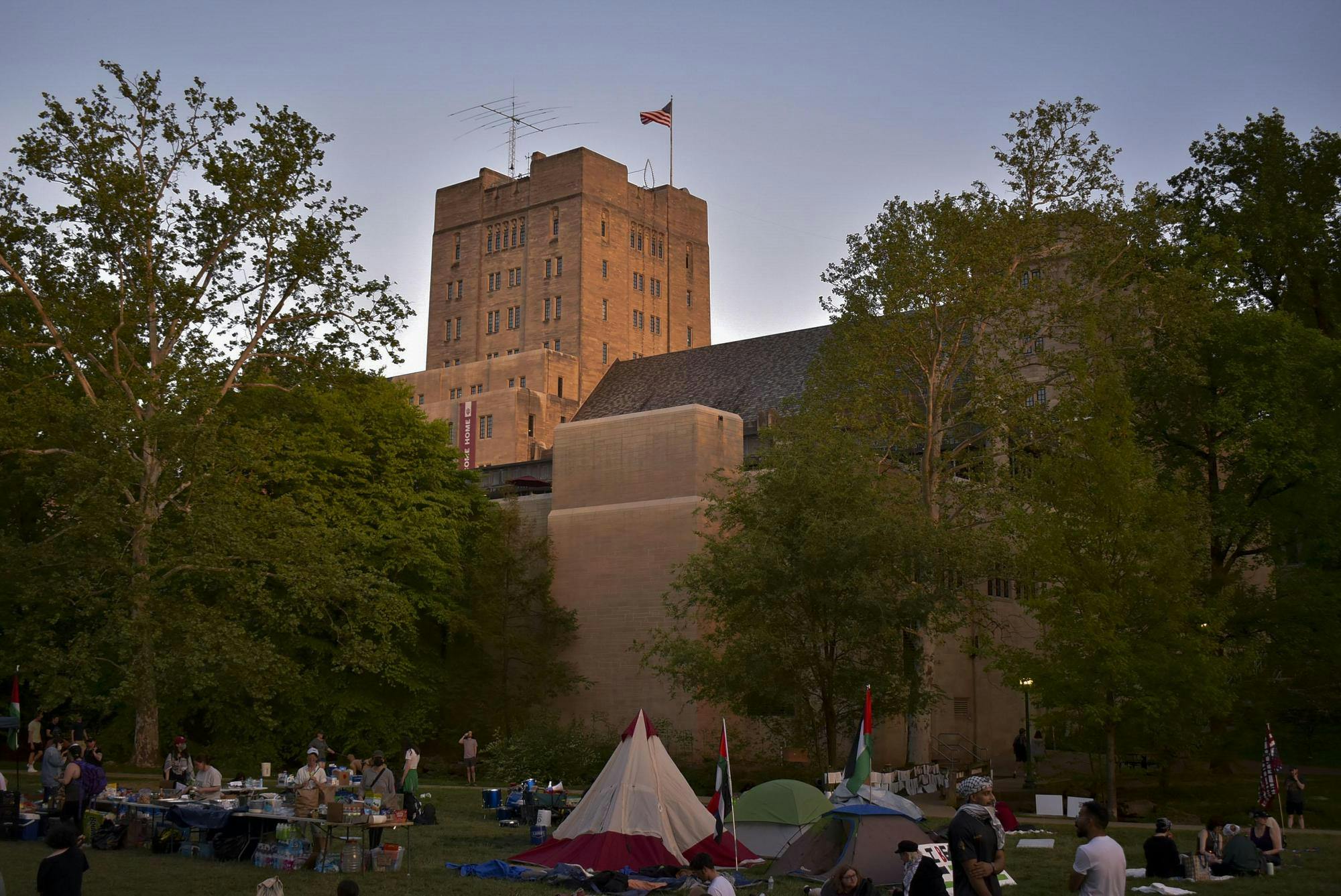
The Gaza encampment is pictured April 28, 2024, in Dunn Meadow in Bloomington. The IU Divestment Coalition organized the encampment to protest the war in Gaza and call for IU to divest from Israel months after the beginning of the Israel-Hamas war.
Looking back
Dennis has worked at IU as a professor since 2001, but she decided in September to leave at the end of the school year due to concerns about the administrative response to protests.
“I felt like I could maybe stand up more or do more if I’m not worried about whether or not I would lose my job,” Dennis said. “So, I took that worry off the table.”
McDonald is still working at IU. He said the encampment was a great opportunity to bring greater awareness of Palestine to campus, but he never expected it to escalate in the way it did.
“I never once thought the university would call in state police to physically and forcefully assault our students to shut down the encampment,” McDonald said.
McDonald said the IU administration had failed in many ways in response to the encampment. He said at no point did he feel like the administration was willing to engage in conversation with the students.
“At every moment, it has taken the wrong decision, and that hasn't changed, even today, a year later, nothing has changed,” McDonald said. “We need to put free speech and academic freedom at the top of our values, otherwise we are no longer a university anymore.”
One year later, McDonald still feels the effects of the Dunn Meadow encampment. He has received emails, voicemails and messages from organizations that disagree with his viewpoints, including threats to him and his family.
Looking back, though, McDonald said he would relive the events if it meant protecting students and their right to free speech on campus.
To this day, McDonald uses the encampment as a teaching opportunity in his classes, deeming it an important part of IU’s history.
“We want to train engaged citizens who see an opportunity and a responsibility to speak out on issues of concern,” McDonald said. “So, I thought the encampment was an incredible moment in IU's history, and one that we should celebrate and discuss with future generations of IU students.”