
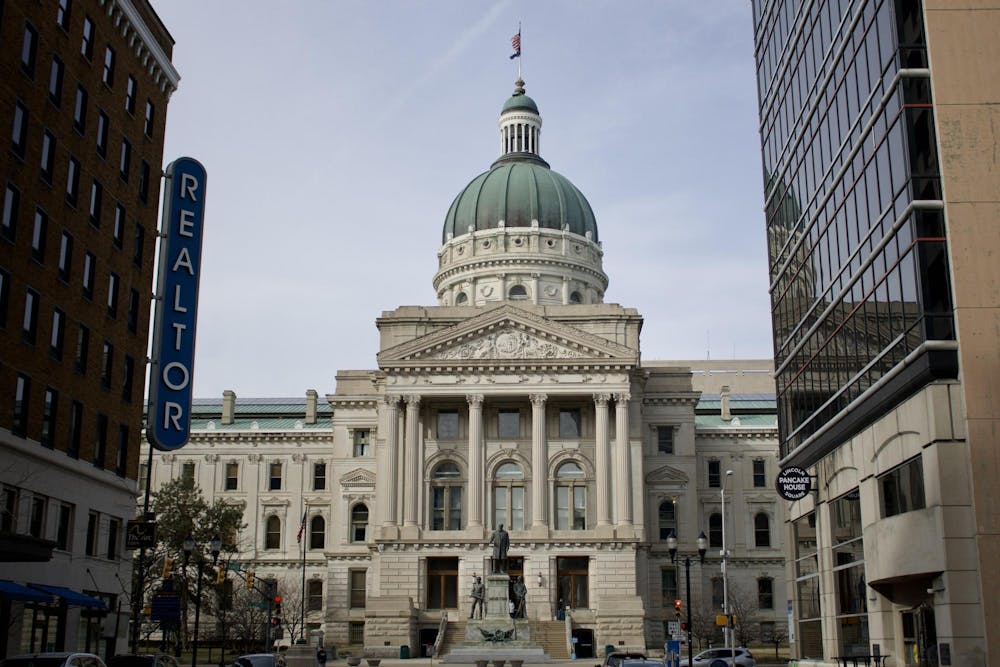
People from across Indiana came together for a “Hoosier Healthcare Day of Action” at the Indiana Statehouse’s third floor Atrium North on Tuesday, calling upon legislators to address medical debt crises, rising insurance premiums and hospital closures.
Federal health care cuts to Medicaid put a dozen hospitals in Indiana at risk of closure, and one in five Hoosiers has medical debt. Affordable Care Act subsidies have expired, leading to higher insurance costs.
People showed up with signs, reading “I MATTER,” “$ome get Richer, many get Sicker” and “Cutting Medicaid is MURDER."
The event was organized by advocacy groups including Hoosier Action, Blood Cancer United, Northwest Indiana Interfaith Action Network and the Indiana Community Action Poverty Institute.
Hoosier Action Healthcare Organizer Tracey Hutchings-Goetz, who is based in Monroe County, said the organization chose to hold the day of action midway through the legislative session to potentially shape the passage of bills. She said around 100 people signed up to come out.
She said the event was held because healthcare costs, access and affordability are “out of control”.
“It’s not a crisis we can GoFundMe our way out of,” Hutchings-Goetz said. “Healthcare premiums for small organizations and businesses like the one I work for, jumping by 50%, doubling in price.”
Enhanced premium tax credits for the Affordable Care Act — which lowered costs of health insurance for 92% enrollees as of 2025 — expired at the beginning of the year. Premiums have increased as a result.
Gabe Pfefer, a reverend at Park Christian Church of New Albany and an uninsured type 2 diabetic, took to the podium to speak about his own experiences. He said health insurance becomes harder to afford every year.
“Proposed changes to Medicare and other health care, changes that affect the ability to get resources, are not affecting abstract people,” Pfefer said. “These are people who work hard, they contribute faithfully and still they can’t absorb another increase or a loss of coverage.”
He called upon the legislature to protect and strengthen affordable health care and listen to the lived experiences of those who depend on Medicaid.
Senate Bill 1, which passed committee Jan. 15, would require Hoosiers to spend at least 80 hours a month working, doing a work program or volunteering to receive Medicaid, as required by the One Big Beautiful Bill Act. That’s one of the bills Hutchings-Goetz said the group was advocating against. Regardless of if the bill passes, Indiana is required to implement the work requirement.
Michele Ketelhut, a home health worker from Lafayette, spoke in support of House Bill 1162. It would require that at least 70% of the state's share of Medicaid reimbursement provided for those services under a home and community-based services waiver will go to direct care staff.
She said many home care workers like herself are currently making $16-17 an hour.
“You cannot survive on that,” she said. “When you pay home health workers poverty wages, it means we can’t afford to go into home care at all.”
The bill was referred to the State House’s Committee on Public Health after its first reading Jan. 5.
Zachary Greenwood, a healthcare worker, spoke about his own experiences working at a short-staffed hospital, with not enough space and rooms for all the patients.
He said his hospital has some patients with COVID-19 that had to stay in the hallway, which increases the risk of infection for everyone. He also mentioned the potential impacts of hospital closures on families and workers.
“People who need ER care or cancer treatment have to travel further, they have to make hard decisions,” Greenwood said. “Do they go to the closest hospital? What if it doesn’t take their insurance?”
Twelve hospitals in Indiana were named “at-risk” of closure after the OBBBA passed in July, meaning they had spent three years in a deficit or had a high number of Medicaid payers.
Lauren Murfree, a policy analyst at the Indiana Community Action Poverty Institute, called attention to Hoosiers’ more than $2 billion in medical debt, landing Indiana near the top nationwide for the number of residents with medical debt.
“[There’s] fear of medical debt to avoid medical decisions in Indiana,” Murfree said. “This is not how our system should work. Medical debt destroys livelihoods and lives, placing the Hoosiers into a place of instability.”
Hutchings-Goetz said Hoosier Action supports House Bill 1271, which requires hospitals to notify people of payment assistance programs before beginning collection, and Senate Bill 85, which also addresses healthcare debt and wage garnishment. The bill would prevent aggregate disposable wages from being garnished from individuals who make 200% or less of the federal poverty level.
After the press conference, she said, constituents have meetings lined up with legislators so people can advocate for themselves and share their own stories.
Hoosier Action is planning two more events to call on the legislature for action or change, including a “People’s Hearing on Data Centers” Feb. 24 at the Indiana State Library and “Annual Harm Reduction Day” at the Statehouse Feb. 26.



