Alireza’s screen time has jumped.
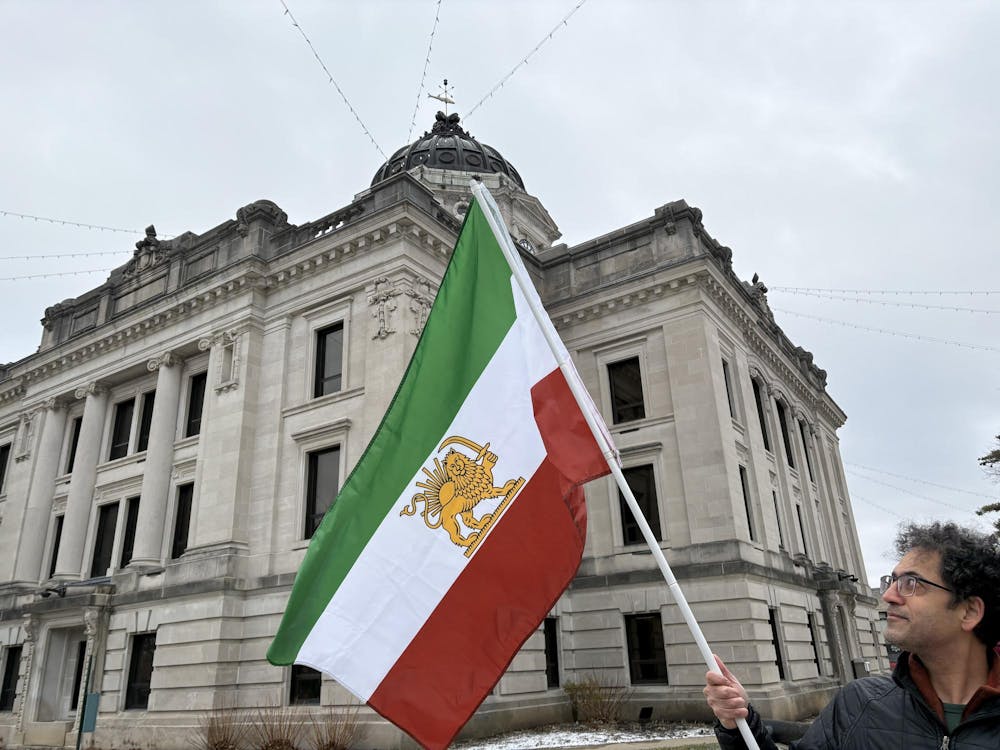
It’s reached more than 12 hours per day, he said. He’s an Iranian PhD student at Indiana University, constantly watching and reading the news of the war unfolding back home.
Alireza calls his family in Iran when he can. Their conversations aren’t long; they just check up on each other and make sure everyone’s all right. His close family has already left Tehran, Iran’s capital, for another city.
He said he last saw his family in 2023 before he left to study at IU. To protect them from Iranian government retribution, he requested his last name not be included in this story.
Alireza said he’s hopeful for the future but scared in the present, a common feeling among Bloomington’s Iranian community. It’s unclear what’s next, but he thinks there’s a real chance the Iranian government falls and the country transitions toward democracy. In his ideal world, that’s what would happen.
“I've never, like, feel like Iran would have a good future, but right now, it's possible,” Alireza said.
It’s hard to focus on schoolwork, he said, but his friends and professors have supported him. He wants people at IU to understand what’s happening in Iran.
“People just need to know what's going on,” he said.
***
The United States and Israel launched widespread strikes on Iran on Feb. 28, killing Supreme Leader Ali Khamenei and much of the country’s top officials. The two countries did not formally declare war against Iran; nonetheless, war has embroiled many countries in the Middle East.
Human Rights Activists News Agency estimates more than 1,200 civilians have been killed since the strikes began in Iran. Israel estimates that it and the United States have killed about 3,000 Iranian military personnel.
The conflict's death toll has grown outside Iran, as well: nearly 600 people in Lebanon. Seven American service members across the Middle East. Twelve civilians in Israel, and more than 30 people in other neighboring countries.
Alireza saw a video of his high school in Iran after strikes hit, showing classrooms destroyed.
“It's kind of sad to see these things,” he said, “but actually, what I believe is the high school or the classrooms are not important, the people are important.”
A third-year IU PhD student, who requested anonymity to protect her and her family, said some of her close relatives’ homes had been bombed in Tehran. Some family members who could leave did so. Others had to stay for work.
“They're not feeling that good, in general, because it's war, but they are hopeful that the regime changes and they wouldn't be dealing with this evil government another 50 years,” she said.
***
IU professor Mostafa Beshkar was born in 1979, the year the Islamic Republic of Iran was established after the revolution that overthrew Shah Mohammad Reza Pahlavi.
His life growing up, he said, somewhat followed the population’s brewing disillusionment with the regime.
He watched frustration develop, protests periodically swell, the population become less religious and the economy worsen.
The last time he visited was in 2022, right before mass protests engulfed the country after 22-year-old Mahsa Amini, arrested and accused of wearing her hijab improperly, died in police custody. Iran Human Rights estimates state forces killed a minimum of 551 protesters in the unrest.
“You could feel it in the air that something was going to happen,” Beshkar said, “because of all the conflicts between people and the morality police that year.”
In January this year, protests again swelled. Contact with most people inside Iran became impossible for weeks as the Iranian government cracked down, killing thousands. Iran’s government put the number of protesters killed at nearly 3,000.
Time Magazine, citing two unnamed health ministry officials, reported that as many as 30,000 people were killed. The Guardian, citing medics and morgue staff, estimated the death toll exceeded 30,000.
Beshkar left Iran in 2003 to study in the United States, where he moved permanently. He’s now a professor of economics at IU, also watching and reading the news.
“My sleep is completely messed up,” he said.
His family is still in Iran and calls him periodically. He said he’s hearing a mix of hope and fear from them. People celebrated on the streets of Iran after Khamenei was killed. But he’s afraid the war might be taking a different turn — from toppling the regime, toward weakening the state.
The aim of the United States and Israel’s strikes remains unclear. On Feb. 28, President Donald Trump said the goal was to defend against imminent threats — an allegation countered in U.S. intel briefings — as well as to prompt regime change and destroy Iranian military and nuclear development. U.S. Secretary of State Marco Rubio later clarified the imminent threat was an Iranian response to a planned Israeli military attack.
More recent messaging suggests a de-emphasis on regime change. On March 1, Trump said the potential leaders U.S. government officials “were thinking of” to replace Khamenei had been killed in the strikes.
“The U.S. every day seems to have — at least seems to propose — a different objective,” Beshkar said. “That makes me worried that maybe they don't have a very coherent strategy of what they want to do.”
Some attacks on civilian infrastructure, including Israeli strikes on fuel depots, have gone too far, Beshkar said. He wants people to contact senators, representatives and anyone in government to push for a clear strategy of regime change.
“The objective should remain liberating the country from this state, from this regime,” he said. “Just weakening this state and just leaving is not going to be a long-term solution for the West, and of course, it's going to be a terrible situation for people in Iran.”
***
Explaining the nuances of the war is difficult, the third-year PhD student said. She woke up to the news of war breaking out in shock. When she heard Khamenei was assassinated, she was happy — she considered him the root of much of Iran’s problems.
After hearing that news, the student said things have been different. It’s difficult to know what the war will hold. Worse, she said, it’s hard to explain what’s going on to others in Bloomington, or why some Iranians wanted a war. She and Alireza said it was inevitable.
She views supporting the strikes as choosing a lesser evil. But that’s hard to communicate. There’s so much pulling her and Alireza in countless directions: hoping for regime change, fearing the war takes a turn for the worse or that the Islamic Republic remains in power.
“(People in Iran are) bare handed,” the student said. “They can't help, they can't fight, because government already killed and prisoned everyone who fought back.”