
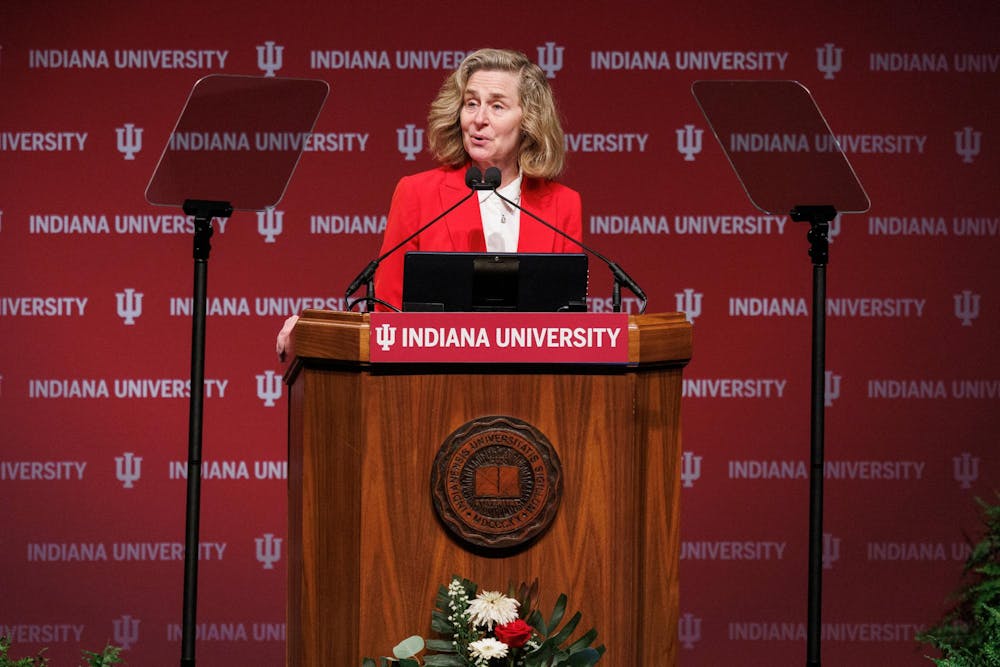
IU President Pamela Whitten gave her annual “State of the University” address Tuesday morning at Hine Hall at IU Indianapolis.
In her address, Whitten covered the university’s progress toward its strategic plan — “IU 2030” — and touched on commitment to free speech and student affordability.
Movement toward 2030 strategic plan
IU 2030 centers on three pillars: Student Success and Opportunity, Transformative Research and Creativity and Service to Our State and Beyond. The plan, officially introduced in 2023, aimed to improve IU’s performance on each metric by the year 2030.
In her address, Whitten put particular emphasis on the university’s progress toward becoming a top-tier research organization.
IU has begun expanding its artificial intelligence programming, including offering an introductory generative AI course to more than 800,000 current students and alumni.
“In this transformational moment for society — where technology like AI must be harnessed alongside the creativity, judgment and empathy that make us human — I firmly believe that IU can become the model that shows others the way forward,” Whitten said.
Whitten said IU increased its research expenditures by 31% and exceeded $1 billion this year in research spending, becoming the first public university in Indiana to do so.
She also cited more than $90 million dedicated to hiring new experienced faculty to grow departments such as engineering and computer science, and more than $250 million dedicated to life sciences.
“By setting and meeting high standards for our faculty, while continuing to invest in our faculty and the facilities they need to pursue knowledge and truth,” she said. “I believe IU Bloomington can and will make a dramatic climb to the top third of the Big 10 in research productivity.”
She also mentioned IU’s partnerships with major medical institutions, including a $40 million partnership with Eli Lilly and a medical research and workforce production collaboration with Cook Medicalacross all nine IU campuses.
Whitten cited IU Indianapolis’ February designation as an R1 research university by Carnegie Classification of Institutions of Higher Education as evidence the 2030 strategic plan was well underway.
Student enrollment, experience and affordability
Whitten said applications to Bloomington have grown 60% in the past four years, and overall applications to other campuses have grown, as well.
IU set a record for enrollment in 2025 with 89,247 students, which included more academically successful incoming students.
Whitten emphasized the value of attracting in-state students, implementing initiatives such as an in-state tuition freeze and a reduction in mandatory fees to reduce costs against trends of inflation. The tuition freeze came in compliance with a recommendation from Indiana Gov. Mike Braun and the Indiana Commission for Higher Education.
She added more than half of IU students now complete a four-year program without student loan debt.
Freedom of speech
Whitten said she and the university would continue supporting ideals of free speech across IU campuses, referencing her request that the University Faculty Council review a new set of free expression guidelines for adaptation.
IU was ranked the third-worst university in the country and worst public university for free speech earlier this year by the Foundation for Individual Rights and Expression and has faced several lawsuits for alleged censorship and free speech violations.
Over 90% of voting IU Bloomington faculty passed a motion no confidence in Whitten in April 2024, stemming among other things from alleged restriction of pro-Palestinian speech on campus.
More recently, lecturer Jessica Adams was removed from teaching a class after a student filed an intellectual diversity complaint following a lesson that included a pyramid graphic listing overt and covert forms of white supremacy. The graphic included Columbus Day and the “Make America Great Again” slogan. She has since been reinstated.
IU faced criticism in October after firing then-Director of Student Media Jim Rodenbush after he refused to dictate content in the Indiana Daily Student’s print newspaper. The university initially ordered the IDS to stop printing entirely, later retreating after backlash.
Still, Whitten projected confidence in her address, voicing her belief in IU 2030.
“We rightfully celebrate this excellence, but we cannot allow ourselves to be satisfied with it,” Whitten said. “We believe Indiana University is too capable and too good not to become even better.”


