
Indiana University has begun providing AI tools for students and faculty, with a GenAI 101 course released at the beginning of the fall semester and the planned rollout of ChatGPT Edu.
“Indiana University is empowering our students, faculty and staff to lead as AI transforms every sector of the economy,” IU President Pamela Whitten said in an August 28 press release. “Working with an industry leader like OpenAI gives the IU community cutting-edge tools that will enhance learning, increase efficiency and prepare our graduates to thrive in the careers of today and tomorrow.”
Generative AI has recently become a prevalent tool for many college students. Survey results released by Inside Higher Ed in August showed that about 85% of college students report that they have used generative AI for their schoolwork within the last year.
Here’s how IU is approaching the rise of AI in higher education:
GenAI 101
The university’s new GenAI 101 course was codeveloped by university technology experts, Brian Williams and Anne Leftwich, along with more than 40 others who contributed to different aspects.
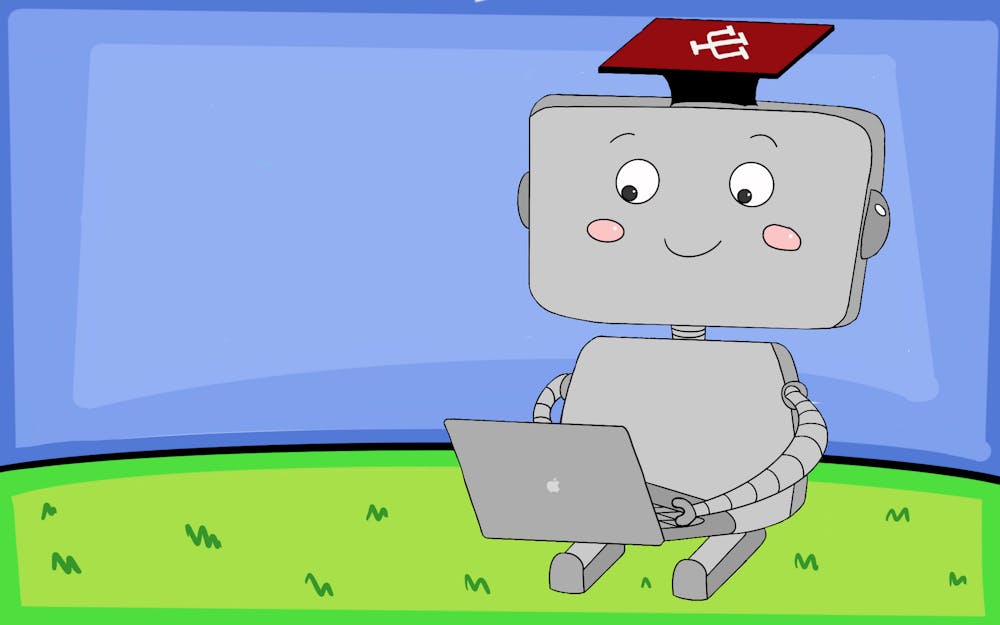
The eight-module course, Williams said, assumes a student knows very little about generative AI, so it begins with the basics. It includes 31 YouTube-style videos with an average length of seven minutes. An animated AI assistant called Crimson interacts with learners and progress assessments are given throughout the course, Williams said.
The entire course takes about four and a half hours to complete, Williams said, and by the end of the course, students are taught to make a custom AI assistant.
Williams is the chair of the Virtual Advanced Business Technologies (VABT) Department in the Kelley School of Business and taught and developed Kelley’s first four generative AI courses.
He said IU leadership asked him and Leftwich to develop a practical, skill-based course in generative AI this summer to help students be more productive and use generative AI as a “thought partner.”
This launch is part of IU’s new “AI Academy,” Williams said, and will likely be accompanied by several other courses in the future. Williams said IU is one of the first schools to make this scale of practical generative AI learning material available for its students, and other institutions, including Harvard University, have reached out to the course-building team to learn from their approach.
“It’s really turning heads across the nation,” Williams said.
Williams said more than 30,000 people had started the course by Sept. 8, and students and teachers alike have given positive feedback. However, Williams acknowledged that AI use can be problematic.
“There’s real concerns with AI and environmental issues,” Williams said. “I also think there’s real concerns with copyright issues, or there’s real concerns with ethical issues. There’s a lot of concerns with AI in general.”
Williams said IU is attempting to be cognizant of the issues with using AI while facing the reality that many employers “won’t even hire students who don’t know how to use them (AI tools)” and trying to help prepare students who are interested in learning AI skills. The course material, Williams said, consistently points out to the learner that AI can make mistakes and that it is not a substitute for doing one’s own work.
GenAI 101 co-creator Anne Leftwich is a professor who teaches technology integration, AI and computer science classes at the School of Education. She has been the associate vice president of University Information Technology Services Learning Technologies for all campuses for the last two years.
She was responsible for teaching the ethics unit of the GenAI 101 course and said the best first step for students to learn how to use generative AI ethically is to take the course.
ChatGPT Edu
According to Leftwich, ChatGPT Edu provides ChatGPT Pro features and added security, as ChatGPT cannot use any of IU’s data from ChatGPT Edu to train its models, which are systems trained by data to find patterns and make decisions without requiring human programming.
More than 30,000 individuals have signed into the free ChatGPT with their IU emails, Leftwich said, so IU hopes providing ChatGPT Edu for these individuals to use instead will keep any internal university data shared with ChatGPT private in case of a data breach.
IU’s rollout of ChatGPT Edu will be the second largest of all time for OpenAI, according to an IU press release. Faculty and staff can now access ChatGPT Edu and student access will launch Jan. 1. Of the 200 faculty who tested several AI tools over the summer, 80% said ChatGPT worked the best for aiding their teaching and research.
“It’s helpful to have all the possible tools in front of you to really think about, ‘How do I reach my students better? How do I build assignments that are going to resonate with them?’” Leftwich said.
Leftwich said AI can be a helpful tool but acknowledged the reality of students using generative AI.
“If a student is using it to cheat, then obviously it's not a good learning tool,” Leftwich said. “However, if a student is using it for a way to brainstorm, to iterate, to get feedback on whatever it is and then incorporating that feedback, or better yet even learning and incorporating that into their next draft, then those can be exceptional ways, in my mind, to learn.”
Leftwich said discouraging students from using generative AI to cheat falls to the instructors and those who create the curriculum. If students are given assignments without an explanation of the relevance or purpose, it’s hard for them to create a good final product and not be tempted to cheat, Leftwich said.
“Because AI is kind of destroying the assignments that we typically assign our students, I would love to see us do more experiential learning where you’re going out into the field,” Leftwich said. Experiential learning is a hands-on approach to teaching in which students are encouraged to learn through direct, in-field experience.
Junior Jonah Katz, president of a new student organization called Advances in Technology & AI Tools, said IU’s planned rollout of ChatGPT Edu shows the university’s initiative in integrating AI and emphasizing the importance of AI.
“I think it’s a great step,” Katz said. “I think that it lowers barriers for students to use AI responsibly. It can help with research, brainstorming and writing, but this is only if professors set clear expectations.”
Katz said AI has helped him be more time-efficient and search for internships.
“This is an innovation that isn’t going to go away and it’s only going to progress over time, so it’s important to be at the forefront of this transformation rather than be left behind,” Katz said.


