
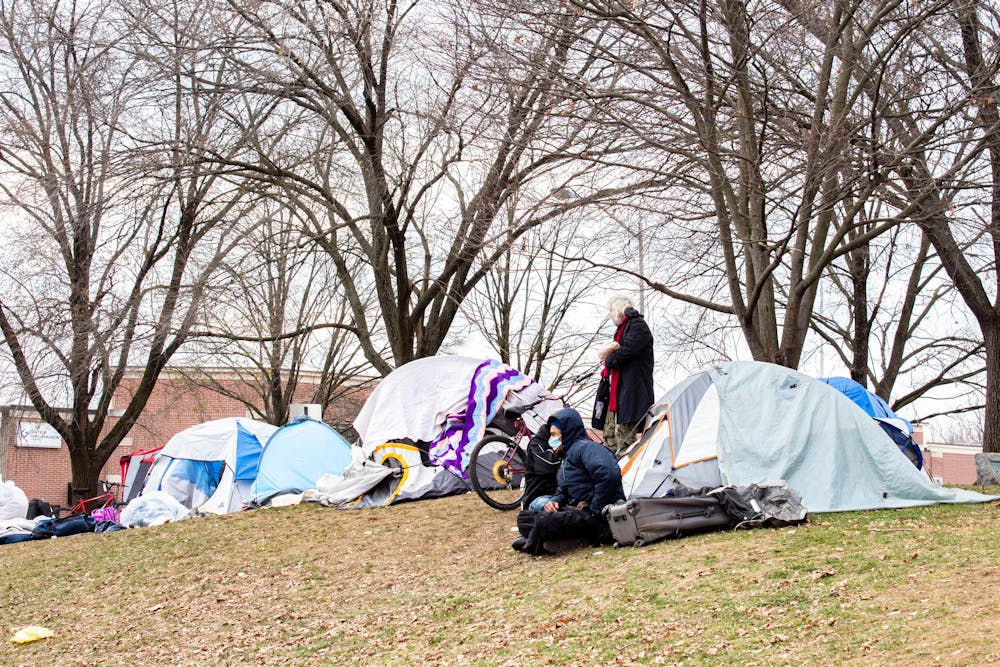
The City of Bloomington released a report Thursday detailing its response to housing changes and homelessness since Mayor Kerry Thomson took office in 2024.
According to the report, the city has invested over $9 million into affordable housing, eviction prevention and rapid rehousing programs since 2024. The report acknowledged that at the end of 2027, after federal funding runs out from the American Rescue Plan Act, a COVID-19 relief package that provided direct funds to local and state governments, city revenue will not be able to sustain those spending levels.
After ARPA funds run out, the report said, one-time investments in housing projects won’t continue, but the city will still focus on improving development processes.
Of the over $9 million, about $2.79 million has gone toward projects aimed at creating affordable housing ownership options, which are meant to support families at or below the Area Median Income. The AMI varies by household size; as of 2024-25, it is $63,300 for one person and $90,300 for four people. About $2.16 million has gone toward affordable rent and $2.2 million toward supportive housing, which includes housing support for domestic abuse victims.
The report cited housing access as the main driver of homelessness. It highlighted homes removed from the housing market for short-term rentals, such as Airbnb, as well as the number of Indiana University students who enter the rental market due to limited on-campus housing.
“Street homelessness is more visible and disruptive today than recent years,” Thomson said in the report. “Our businesses and neighbors are struggling with unexpected costs and struggling to set compassionate boundaries with those who are living in deep crisis.”
In 2025, 305 people experienced homelessness in Monroe County. The data, collected on a single night in January, showed a decrease in homelessness of 12.8%, the first decline since 2022.
The report shared four strategies for preventing homelessness: increasing housing stock, preserving existing housing, preventing eviction and implementing a strategic approach to housing.
Increasing housing stock has involved infrastructure support, funding, land acquisition and down-payment support for new homes and apartments, the report states. Additionally, the city is working on the Hopewell Development, which the report says will provide 500-1,000 homes, and the Summit neighborhood, which the report says will provide 4,000 housing units.
Hopewell is a city-led neighborhood development that will be built on the site of the old IU Health Bloomington Hospital. The city hopes to break ground on the first phase of the project in July 2026. In May 2024, the City Council approved a rezone for the about 140-acre site of what will be the Summit District, which is expected to take 10-12 years to develop.
The report also addressed regional service boundaries, a framework the report said is meant to prioritize long-term care for people from Bloomington’s six-county Housing and Urban Development region: Morgan, Monroe, Greene, Lawrence, Owen and Martin counties. Bloomington outreach teams have observed a trend of “high-need individuals being discharged” into the city from facilities outside the HUD region or Indiana, the report stated.
In a July press conference, Thomson said relocating housing-insecure individuals can cut them off from their local support systems.
“We are also continuing to tell other communities, municipalities, jurisdictions, and criminal justice organizations: stop transferring individuals to Bloomington without a local connection or follow-up plan,” the report said.
The report defined regional service boundaries as a temporary framework that keeps resources available for people who receive support in the HUD region, so that support is continuously available. It clarifies that the boundaries are not barriers to immediate food, housing or other support based on someone’s identity or background.
The city has worked with multiple community partners, such as New Hope for Families, to prevent evictions, provide individuals with grants or loans and support evicted families. New Hope for Families provides emergency shelter for 12 families at a time and has a childcare program.
While the city does not run any homeless shelters, it dedicated $600,000 to the development of the new Beacon Center, set to open in 2027. The center, which will be at 1201 W. Third St., will provide emergency shelter, permanent housing and rehousing services.
From April to November 2025, most of Kirkwood Avenue was closed to vehicles, which the report said accounted for increased Bloomington Police Department and IU Police Department presence in the area.
The city has also contracted professional security around parks, parking garages and civic facilities, as well as training city staff to be “After Hour Ambassadors” to patrol downtown. Both increased security measures are meant to deter or de-escalate vandalism or other issues on evenings and weekends. After Hour Ambassadors are trained to connect homeless individuals, as well as residents and businesses, with necessary resources.
Fully staffing police with 105 officers is another goal of the administration. The report said BPD has been operating at a 15-20% officer shortage for the last five years. It also said that while the city is committed to making arrests for serious crimes, alternative solutions focused on housing and employment for individuals are a priority.
“Another step in rebuilding our police department to its intended levels is ensuring they have adequate facilities,” the report said.
Currently, the city is planning to relocate BPD headquarters to the former Bloomington Convalescent Center. The site is located near the Hopewell South development, and could be included in its Planned Unit Development, a type of zoning district meant for mixed use developments and housing.
The administration is currently working on two permitting audits meant to quicken and standardize the housing development process: one focused on zoning, and one that is a comprehensive review of the development processes in Bloomington. Additionally, they are working on possible revisions to the city’s Unified Development Ordinance, which is the city’s zoning code.
At a City Council meeting earlier this month, attendees discussed housing reforms such as zoning changes and pre-approved housing plans. City Council President Hopi Stosberg said that the next step is making policy changes to the UDO.
“We have to be candid: we’re part of the problem,” the report said. “Much of the housing bottleneck is inside City Hall, in our rules and workflows.”


