
Monroe County officials are facing pressure to resolve longstanding alleged constitutional rights violations at the county jail before a private settlement agreement is set to expire in April. If progress stalls, it could reopen the county to litigation.
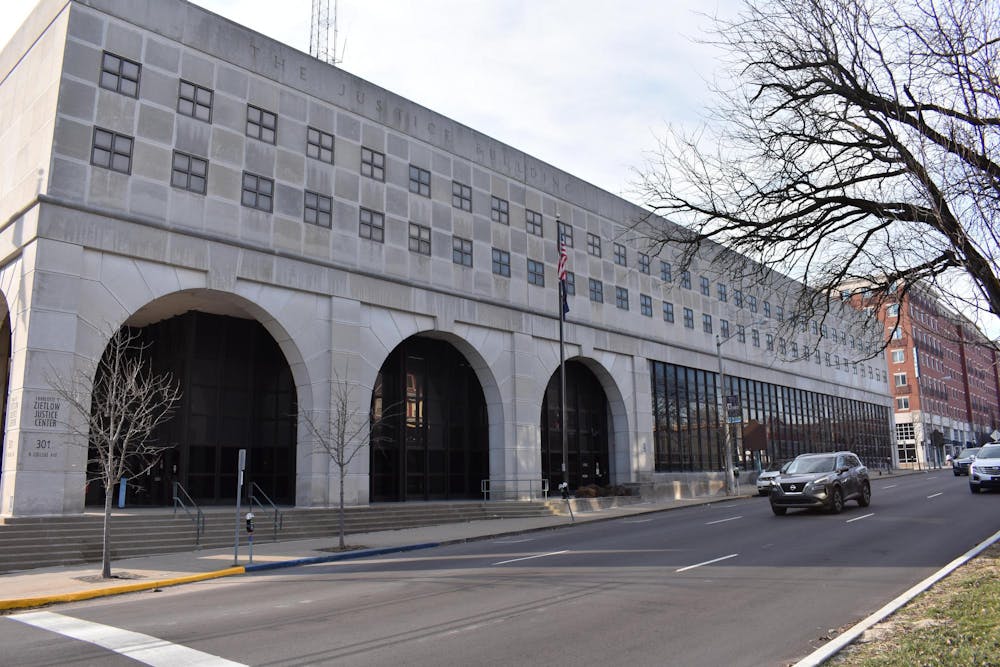
The Monroe County Jail, housed in the Charlotte Zietlow Justice Center, was first subject to legal action in 2008. According to a Dec. 29 letter sent to the county legal department from the American Civil Liberties Union of Indiana, the jail has problems with exposed piping, insufficient space, exceeding its intended lifespan and more.
The jail was originally designed to hold about 180 people but now houses roughly 300, Monroe County Commissioner Jody Madeira said. In 2017, the jail underwent significant renovations to expand the bed count. The current facilities bed count is at 294.
While most county officials agree the jail is unconstitutional, Madeira said, disagreements over cost, location and recent state legislation have complicated efforts to move forward with a new facility.
“Our big concern is that while we don’t want to be fiscally irresponsible, it would also be another fiscally irresponsible move to not be mindful of the fact that this has to be in the community for another 40 years,” Madeira said.
In October, the Monroe County Council voted against funding the North Park property for a proposed justice campus that would have consolidated the jail, courts, prosecutor’s office and other county services into a single location. The proposed jail location was north of Bloomington at the northwest corner of I-69 and State Road 46, an area not currently serviced by public transit. The council unanimously rejected funding the over $11.3 million land purchase after a nearly six-hour meeting with high community opposition to the site.
Monroe County Councilmember David Henry said that the council’s decision at the meeting was not to stop a new jail from going forward. Their vote was just against the North Park property.
During the meeting, county councilmembers raised concerns about costs, the size of the planned facility and the impact of relocating the jail away from downtown Bloomington. The Monroe County Board of Commissioners and the council had previously approved the site in 2024.
In December, ACLU of Indiana Legal Director Kenneth Falk declined to extend a private settlement agreement that has governed jail conditions since 2009. Falk initially represented a Monroe County Jail inmate in a 2008 lawsuit, alleging unconstitutional conditions that included overcrowding severe enough to force inmates to sleep on the gym floor.
The settlement agreement, which was never ordered by a judge, imposed capacity limits at 278 while the county worked toward a longterm solution. Falk said in an interview he continued granting extensions for more than a decade under the assumption the county was moving toward a new facility.
Falk said he would not allow what he described as “unconstitutional conditions” to continue without meaningful progress on replacing the jail.
Falk toured the jail on Nov. 25, 2025 and found a facility that has “exceeded its useful life.” He said there was a lack of space to separate inmates, inadequate medical and mental health facilities and no room for programming.
“You can't do that in this jail,” Falk said. “Prisoners have been able to kick at the walls and break off parts of the wall. It is inconceivable to me that Monroe County has allowed this jail to get in this condition.”
If the settlement agreement expires April 15 without a replacement, the case will be dismissed, Falk said, making it so “the field is open” for potential suits over constitutional rights violations.
While the private settlement agreement does not constitute an admission of wrongdoing, Falk said a future court ruling could expose the county to significant financial liability.
“While people in the county are arguing back and forth about how best to deal with the population, you're violating the constitutional rights of people in the jail, and something bad is going to happen,” Falk said.
He added that if a court finds ongoing violations, anyone who has been incarcerated at the jail within the last two years could be eligible to sue for damages.
Complicating the jail process further is Indiana Senate Enrolled Act 1, a law that restricts local governments’ ability to raise revenue through property taxes. Henry said the legislation has shifted the focus from property taxes to income taxes, making it more difficult to raise county government funds for services and quality of life.
“The county’s credit card has been cut,” Henry said. “The message from Indianapolis is clear that we’ll have to do more with less in the years to come.”
The Charlotte Zietlow Justice Center was built in 1984. Madeira said the building appears functional from the outside, but tours show how “crazy” it is. She said there are leaks that haven’t been fixed in 15 years and piping access points that you can “barely fit an arm or leg in.”
“When you drive past it, it doesn’t look that bad,” Madeira said. “But you have to go inside to see how bad it really is.”
After more than 16 years of litigation and failed proposals, county officials now face a small window to make progress or risk more court involvement.
“The damn thing could have been built by now,” Madeira said.
The County Council and Board of Commissioners will hold a joint executive meeting — closed to the public — followed by a public joint special meeting at 6 p.m. Feb. 9. During the session, officials will continue to discuss the justice center.


