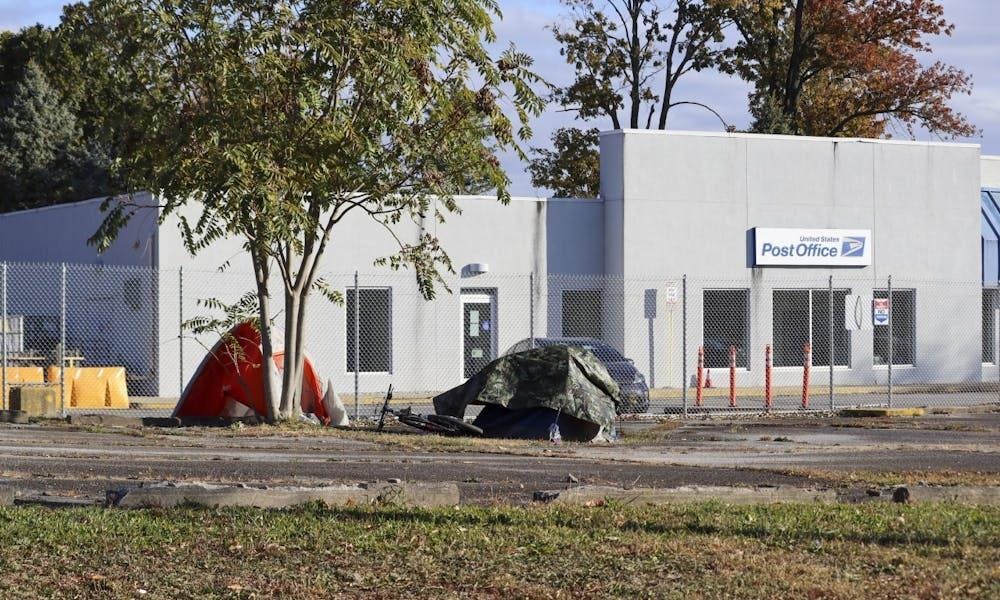
The number of people experiencing homelessness during a single night in Monroe County in 2025 has reportedly decreased by 12.8%, according to the Indiana Balance of State Continuum of Care 2025 Point-in-Time Count report.
This marks the first decline in recorded cases of homelessness for the county since 2022, despite changes to the data collection that could have increased the number of people surveyed.
The Indiana Housing and Community Development Authority helps organize the annual PIT Count and is carried out by a combination of staff and volunteers. The staff survey individuals experiencing homelessness, both sheltered and unsheltered, during the final days of January. An IHCDA slideshow shows that Indiana’s data last year was undercounted.
Some unsheltered PIT data was not entered properly into the Homeless Management Information System, leading to underrepresentation of individuals experiencing homelessness. Additionally, previous PIT reports did not include specific counts for the unsheltered chronically homeless population.
The U.S Department of Housing and Urban Development defines the unsheltered chronically homeless population as people with a disability who live in a place not meant for human habitation and has been homeless for at least 12 months on four separate occasions in the last three years.
Both of these problems were fixed for this year’s collection, according to the IHCDA the latest data was taken on Jan. 29, 2025. It showed that Monroe County had a total PIT count of 305 people experiencing homelessness— 45 people fewer than in 2024.
However, Indiana’s overall PIT count increased. This year, the state reported 4860 individuals, 255 people more from the previous year.
Monroe County reported the highest recorded number of individuals experiencing homelessness in a single night among all counties in its region. This includes Green, Lawrence, Martin, Morgan and Owen County. Lawerence County had the second-highest count, with 68 individuals.
Just over 20% of those experiencing homelessness in Monroe County were children under the age of 18, making them the largest demographic group representing the county’s PIT count.
According to the IHCDA, the report is intended to support communities and local agencies in planning and allocating resources to address the future needs of unhoused individuals.
Forrest Gilmore, executive director of Bloomington-based antipoverty organization Beacon, said the city shouldn’t see this decrease as a major change.
“It isn’t significant enough in terms of the actual numbers,” Gilmore said. “I think if we see a long-term pattern, I’d be pretty excited about that.”
Gilmore said he believes this decrease could have been caused by PIT Count number errors. However, he also said this could be the start of a “really serious downward trend and pattern.” To assess this, Gilmore said the county needs more data over time.
Heading Home of South Central Indiana, an organization working to strengthen housing security and decrease homelessness, provides a data dashboard on their website. The site’s data comes from the HMIS in Monroe, Morgan and Lawerence counties.
One piece of data collected is the active number of people in a selected population who are homeless. The graph includes the single active homeless number for all single adults age 25 and older who are experiencing homelessness.
According to the dashboard, there were 575 people, single adults 25 and older, actively homeless in January across the three counties. This number saw a steady decline and dropped to its lowest this year in April, with 454. Since then, the counties have seen a steady increase.
Gilmore said that a downward trend over the next three to five years would give Monroe County an indication that things are changing for the better. Until then, the county still needs to work towards aiding those in need.
“The biggest challenge, not only in our community but across the country, is that when you have a housing affordability issue, you have a homelessness issue,” Gilmore said. “Until we address that, we are going to have a serious homelessness issue.”
CORRECTION: This article has been updated to correctly identify the lack of specific counts for the unsheltered chronically homeless population in previous PIT reports.