
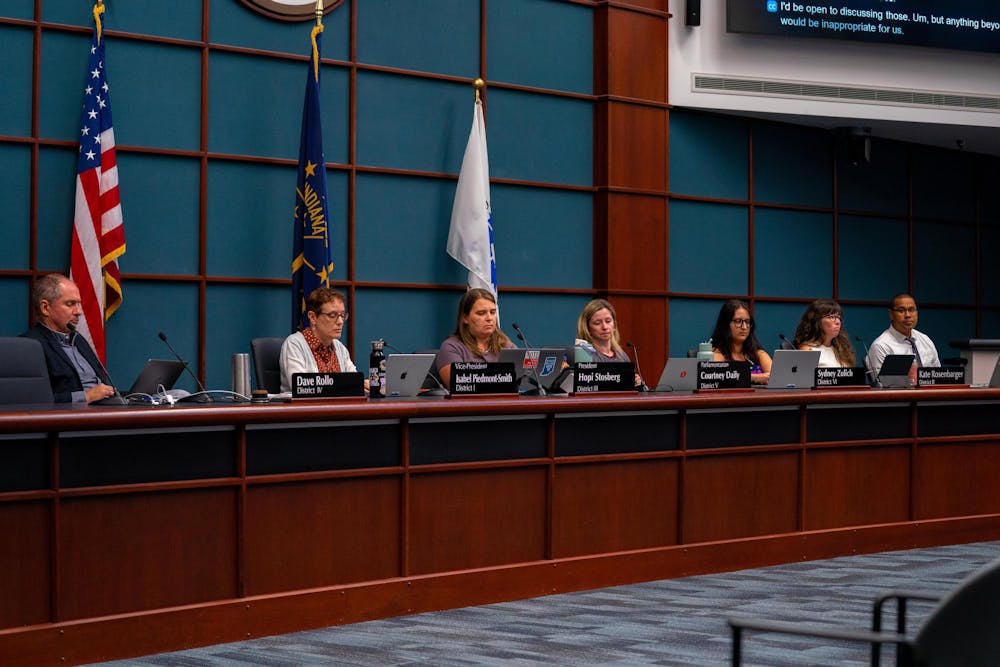
The Bloomington City Council spent much of Wednesday’s meeting addressing the city’s recently-announced plan to end the Kirkwood Avenue Outdoor Dining Program that closed Kirkwood Avenue to vehicle traffic from April to November.
Councilmembers unanimously approved an amendment to the outdoor dining ordinance last year. The amendment supported closing the street entirely and allowing businesses to apply for either full use of the street or “parklets,” which are parking spots converted to outdoor restaurant seating.
This year, however, staff from the Department of Economic & Sustainable Development recommended the street stay open to vehicular traffic year-round, citing a decrease in visitors, with average daily visits down 8% from 2024 to 2025 despite a 57% increase in event activity.
“This tells us that street closures alone are not enough to support consistent vibrancy, and that thoughtful activation and infrastructure improvements have a greater impact,” Chaz Mottinger, the special projects manager for the Department of Economic & Sustainable Development, said.
Mottinger said the city does not have the staff capacity to support event programming continuously if Kirkwood remains fully enclosed. Additionally, parking revenue loss because of the closure is estimated to be $80,000 a year.
“Seasonal closures provide value, but they expose limitations of temporary infrastructure and limited city resources,” Mottinger said.
City staff recommendations for Kirkwood in 2026 include continuing to support large festivals downtown, enhancing parklets to create more restaurant seating and preparing for a proposed 2027 corridor study of Kirkwood.
Council Vice President Sydney Zulich asked Mottinger, Department of Economic and Sustainable Development Director Jane Kupersmith and other city staff if they would plan to close Kirkwood for Indiana University home football games, to which they responded that this had not been considered yet.
Section 7 of Ordinance 2025-02, which established the program in January 2025, allows for it to be permanently or temporarily suspended by the city engineer in case of emergency, lack of participation, or any reason that “may render the program impractical.” Councilmembers Kate Rosenbarger and Matt Flaherty both said the decision was an overstep.
“Even if it doesn’t violate the letter of the ordinance, it certainly violates the spirit in my mind,” Flaherty said. “And that’s not the first time that’s happened under the Mayor Thomson administration.”
Councilmember Hopi Stosberg said she was concerned about reopening the street now that many Bloomington residents may assume it is closed.
Bob Costello, president of Kirkwood Community Association, expressed disappointment that the city was closing the program just a year after passing an ordinance to make it permanent. Costello said the goal of the program was to give business owners time to invest in an outdoor environment for the community.
“Once again, we are here in February talking about whether we are going to keep this open or closed,” Costello said., “And I feel like it was disingenuous of the city administration to enter into that agreement last year only to come here this year with engineering issues that they think they need to implement in order to close the street.”
Costello also said KCA did not receive a memo from the city about plans to close the program ahead of Wednesday’s city council meeting.
During public comment, Nathan Petrie, who works part-time as an Uber driver, echoed concerns about how the city only shared information about plans to close the program on social media days before the meeting.
Petrie said the program made the area around Kirkwood safer.
“You guys would know that Kirkwood and Dunn is a very, very busy intersection, and the street closure does nothing but help me when I’m dropping students off at the bars,” he said.
Council President Isak Nti Asare said since it’s “clear that we want to continue having conversations,” the council may plan to discuss possible actions regarding the change in deliberation sessions.
Before the Kirkwood Avenue discussions, councilmembers addressed nationwide concerns about how U.S. Immigration and Customs Enforcement has detained children, including recently released 5-year-old Liam Conejo Ramos, in immigration facilities. Stosberg commended the students at Bloomington high schools who have protested ICE’s presence in Minneapolis.
Last Friday, Bloomington residents protested the city’s use of 40 Flock Safety surveillance cameras. Protestors and the American Civil Liberties Union allege the license plate readings are being used by ICE.
“In this national context of creeping fascism and increasing loss of personal liberties, I don’t think the city should continue its contract with Flock,” Councilmember Isabel Piedmont-Smith said.
Several residents brought up the recent snowstorm during public comment. Bloomington resident Greg Alexander said he was dismayed at the state of the sidewalks a week and a half after the snow stopped.
Another resident, Paul Rousseau, said the city cleared roads faster and better than it cleared the sidewalks, creating difficulties for pedestrians.
The council also approved appointment recommendations from the Board and Commission Interview Committees, as well as the mayor’s appointment recommendations for the Historic Preservation Commission.
It also passed Ordinance 2026-01, an amendment to the Unified Development Ordinance that aims to increase the maximum amount of impervious surface coverage from 50% to 80%, in a 6-2 vote. The increase is meant to increase the number of affordable housing lots created.
Vice Chair and Treasurer of the Bloomington Environmental Commission Matt Caldie spoke on behalf of the commission to express concern that allowing for more impervious surfaces, such as roofs, driveways and sidewalks, could negatively impact the environment by harming tree canopy health, increasing the heat island effect and leading to floods.
The amendment was delayed after the last council meeting Jan. 14 due to a technicality in the wording that Mayor Kerry Thomson worried would make getting a mortgage harder.
Editor’s note: Chaz Mottinger is a former staffer of the Indiana Daily Student.


