
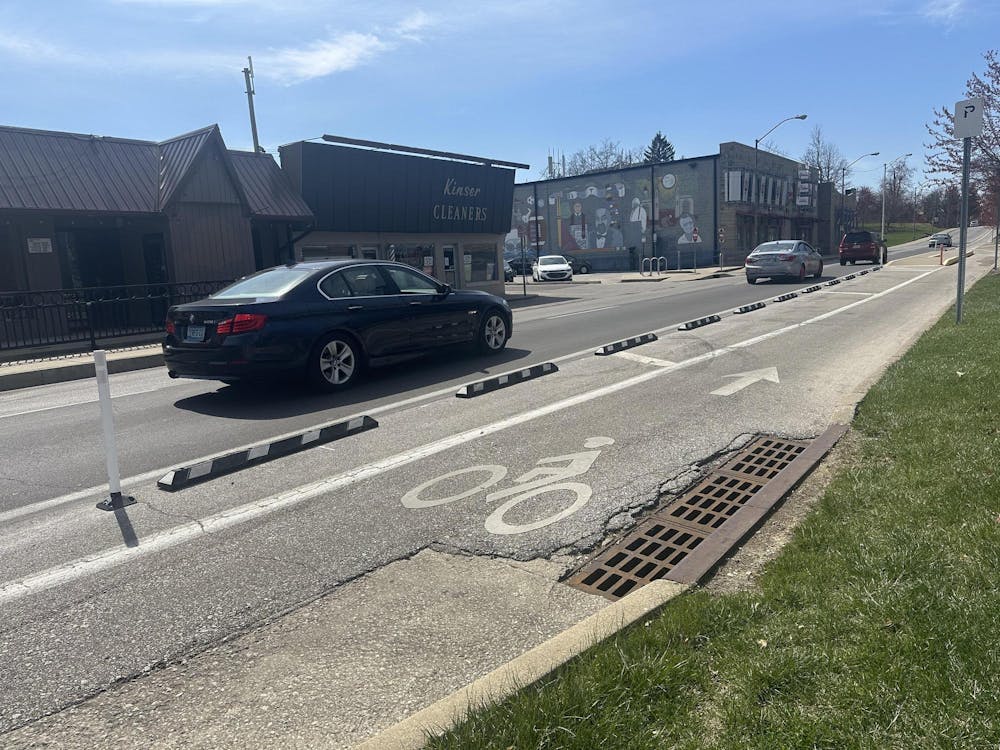
Last year, second-year IU student Gabe Herrera was riding his bike down a designated bike lane on Woodlawn Avenue. This wasn’t unusual for Herrera, as he bikes daily to commute and run errands.
But this time, a Republic Services garbage truck turned directly in front of him, splitting his bike in two and forcing him to roll out of the way to avoid serious injury. Herrera said his bike was unrepairable and he later received $3,000 in compensation from Republic’s insurance.
Bloomington’s working toward fewer stories like Herrera’s. The city’s ambitious goal is for zero fatalities and serious injuries caused by traffic accidents, as seen in the city’s Safe Streets for All Action Plan, adopted in 2023.
Part of that effort is through its 2025 Local-Motion Grant Program, which provides funding for community projects aimed at improving walking and biking infrastructure. The grant’s applications are open until Nov. 3, and as of Oct. 24, one has been received.
Run in partnership with the city’s Transportation Commission, the project offers grants of up to $2,400 per project to nonprofit organizations, neighborhood associations and local businesses.
The program funds "creative and impactful” ideas that encourage residents to walk and bike more while building awareness about alternative transportation options.
Hank Duncan, the city’s bicycle and pedestrian coordinator, administers the grant program and helps applicants develop their proposals. He encourages anyone with an idea to apply, noting the criteria is intentionally broad.
“If it's an idea that helps promote walking and biking in our community, they should apply.” Duncan said.
The program operates on an annual cycle, with each typically lasting about one year from application opening to project completion. Through a Google Form, applicants must outline their proposed project with milestones, explain how it will benefit the community, provide a detailed budget and include a timeline for completion.
Once applications close Nov. 3, the city’s Transportation Commission will review and select this year’s projects. Applicants will then pitch their ideas to the Transportation Commission at its Nov. 17 meeting. Grant recipients are expected to be announced later that week.
At least $2,400 is available this year, but total funding could increase depending on the number of strong applicants. Eligible applicants must provide at least a 10% cash match, which can come from their own budget, donations or other funding sources and are limited to one proposal per cycle.
Interested applicants can review detailed program guidelines on the city’s website and submit proposals online.
2024 grant participants have launched various projects throughout Bloomington. My Sister’s Closet of Monroe County, a non-profit that helps women with job training and provides professional clothing, used the money to create a bike rack featuring the words “equality” and “freedom”, dedicated to suffragettes who rode their bikes as they campaigned to pass the 19th Amendment.
The Boys and Girls Clubs of Bloomington, a youth development organization serving children from low-income families, expanded its Club Riders program. This program teaches youth how to ride bikes and bicycle safety and promotes healthy lifestyles.
In 2023, The Monroe County Public Library used grant funds to refresh its StoryWalk collection, adding new illustrated children’s books to outdoor paths where families can read while walking through parks. Each page is laminated and displayed in a frame along the route, with icons suggesting activities such as talking, singing, reading, writing and playing.
Craig Medlyn, safety coordinator for the Bloomington Bicycle Club, said his group often works with the city on bike safety initiatives. He said programs like the Local-Motion grants show how Bloomington is using community partnerships to expand that work.
“The city is highly committed to furthering the enjoyment of cyclists as well as pedestrians,” Medlyn said. “It’s another example of how dedicated the city is to furthering pedestrian and cycling safety.”
Medlyn said the club focuses on building a “culture of safety,” offering weekly group cycling outings and safety education for both new and experienced cyclists. While the city has invested in bike infrastructure, he said awareness and visibility remain two of the biggest safety issues on local roads.
“Bike lights on the front and bike lights on the back are really important,” Medlyn said. “Visibility is really key.”
Herrera’s close call highlights another big problem he has with current bike infrastructure: lanes often lack proper separation from traffic, leaving riders dangerously close to cars.
“Paint is not going to stop a car,” Herrera said. “I don’t feel safe even riding in a bike lane because I’m literally one foot from a car that, if they turn just a little bit, I’m done.”
Herrera suggested the city could learn from other university towns, like West Lafayette, by creating more pedestrian-only streets. He pointed to 10th Street between the Kelley School of Business and Herman B Wells Library.
Herrera said that during certain times of the day, walking through that area becomes nearly impossible and that pedestrians face numerous obstacles. Despite these frustrations, Herrera said he appreciates that Bloomington is taking steps to address cycling and pedestrian safety, including programs like the Local-Motion grant.
“Really all these things come down to infrastructure and how these systems are created, how they’re set up,” Herrera said. “I hope that this would be a step in the right direction towards pedestrian safety.”
Duncan said the city is improving infrastructure but also needs to shift community culture around transportation safety, including driver behavior toward cyclists and pedestrians.
“These people who are affected by the severe and fatal crashes, they aren’t just numbers on a page,” Duncan said. “When somebody gets hurt, we all get hurt.”
Duncan said changing that culture requires collaboration across the entire community.
“We can’t act alone,” Duncan said. “We need community support, we need support from the public, from businesses, from nonprofits, from IU.”


