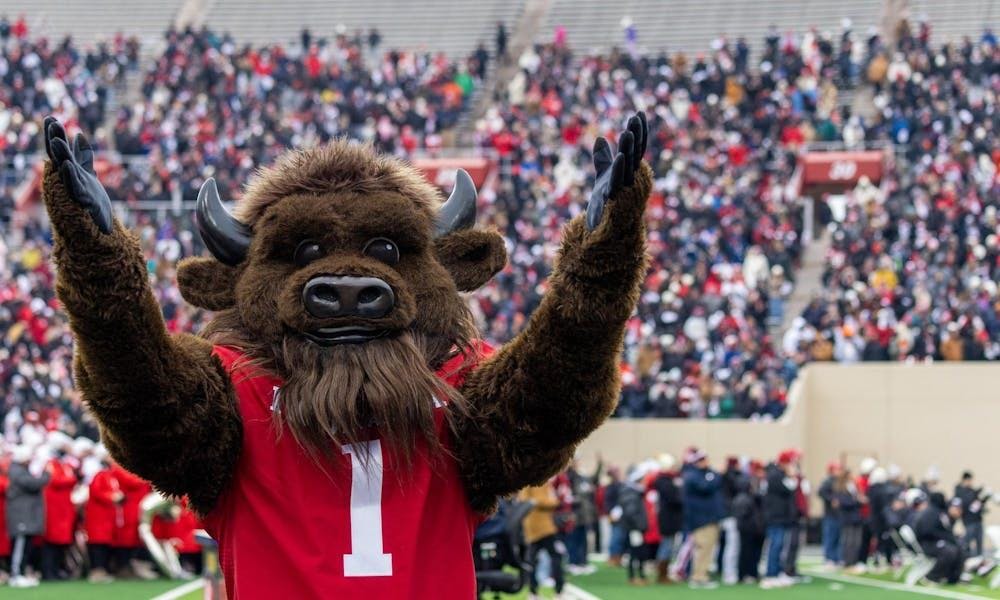
Indiana football has completed one of sports’ most historic, shocking and inspirational stories. I expect forthcoming movies and documentaries to convey how this team encompassed the entire range of what attracts us to sports. In the meantime, it is worth considering precisely what this championship means for the university and broader Hoosier community.
As someone who studies the relationship between sport and communities — and as a neurotic football fan — colleagues and friends alike have asked me how football championships benefit a university. The most truthful answer is: They can bring vast benefits, but universities usually fail to fully capitalize on their championship moment. Indiana has the opportunity to forge a new path.
In terms of sheer numbers, it is true that athletic success yields unprecedented economic value for universities. IU will receive a direct award of $20 million from the NCAA for winning the National Football Championship. Yet this one-time check pales in comparison to longer-term forms of compensation IU will enjoy: surges in ticket sales, merchandise sales, concession sales and even tourism to Bloomington. The indirect benefits tied to branding and media exposure are even more exponential. Studies show that a football championship victory often leads to increased application rates, increased alumni donations, and even increases in college prestige rankings for universities.
It appears that IU is experiencing such benefits. Fall enrollment and application rates are up 9.3%. Midway through the 2025 season, IU athletic director Scott Dolson shared that “ticket sales are up 50%... our concession sales are double what they were 2 seasons ago... The overall income just around football is more than doubled.” Even prior to the national championship, IU Columbus associate finance professor Dr. Ryan Brewer told Inside Indiana Business that each football game creates $9 million in economic impact, football viewership is up 175% in two years and IU’s total revenue is up about 40%.
These figures are often invoked to suggest that collegiate athletic success naturally trickles down to the broader university community. As captured most succinctly by the popular “What a time to be a Hoosier” T-shirts, the outside assumption is that the academic faculty, student and staff experience at IU is just as vibrant and thriving as the athletic experience. The reality, however, is far more complicated. Rather than being imagined as a rising tide that lifts all boats, a more appropriate metaphor for IU’s national championship is one of a life raft that, improbably, comes along to rescue an academic community on the verge of drowning.
In most cases, the benefits accrued from athletic success are not enjoyed by all. They are instead cycled right back into what’s been termed the “collegiate athletics arms race.” Amid an increasingly-competitive higher education landscape, where the economic survival of so many universities is contingent upon maintaining a brand as a football or basketball powerhouse, administrators feel pressure to dedicate resources to what they believe will attract top athletic talent and project an image of athletic legitimacy.
As a result, rather than championships bolstering Student Success and Opportunity, Transformative Research and Creativity and Service to Our State and Beyond — to quote the three foundational pillars of IU’s 2030 Strategic Plan — resources are instead disbursed on even more million-dollar Name, Image and Likeness payments, coaching salaries that rival those of professionals, state-of-the-art practice facilities and other luxurious new athletic amenities designed to dazzle recruits. In other words, the benefits of “champion status” are often spent on the Sisyphean task of maintaining it.
Without a doubt, a “perfect season” requires remarkable dedication and a bit of magic. But IU’s ascension atop the college football pyramid must be understood as the result of similar financial investment.
IU has committed more than $90 million to stadium upgrades over the past 16 years. In 2024, IU spent more than $61 million on football in 2024, well above-average for the Big Ten, college football’s top conference. Halfway through the 2025 season, when a championship was hardly on the horizon, IU renegotiated head coach Curt Cignetti’s contract, granting him an eight-year, $93 million extension (with room for more) that effectively made him highest paid coach in college football — and the highest-paid public employee in the state of Indiana. Members of Cignetti’s staff also signed contracts that made them among the highest-paid assistant coaches in the country. To be fair, these eye-popping numbers are quite common, if not mundane, in the cutthroat business of college football and its surrounding athletic industrial complex.
The collegiate athletics arms race explains why numerous studies show that, while winning a football national championship often significantly boosts undergraduate admissions applications and leads to higher public perceptions, it typically does not translate to better academic quality. Other studies suggest that athletic success actually leads to worse academic outcomes.
For IU faculty and staff, this paradox hits close to home. The unfortunate reality is that a new golden age of Hoosier athletics has occurred alongside a period of devastation of Hoosier academics. The implementation of unprecedented budget cuts of over $100 million has coincided with the closure or merger of roughly 250 academic programs across IU campuses. Additional hurdles to hiring staff have resulted in a drastic reduction in the operational capacity of the programs that allow IU to serve our students and the community. Faculty and graduate students have lost over $68 million in crucial grants and fellowships in the past year that have forced them to discontinue world-changing research, teaching and service.
These bleak trends of academic frugality culminated in the recent controversy over the Indiana Daily Student, in which the paper’s financial deficits were cited for the (now-reversed) decision to eliminate the print edition after 158 highly-decorated years.
One might be tempted to point out the striking juxtaposition of the academic community being forced to tighten its belt while the IU athletic community continues to feast with extravagance.
At the same time, I do not find it productive to treat athletics and academics as if they are naturally separate, competitive entities. Instead, Indiana has a chance to model an athletic-academic synergy that other universities will replicate. This will require the IU budgetary distribution to reflect the collaborative community ethos so often espoused by President Pamela Whitten, Cignetti and other university leaders.
In an open letter to the “Hoosier Nation” following the national championship, President Whitten remarked that “this victory is one for all of us... While football has been center stage, it is just the tip of the iceberg of IU’s excellence. At IU, our faculty, staff, and most importantly, our students are constantly pursuing championship-caliber success.” President Whitten could not be more correct in placing the broader IU community at the foundation of IU’s athletic success.
It is the faculty, continuously finding ways to do more with less, who set up players for success after football. It is the alumni base, whose donations were critical for supporting athletics and creating a competitive reserve of funds to attract Heisman winner Fernando Mendoza and other star players. It is the IU fans, who spent their limited time and money to travel to Los Angeles, Atlanta and Miami and, according to Cignetti himself, gifted the team a significant advantage that helped them achieve the impossible. It is the IU media and athletics staff, whose work positioned IU as a world-class athletics destination even before it was one. It is the Bloomington community that invites athletes to our community and shows them so much love that they refuse to leave.
In the coming weeks, IU will decide how the benefits reaped from the championship will be distributed. The entire IU community — students, fans, faculty and staff — must be not only included, but centered, in these conversations. Their championship-caliber performance must also be rewarded with championship-caliber investment. Rather than reflexively feeding the collegiate athletics arms race, Indiana has been given a rare chance to revitalize its Three Foundational Pillars that are at risk of crumbling. By breaking the cycle, IU can demonstrate a “bold, ambitious future” where universities can serve as both an athletic powerhouse and an academic powerhouse.
Dr. Brandon T. Wallace is an Assistant Professor of Cinema and Media Studies in The Media School. He studies what sport can tell us about our culture, our communities and ourselves. Dr. Wallace is completing his first book, titled Beyond a Kneel: How Social Movements Harness the Power of Sport.