Two years ago, the area in Crestmont Park along 13th Street was an empty grass field. Now, rows of tree saplings are sprouting.
Volunteers with Bloomington’s Urban Greenspace programs lined up and planted tree seeds across a patch of land next to the parking lot, spaced every two feet, retired forester Ray Major said. They repeated that process seven times across three city parks.
The taller saplings are now over five feet tall.
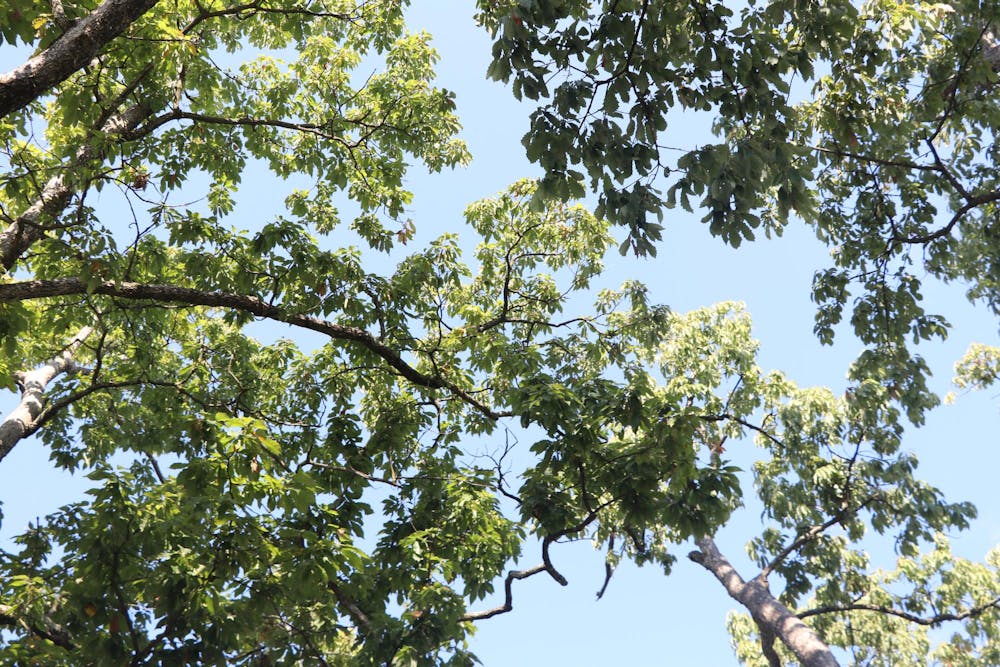
The Urban Greenspace volunteers planted these trees to supplement Bloomington’s tree canopy. In 2019, a report by Davey Resource Group found Bloomington’s canopy covered 38% of the city out of a possible 61%. The canopy heavily mitigates the city's water pollution by diverting rain from polluted surfaces like sidewalks and gutters while also improving air quality by absorbing air pollutants and carbon emissions.
That canopy is under increasing strain. Some neighborhoods are losing trees due to development, Ava Hartman, director of local nonprofit CanopyBloomington, said. Other trees die off due to disease or invasive bugs, including the emerald ash borer, which eats and kills ash trees.
Bloomington Urban Forester Haskell Smith said the city’s maple trees have been declining due to worsening periods of drought, while rainy springs are damaging the health of pine trees.
Smith also said residents frequently tell him they can’t keep up with the costs of planting or managing trees.
This is the first year of the Parks and Recreation Department’s Tree Assistance Program, which arranges tree care for qualifying Bloomington homeowners. The program plants trees and prunes or removes and replaces high risk trees, such as dead, damaged or invasive trees.
The city will pay a percentage of these service costs up to a maximum amount based on income. The maximum cost covered for tree removal or mitigation is between $1,500 and $2,500, while tree plantings are capped between $270 and $450.
Applications for the program close Oct. 1, and work will begin in spring 2026.
CanopyBloomington also works to reduce the costs of tree ownership by arranging volunteer-led tree plantings. Neighborhoods or residents can reach out to CanopyBloomington to request a planting in their area.
CanopyBloomington chooses planting areas based on its priority map, which outlines areas based on their environmental impact on soil and water quality and the social metrics of the neighborhood, including income, population density and racial demographics.
Once an area is selected, Hartman said members attend neighborhood meetings, host potlucks and go door to door to offer nearby residents the chance to get a tree planted in their yard.
CanopyBloomington has neighborhood plantings scheduled for Oct. 18 in the Waterman neighborhood, an Oct. 25 planting at the Near West Side neighborhood, and a Pigeon Hill neighborhood planting Nov. 8.
The plantings usually last about four hours, and volunteers are taught how to plant a tree, Hartman said.
“Residents and volunteers are working together to get those trees in the ground, and then at the end we have a little celebration,” Hartman said. “So, we'll have music and food and people just talk and have a good time.”
At Crestmont Park, volunteers gather every Monday for a Weed Wrangle, where Major said they cut weeds and layer the stems around the base of the seedlings.
Major said this smothers any weeds that would grow around the trees’ base and boosts the nutrients and moisture in the soil, serving as a natural, free mulch.
“Many people regard such a mulch as not very pretty,” Major said. “So people may or may not want to do it in their lawns. But the point is, it works. The material was here and readily available.”
Major owned a tree farm in southern Indiana for 45 years before retiring to Bloomington. Now he shares information on tree care through the Facebook page Trees from Seed and teaches volunteers with the city’s Urban Greenspace programs how to plant trees from seeds instead of using nursery-grown saplings.
Bloomington's Parks and Recreation Department provided cages for the saplings at Crestmont Park to keep deer from eating the tops of the leaves. At about $5 for a small cage and $30 for a six-foot cage, Major said the cages were the most expensive part of the process.
Nursery stock trees, or pre-grown potted saplings, can cost several hundred apiece, Major said. Once planted, because their roots are still embedded in their potting soil, they can struggle to pull nutrients and moisture.
Major said it can take longer to see results with trees planted from seed, and the seedlings require a specific kind of care. But planting this way can save money for homeowners and help restore city canopies at a time when federal cuts are impacting funding for parks departments and environmental nonprofits nationwide.
Major said one of the biggest barriers to planting trees this way is convincing landscapers and city residents to give the seedlings time to grow.
“That's the hurdle to overcome, is instilling enough faith and patience in people to plant them,” Major said.