
EDITOR’S NOTE: This story includes mentions of triggering situations, including violence and sexual violence.
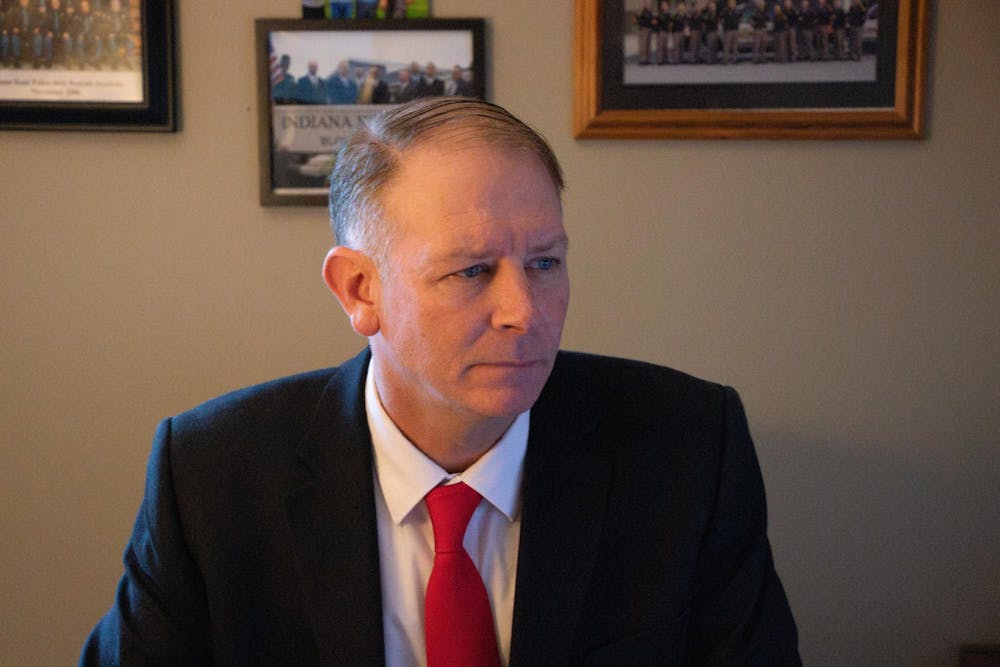
Bradley Stille, 49, had only been asleep for about an hour when he got the call. Every time his phone rings late at night because of a violent crime, his wife wakes up with him.
“It’s going to be a while before I get back,” he tells her.
It’s after midnight. She packs him a cooler — crackers, a beef and mayo sandwich on white bread and Diet Mountain Dew.
It’s a ten-mile drive from his home in Bloomfield to Linton, where a trailer home has been set ablaze. He gets out of his car when the street ends in a blockade of firetrucks, ambulances and police cars. The entire area is taped off.
Smoke, steam and the smell of a burnt residence are thick in the air. The fire is mostly out by the time he gets there, but certain areas have rekindled. Responders found a man dead inside the trailer with cuts to his neck and shoulder. They pulled him out of the fire before evidence could burn away.
Stille calls two other Indiana State Troopers and asks them to come out and help him with the case.
“It looks like we have a homicide,” he says.
It doesn’t matter that it’s early on a Sunday morning in June. They’re all used to the sleep deprivation.
***
For Stille, the most fulfilling part of the job is putting the handcuffs on. That’s worth more to him than any paycheck.
As the District Investigative Commander of District 33 for the Indiana State Police, Stille is the one who oversees all of the investigations in the Bloomington district.
Police work, the uniform and the clean police car, had been a childhood dream of his. As a kid growing up in Ellettsville, he always looked up to his uncle, who worked as a police officer in Kansas.
But Stille’s path to being the one with the handcuffs wasn’t linear.
After graduating from Edgewood High School, Stille worked in construction for a few years and joined the volunteer fire departments in Owensburg in 1997, which eventually led to an EMT job in 1999.
While Stille worked as an EMT until 2001, police officers would stop by the firehouse where the ambulance was stationed and work out or shoot baskets with him. Stille started grabbing lunch and dinner with them.
He spent more and more time with the deputies, seeing their camaraderie, the brotherhood they seemed to be a part of and hearing their stories of arresting people who hurt others. That drew him in.
So he took a deputy position at the Greene County Sheriff’s Department in 2001. In 2006, he transferred to the Indiana State Police via a lateral academy program. He started out in enforcement for about two years, doing traffic enforcement, helping motorists and backing up county or local officers, but there was still something missing.
“Writing speeding tickets was never satisfying to me, and the uniform’s somewhat uncomfortable,” Stille said.
Stille switched over to be an investigator and has been there ever since.
“Investigations, (are) always where my heart is,” Stille said. “Putting those who commit crimes against other people in jail, taking them out of society and making society safer.”
***
While the Linton Police Department is canvassing the area around the trailer home, Stille stays at the scene. The victim’s sister arrives, and he asks her if anyone else lived inside.
She says sometimes friends stopped by, but her brother lived alone. Stille tells her that the police believe her brother may have died, but they can’t confirm that it’s him yet.
Death notifications are one of the worst things officers have to do. They’re difficult, awkward, sad and unpredictable.
LPD finds a man walking around near a Sunoco gas station the same day. They take him into the station for questioning, while Stille coordinates with the LPD to pull video surveillance from the gas station.
The man, Brandon Criss, was first seen in the Sunoco footage with another woman around 11 p.m. on the night of June 7, according to a probable cause affidavit associated with the case. He returns about 20 minutes after midnight, alone. He takes his jacket off and looks visibly upset, like he’s crying. There’s a large knife attached to his belt line.
When they bring him in for questioning, his brown boots are stained red.
***
Stille tries to make his office homey.
Photos and awards decorate the walls, and a small fireplace lights up one corner of the room. He spends around 60 hours a week, at a minimum, at the Indiana State Police station off North Packing House Road.
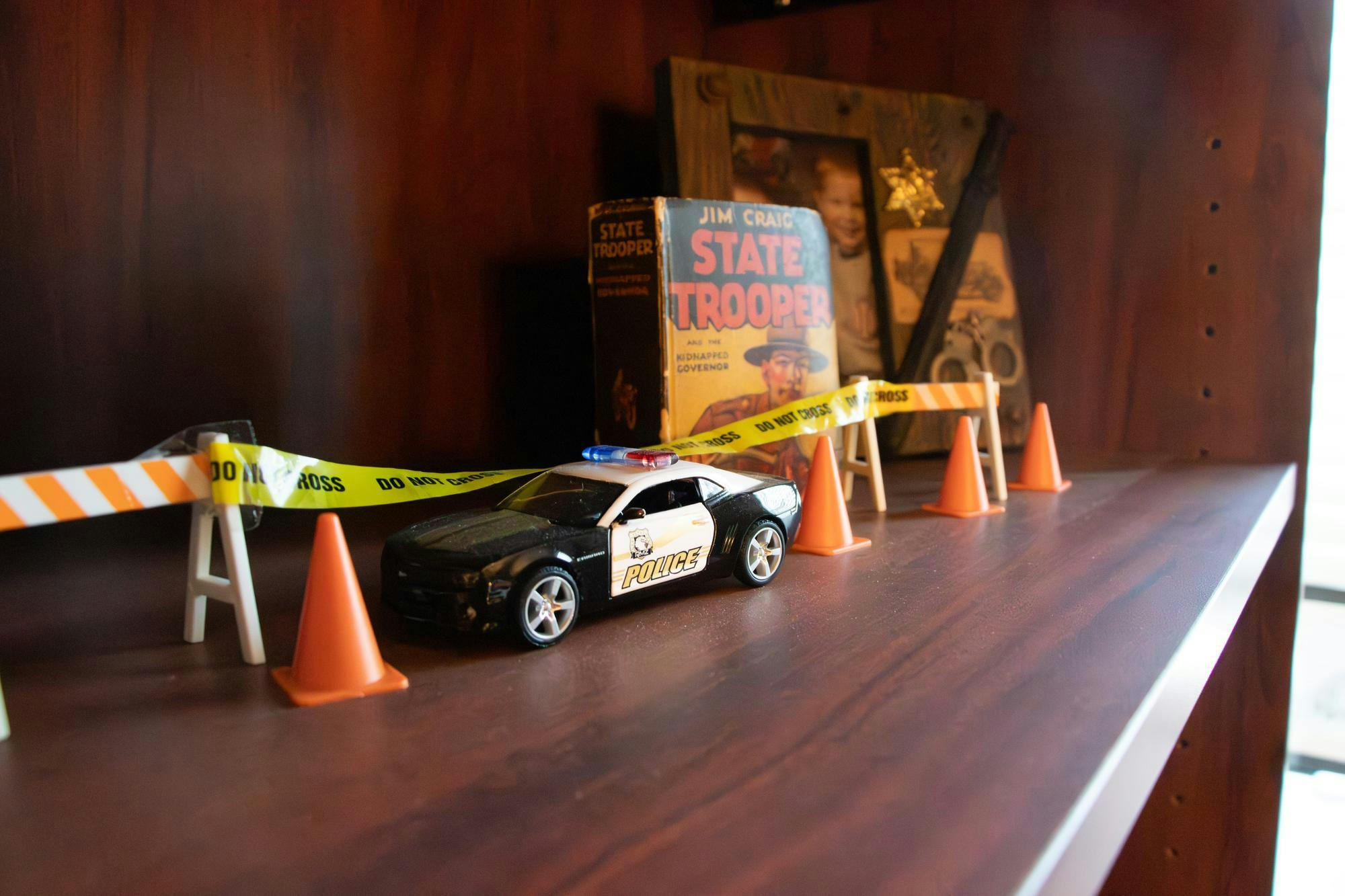
A toy police car and police tape are arranged on the shelf in Bradley Stille's office Jan. 29, 2026, at the Indiana State Police station in Bloomington. He's been with the ISP since 2006.
His phone starts ringing at 8 a.m. and doesn’t stop until late at night. On the other line are detectives and troops who call asking for advice on their investigations.
“We try to sit down and watch TV, and it’s ringing at 10 or 11 at night,” Stille’s wife, Grayson, said. “It’s constant for him. There’s always, always something in the general public.”
Whether the investigative arm of the ISP takes a case or not is up to Stille. High-profile crimes like child molestation, rapes and homicides within the six counties he covers go straight to the five detectives working at the station.
Child abuse instances cover the majority of their caseload, and at any time, each detective will be working on nearly twenty active cases.
“When the phone rings and you have cases like these, it is the worst time in those people’s lives, that family, that victim,” Stille said. “That’s what we live for, is to help them and to rectify and to find out who did this.”
Grayson said sometimes, her husband will be called out and she won’t see him for a while. Once he was away for almost two days, she said. She texts him if a couple of hours go by without any word, and he keeps her updated.
“All good,” he’ll message back.
They met at the “Lonely Night Saloon,” a bar in Crane, Indiana. They played pool, and he was impressed that she was able to beat him more than once. They’ve been together for six years and married for three.
Like all cops’ wives, she said, she sometimes worries for him.
“The stuff that they have to see with their own eyes in person, it’s hard enough hearing about it,” Grayson Stille said. “But knowing that they had to see it is difficult.”
When Stille’s doing investigative work, he said he doesn’t stop and think about how bad the situations are, the death and violence that he’s constantly exposed to. He had to learn how to leave his work at the station.
“You go home and you play with your dog, you know, you go kayaking with your wife, or throw a baseball with your boys,” Stille said. “You just try to shut if off and just know that you did everything that you could.”
In recent years, Stille thinks the profession has suffered due to the media and political landscapes after the murder of George Floyd in 2020. There are 14 people in the ISP academy graduating from the lateral class in 2025.
The picture of Stille’s 2006 ISP academy graduating class on his office wall shows over double that number. The low rates of incoming troopers make it difficult to cover those who retire.
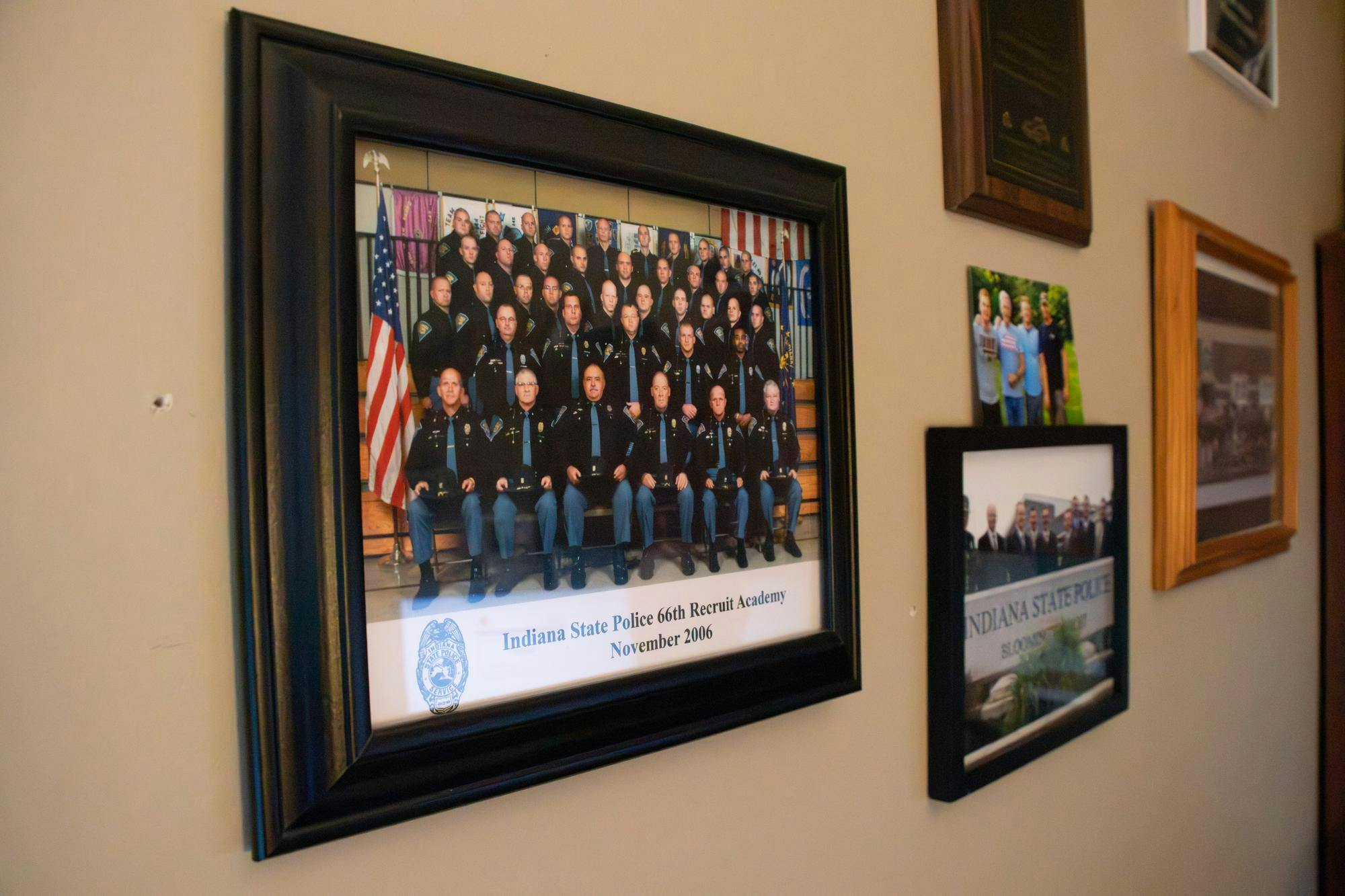
A framed photo of Bradley Stille's graduating class hangs on the wall behind his desk Jan. 29, 2026, at the Indiana State Police station in Bloomington. It's been harder to recruit new troopers in recent years, Stille said.
He said he wishes people could see that, despite the profession’s “bad apples”, police don’t want those kinds of people to be a part of their departments and are there to help.
“We’re proud that we help people, whether it’s you have a flat tire on the side of the road and we can stop and help change it, or if somebody were to commit an act of violence against you or hurt you,” Stille said. “We’re here.”
Two separate sanity evaluations were filed for Criss in September and December last year. In September, he filed an amended pleading and a list of witnesses, exhibits and defenses. The first pretrial conference occurred Jan. 14, with a second scheduled for March 3.
***
Criss sits in the LPD interview room June 8, his hands handcuffed behind his back. He wears blue jeans, a white tank top, a brown belt and a necklace. He waives his Miranda Rights and agrees to talk with the ISP.
The trooper asks him where he was on the night of June 7 and the early morning of June 8, according to an affidavit. He says he got into an argument with his fiancée that night and he walked to the residence of a woman with whom he said he had been cheating on his fiancée for a while.
Criss says he left her house and on his way back, the LPD arrested him.
“To get into your phone, do you have a passcode or something?” the trooper asks.
“0512,” Criss responds immediately.
The trooper leaves to get a search warrant for the cell phone. In the meantime, Criss waits in the interview room. He takes several trips to the bathroom, and the police offer him water. They make sure his handcuffs aren’t too tight.
Meanwhile, Stille is in the big conference room of the police department. He had been periodically updated by the other troopers on their progress. While Criss was being interviewed, another witness shows Stille a photo that Criss had allegedly taken.
It’s a picture of the dead man in the trailer, in the same position the first responders found him in. He's naked and covered in blood, lying between the shower and the toilet.
The person holding the phone wears a pair of red-stained brown boots.


