

In a wooded backlot south of the Indiana University Auditorium bees buzzed around a patch of white wildflowers.
Starting in the fall of last year, ReWild IU, a club that restores wild areas on campus, cleared this area of the invasive species that once inhabited it. Before, dense shrubbery and vines choked the underbrush. Now native plants, like orange jewelweed and white snakeroot, are sprouting up in the cleared-out areas, feeding bees and other pollinators.
“Before this was straight bush honeysuckle, almost to the edge of this wetland,” ReWild IU President Ethan Iversen said.
At six to 15 feet tall, Asian bush honeysuckles grow thick enough to block out sunlight, according to the Indiana Department of Natural Resources. They overrun fields, forest edges, roadsides and wetlands, crowding out native species and preventing tree growth.
When invasive species crowd out native plants, they can swarm forest floors, wetlands and waterways, causing local wildlife to lose habitat and insects and birds to lose access to food sources.
The woodlot was also crowded with invasive species like common privet, purple wintercreeper, European buckthorn and European cranberry bush, Iversen said.
At first, most invasive species are planted intentionally, Gillian Field, Bloomington’s Urban Greenspace outreach coordinator, said. Gardeners often buy non-native species for aesthetic purposes, or because bugs don’t eat them.
But when bugs or herbivores can’t eat a non-native species, that allows the plant to spread unchecked, Field said. With evolutionary advantages, introduced species can spread into the wild, where they outcompete native species.
“Because it evolved to a different ecosystem, a lot of times invasive plants have, like, a crazy leg up here,” Iversen said.
Some plants, including Asian bush honeysuckle, keep their leaves longer into fall and winter than native plants. Many invasive shrubs block out sunlight, creating a monoculture that prevents native plant growth.
With the City of Bloomington’s Parks and Recreation Department, Field organizes volunteer events for getting rid of invasive plants on public property. These include the Adopt-A-Greenspace program, where volunteers manage greenery and eradicate invasive plants in an assigned plot of public land, and Weed Wrangles, which are hosted multiple times each week for a typical maximum of 12-24 people. But to fully support local ecology, Field said communities need to push for native plants to be planted.
“We cannot support wildlife with what we have,” Field said. “But the room that we have to grow are all the yards and the churches, you know, places of worship and businesses and schools.”
Callery pears, also called Bradford pears, are flowering trees from East Asia that became popular as ornamental trees for use in gardens and urban plantings. Now they are pushing out native trees in Indiana’s forests and natural areas.
When Haskell Smith signed on as Bloomington’s Urban Forester in 2022, he said he was up against about 1,250 Callery pear trees on city property.
“We set out on a 15-year adventure, for lack of a better term, to remove them,” Smith said.
Almost four years later, the number of Callery pears on Bloomington’s public land is down to 960, Smith said. But another invasive species, the tree-of-heaven, has taken priority.
Tree-of-heaven, recognizable by its rough gray bark and dense rows of bright green, heart-shaped leaves, is a preferred host of the spotted lanternfly, a rapidly spreading invasive bug that destroys ecosystems and agriculture by sucking the sap from trees and spreading harmful fungus. In June, the City of Bloomington announced spotted lanternflies had been reported in Bartholomew County, about 50 miles away.
At the top of a riverbank toward the south of campus, several trees-of-heaven overlook a sidewalk next to the East Parking Garage. Iversen said these probably sprouted from several older trees-of-heaven that sit near the crosswalk junction on Eagleson Avenue. The trunks of the older trees are marred with horizontal slashes.
Iversen said this is a method of killing trees where herbicide is applied to a cut in the bark.
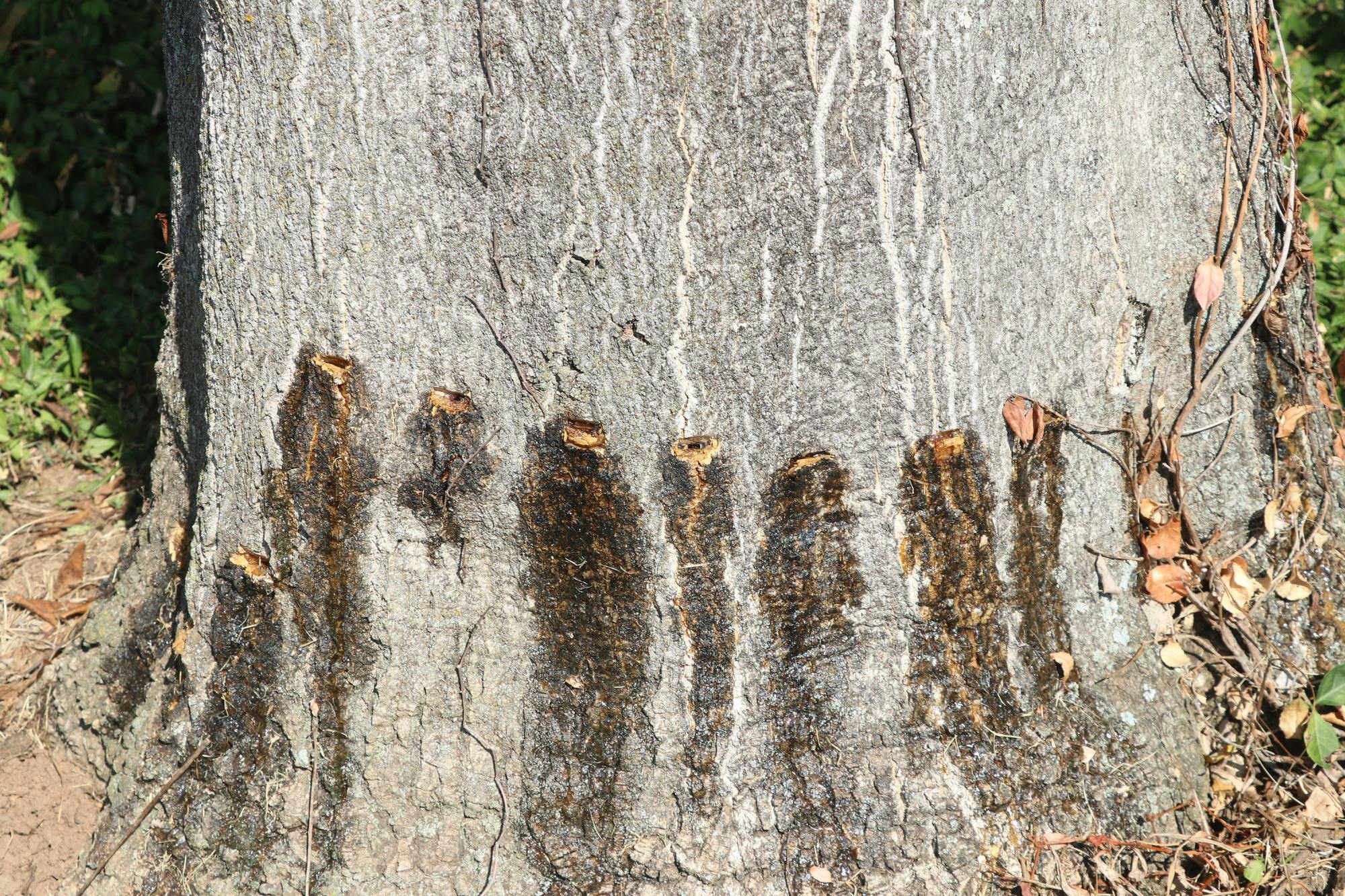
Sap weeps Sept. 20, 2025, from cuts drilled in the trunk of a tree-of-heaven by Eagleson Avenue on Indiana University's campus in Bloomington. Iversen said the holes were drilled because trees-of-heaven attract spotted lanternflies, a highly invasive bug currently spreading in Indiana.
“They have tried to kill this tree for so long,” Iversen said. “Like, look at it. It’s like a zombie tree, but they just won’t die.”
In the woodlot behind Lilly Library, some of the invasive plants ReWild cleared out last year are beginning to creep back in, including Asian bush honeysuckle and purple winter creeper.
ReWild will come back this year to keep these areas in check, Iversen said. Volunteers with ReWild curb invasive plants by cutting them at the base, then dabbing herbicide on the stem.
Meanwhile, native redbud saplings and the willow trees ReWild planted last year are also growing, and in a few years, they will be tall enough to survive if invasive shrubs return.
“As long as we're making sure that those invasives are kept at bay, these will be five, six feet tall,” Iversen said. “They'll be tall enough to make it to the canopy and shade them all out.”
Students can find more information about ReWild’s volunteer efforts on the organization’s Instagram. Upcoming volunteer events by the City of Bloomington Parks and Recreation Department, including Weed Wrangles, are available on the volunteer portal, and can learn more about the Adopt-a-Greenspace program on the city’s website.



