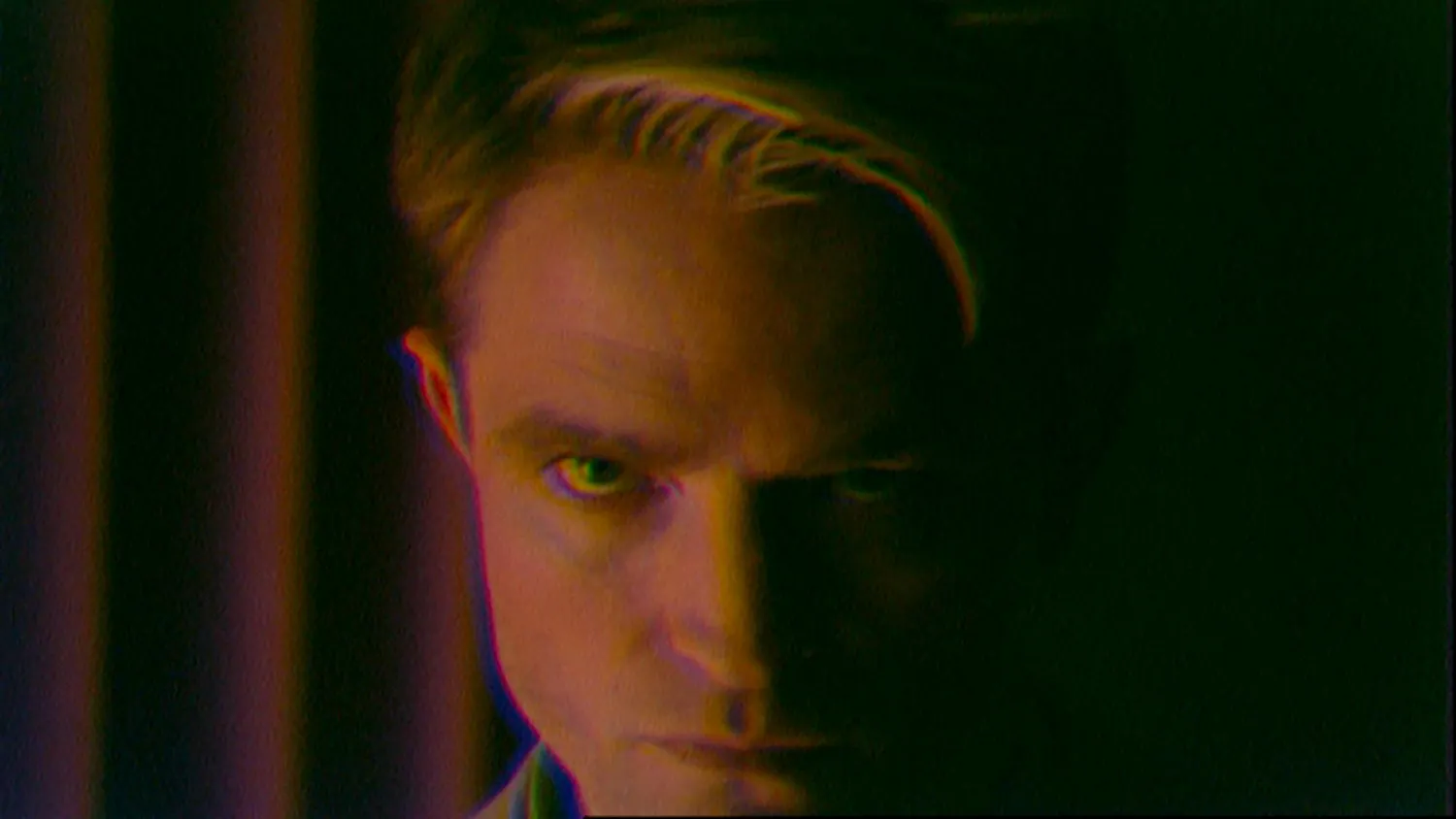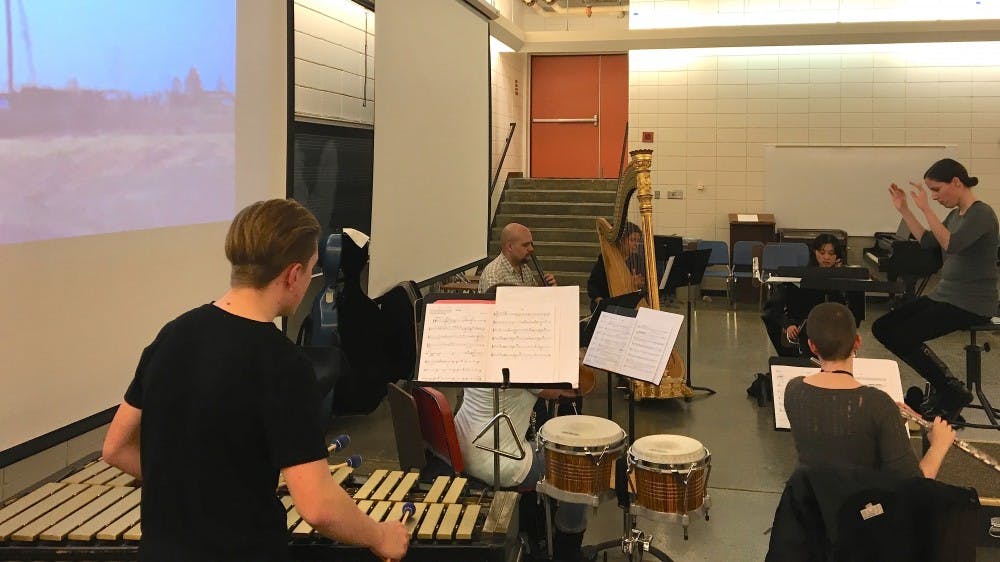
The student filmmakers and composers first met in a speed-dating fashion. Based on the four-minute conversations they were allotted, they had to decide who they would work with for the next six months.
The fifth annual Double Exposure program returns Sunday to the IU Cinema. The program pairs composition students and film students to make a silent short film and score, which is performed by a live orchestra.
Yasmin Al-Jawad, a junior who’s participating in the program, said she and Justin Parish, her composer, immediately got along.
“We knew instantly we wanted to work together, because I said, ‘Have you seen ‘True Blood?’’ and his face just lit up,” she said.
Double Exposure began in 2012 as cinema director Jon Vickers’ vision to create more collaboration between the arts and include more live music performances in the cinema.
Over the years, the program has been put into the hands of Media School professor Susanne Schwibs and Jacobs School of Music professors John Gibson and Mark Hood. However, Schwibs said the program is largely driven by student work.
“It’s all student-made: student films, student compositions, student performances, student conductors, student sound designers,” she said.
The goal of Double Exposure is to have the film and music on an even keel, Schwibs said. Because of that, she said the films tend to have little to no dialogue and are often experimental in nature.
Despite a recent revival in silent film with live accompaniment, Gibson said programs like Double Exposure are not common.
“When you’re in the audience and you see the films, you can really tell the difference between having a recorded soundtrack and having one where it’s being performed live,” he said. “It’s not just something you can just take home and play on your computer.”
Originally from the United Kingdom, Al-Jawad said her film “Haint” is an exploration of the myths and religious elements of the Midwest from an outsider’s perspective.
However, she said many of the religious aspects were lost in the filming. Parish said he used the lost footage as an opportunity to bolster the score.
“If you listen to the score, you’ll hear bits and pieces of ‘Jesus Loves Little Children’ weaving in and out of the texture,” he said. “There are some Bible verses that are being whispered throughout by the instrumentalists when they aren’t actually playing.”
Reed Brown, a senior filmmaker, said he and composer Chris Neiner made a film called “Don’t Smile Me,” which explores fatherhood and the relationship of cameras to parenting.
Although Brown and Neiner spoke with each other in the early stages, Brown said he did not want to instruct Neiner on what the score should sound like.
“I wanted to give him freedom as far as collaboration goes,” he said. “It was like I was handing him a half-assembled Lego set and was like, ‘Here, do whatever you want.’”
Although Hollywood film scores are typically composed after the film is made, Gibson and Schwibs said Double Exposure is designed for more collaboration and less give-and-take.
“Here, we actually manage to get really genuine collaborations going from the start of the project,” Gibson said.
Keenan Crotty, a senior filmmaker, said his film “Living the Dream” follows a screenwriter as she dreams of being sucked into classic Hollywood genres.
Working with freshman composer Luke Accera, Crotty said their similar tastes in film fueled their team.
“Since visually, my movie expresses my love for movies, I wanted him with the music to express his love for movies,” he said.
With 11 films premiering on Sunday, Schwibs said Double Exposure typically fills the IU Cinema due to the large number of students involved.
She said friends, family and film lovers come to support the collaborations.
Even though her film is less than five minutes long, Al-Jawad said her parents are flying from the UK to come to Sunday’s program.
After working on his score since September, Accera said he hopes the audience has fun watching his team’s film.
“I’m looking forward to people reacting to my score,” he said. “I want them to laugh in the funny moments and get goose bumps in the scary moments.”
Due to the level of skill in both the Jacobs School of Music and the Media School, Gibson said an arts-filled community like Bloomington can successfully program events like Double Exposure.
“There’s a kind of hunger for the arts here,” he said. “People who come here as students really want to be exposed to different kinds of experiences.”