
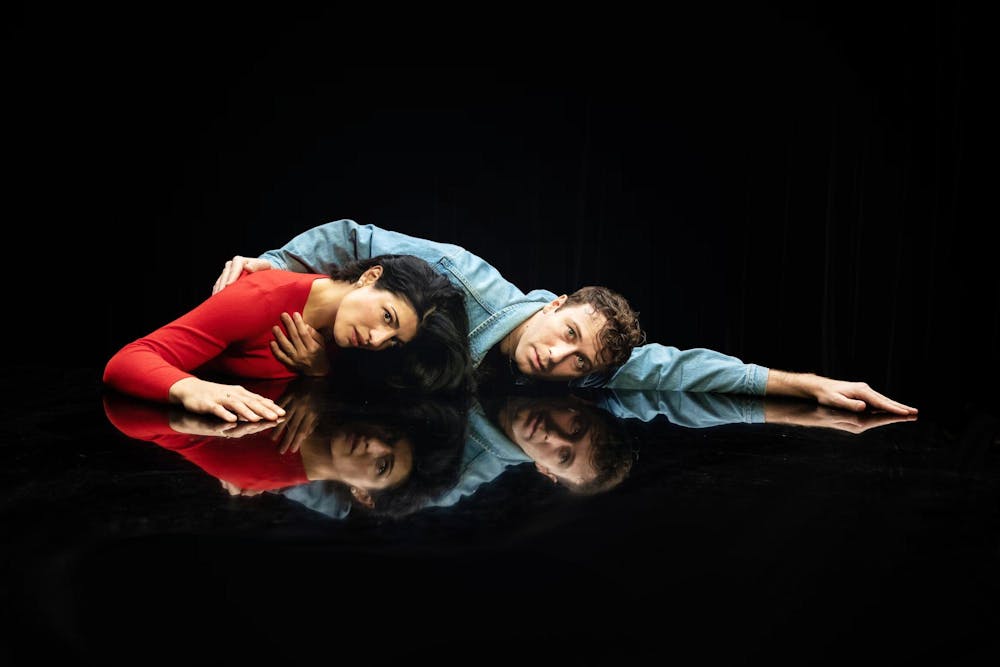
Jacobs School of Music alumnus Jeremy Weiss and his co-composer Nicole Brancato finished their two-day residency at IU on Friday night in Auer Hall, showcasing the immersive concert version of their opera “Infinitesimal: An Innovative Opera for Voice and Piano.” They were invited by the National Association of Teachers Singing and the Office of Entrepreneurship and Career Development.
Following a tour through Europe featuring the opera’s semi-stage version, mostly focused on the vocal sound of the performance, Friday night was their first concert showcasing the opera. Weiss and Brancato ran all the electronics on stage. Featuring props, audience immersion and expressive performances, the artists said they have still not built up to the full production version yet, still thinking of the IU showcase as “a recital on steroids,” Weiss said.
“Infinitesimal,” meaning extremely small, explores the passage between life and death. Specifically, it takes moments from Weiss’ and Brancato’s lives, as if they are reliving their memories, and showcases them through a combination of traditional opera, musical theater and lyrics from musician Billy Joel and poet Walt Whitman.
The idea to explore the passage between life and death began on a hike. At the time, the artists were commissioned by Pure Art Circle, an organization aimed at promoting contemporary and unconventional art, in Dolomites, Italy, to write a piece. After just landing in Italy, Weiss and Brancato went on a hike to see the sights and brainstorm ideas in 2024.
Silently hiking and jetlagged, Weiss began to tell Brancato his theory about what happens when humans die. Curious, Brancato insisted that he share.
“He went on to say this really beautiful and human perspective that he had on, you know, that our body releases these really good-feeling hormones, and we revisit moments from our lives,” Brancato said.
After Weiss shared his theory, Brancato said she felt inspired, and she knew immediately this was their piece to compose. So, the two spent the next three weeks extensively researching the topic and interviewing scientists who were experts in the topic.
One of the scientists who Weiss and Brancato interviewed was Sam Parnia at New York University. Parnia’s lab conducted experiments where he monitored brain activity of people undergoing cardiac arrest. He observed a surge in brain activity for about 30 seconds after death.
Afterward, Parnia resuscitated and interviewed patients, and about 10% of patients reported positive psychological experiences alongside some kind of cognitive awareness or function.
Within the opera itself, audio clips from these interviews were featured as a story telling device, telling the audience about bursts of cognitive function after death.
“We thought a lot about what those memories are that you would come back to if you died,” Brancato said. "We worked with a social psychologist and a researcher in particular when writing the libretto.”
Weiss and Brancato’s residency began Jan. 15 with a lunch where students could ask questions and a masterclass aimed at cultivating students’ work.
Ella Cope, a master’s student at the O’Neill School of Public and Environmental Affairs, did not know anything about the opera when she stepped into Auer Hall. She said she was surprised by the performance, and it caused her to reflect upon death and what it would be like.
“It made me think about the people I love who have died, and, wonder, you know, what it felt like for them,” Cope said. “It makes me think about people I know who are maybe going to pass through, and what I hope it’s like for them, and what I hope it’s like for me.”
The performance in Auer Hall is one of the stepping stones the co-composers are building before the official premiere in New York City at National Sawdust on March 28. After the premiere, Weiss and Brancato will announce a larger tour coming in the next year.
CORRECTION: This story has been updated to accurrately reflect the year of Jeremy Weiss and Nicole Brancato's hiking trip.


