
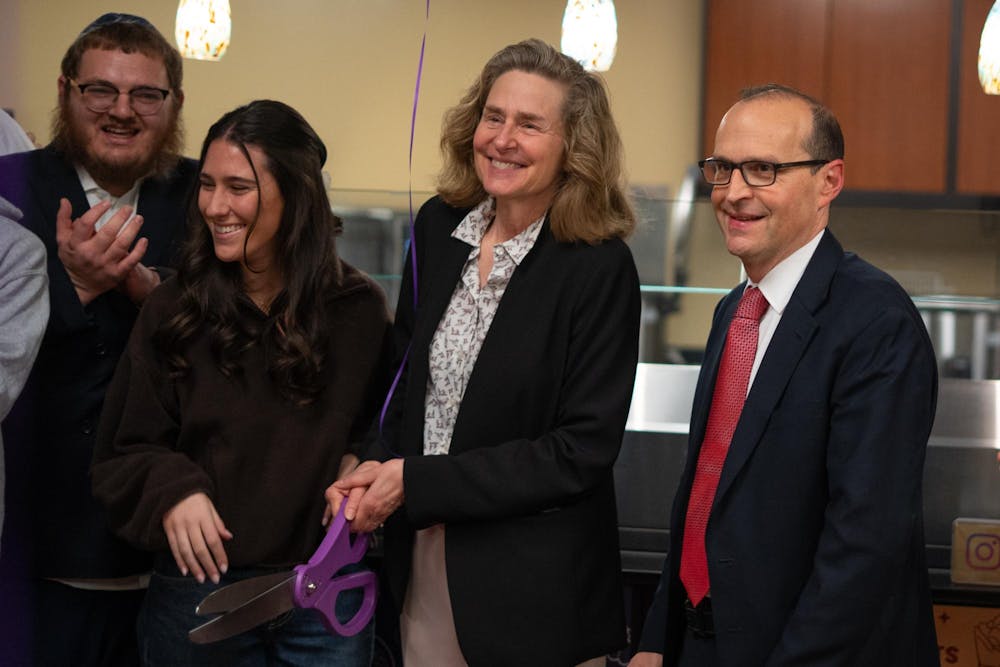
The aroma of Mediterranean food filled the air Tuesday at the IU Kelley School of Business Godfrey Graduate and Executive Education Center. A long line of students led into the hallway at Yalla Bloomington, the first kosher and halal certified restaurant of its kind on Bloomington’s campus.
Yalla hosted its grand opening Tuesday morning with IU President Pamela Whitten delivering remarks and participating in a ribbon cutting ceremony. The restaurant offered all attendees free food and merchandise.
The celebration marked a milestone for Jewish and Muslim students who have religious dietary restrictions.
Open 11 a.m. to 3 p.m. Monday to Friday, Yalla offers shawarma, falafel, grilled chicken and kebabs. The restaurants co-owner, Berel Shur, describes their food as a take on Cava or Chipotle, featuring Middle Eastern and Mediterranean cuisine.
Being halal certified, the restaurant adheres to Islamic dietary laws on allowed foods and preparation methods, such as prohibitions on pork and alcohol and requirements for specific animal slaughter practices.
It is also kosher certified, following Jewish dietary laws that prohibit foods like pork and shellfish, requires meat and dairy to be kept separate and mandates specific preparation methods for allowed foods among other rules.
IU senior Joshua Huss is strictly kosher. Before Yalla, Huss had trouble finding a dining option that fit his dietary needs.
“Over the past four years that I’ve been here, we haven’t had any kosher-like dining option at all,” Huss said. “It’s a huge deal for me because at the IU dining halls, I can’t eat any protein.”
Rabbi Levi Cunin, director of the Chabad Jewish Student Center at IU, first pitched the idea to Whitten and IU Dining several years ago. The restaurant had a soft launch in August 2025 and feeds over 300 people daily, often selling out before closing.
“Having this option allows students to be able to focus on their college experience, on their studies, on their classes, on their social life and not have to worry about cooking their own food or their parents shipping the food,” Cunin said.
Cunin partnered with head chef Shur to co-found the restaurant. Development on the menu began June 1, and by mid-August, the restaurant was approved for a menu, space and kitchen.
In an interview with the Indiana Daily Student, Whitten emphasized the importance of creating an inclusive campus environment.
“We want students that come to IU to have the opportunity to live and learn and study in an environment that’s comfortable and inviting to them,” Whitten said.
Maintaining kosher and halal certification requires extensive work, Shur said. All food, except produce, must be kosher certified.
Shur, who serves as a mashgiach, a religious supervisor to ensure food complies with Jewish dietary laws, must be present when food is cooked.
The restaurant sources kosher protein from Chicago, requiring deliveries twice a month from suppliers. IU provides the necessary freezers and refrigerators for storage.
“They set us up for success and they gave their time to make it happen,” Cunin said.
The restaurant represents a personal legacy for Cunin. He said his great-grandmother opened one of the first kosher restaurants in New York in the early 1900s called Ratner’s. Now, more than a century later, he’s brought the same tradition of kosher dining to Indiana students.
Whitten said she plans to return regularly and encourages students across campus to visit.
“Food is part of everyone’s life,” Whitten said. “This is a great opportunity for our Jewish students, our Muslim students, that have a place to come have wonderful food.”
CORRECTION: This story has been updated to correct the spelling of Cava.


