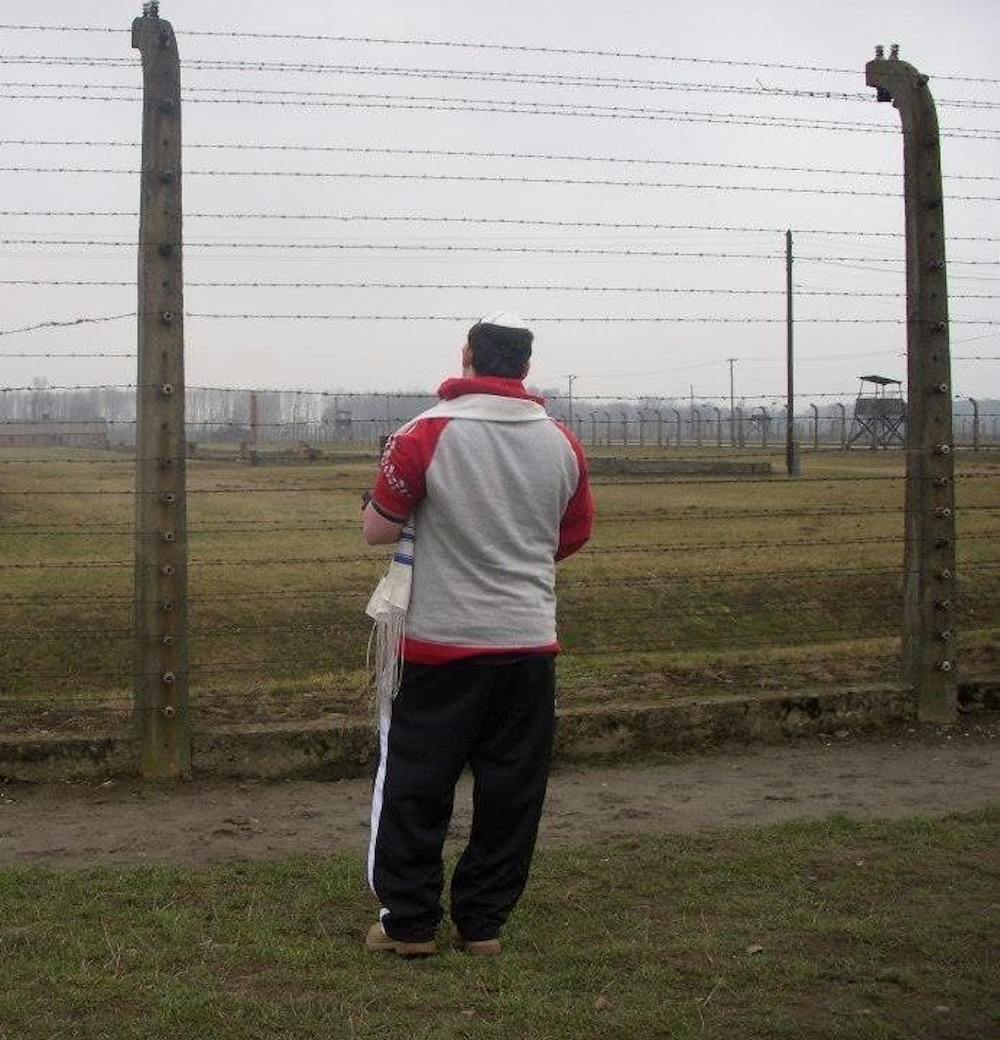
A light cold rain was falling as David Solkowitz stood on the train tracks of Auschwitz decades after World War II, as he prayed and remembered the victims from the concentration camp.
His friend, who had family who had been in Auschwitz, led the prayer on the class trip his high school took this past year. Some students were crying. Some were saying all the words to the prayers, and some were just standing silent on the land where a generation of Jews stood before them.
“It’s an experience I’ll never forget,” IU freshman Solkowitz said. “It was uncomfortable. It was really cold. But the fact that I was doing something in a place where not even 100 years ago before my people were sent there, because they were doing what I was doing. It was probably the most incredible, intense, spiritual experience of my life.”
Monday was the Jewish Holocaust Remembrance Day. But this year Hillel didn’t read names of victims or plan any programs, a Jewish tradition.
“Since the day fell towards the end of the year in America this year, we didn’t want to plan anything so close to the end and not have anyone show up,” Rabbi Sue Silberberg said. “It kind of says something worse if no one shows up than if we just don’t have anything.”
Instead, Hillel used social media to reach more people by tweeting and posting stories of survivors, videos on the event and an online audio reading of the names of victims to Facebook, Hillel engagement associate Ally Turkheimer said.
“We felt like we still wanted to recognize the day,” Silberberg said. “We thought social media would be a better way to reach more students than inviting them in during finals and the end of the semester.”
Hillel at IU received a grant from Hillel International to do a Holocaust Remembrance program next fall in concordance with the anniversary of Kristallnacht, or the Night of Broken Glass. Kristallnacht was a series of attacks on Jewish stores and people, named for the shards of glass from the broken windows of Jewish peoples’ stores and homes on November 9, 1938.
The program will have three different activities, including a walk of silence, a sharing of survivors’ testimonies and a special Seder-like meal based on Holocaust Remembrance, Jon Schulman, Hillel program director and grant writer, said.
“We’re doing this for a couple reasons,” Schulman said. “The Holocaust is vital to think about and talk about and do programs, because it’s a part of the history of Jewish people. And it’s so important to remember the 6 million Jewish people who were killed. It’s also important to discuss it so it never happens again.”
Schulman is not the only person who believes it’s important to remember the victims and ensure history doesn’t repeat itself.
Solkowitz wore only black and white Monday to honor the lost people, which he said is how Jews in Israel dress on the Remembrance Day. He also wore his Jewish star and a kippah under his hat.
“It’s important to show people that Jews are still here and even though they tried to get rid of us — that through courage and perseverance Jews survived,” Solkowitz said. “To remember is at least what I’m going around today with in my head. That, and the idea of ‘never again,’ so we as people should never again let anything like this happen again. Not to us as Jews, or any other group of people.”
Not only has sophomore Jessie Nejberger taken the time to remember the Holocaust, but she is also using her life to commemorate the victims, especially her family.
Three of her great-grandparents died in the Holocaust, she said, two at concentration camps and one fighting for the Red Army in Stalingrad. Luckily, her grandparents were able to survive as small children.
“I’m fortunate enough to be here, because they survived,” Nejberger said. “If they hadn’t, I wouldn’t be here, so I have to take that and do what I can to protect the interests of the Jewish people.”
In order to protect Jewish interests, Nejberger is spending 16 days this summer learning how to be a campus advocate for the state of Israel. She is also an American Jewish Committee Fellow, which is a group working to combat anti-Semitism and globally promote Jewish interests.
“The last time I went to Israel, I remember being there and realizing my great-grandparents died in camps for being Jewish,” Nejberger said. “And I think how they never would’ve imagined a state created solely for Jewish people. For me to be there and see that is so powerful.”
Growing up remembering the Holocaust changed even small aspects of Nejberger’s life.
“It’s the little things like eating what you’re served for dinner and not complaining,” Nejberger said. “My grandparents didn’t know where their next meal would come from. Jews starved, so it’s as small as being grateful for food.”
Nejberger said she thinks it’s important to remember the Holocaust, because it’s easy to forget what happened.
“Jews have been so successful since then,” Nejberger said. “We really raised up since the Holocaust and have control in the financial industry, Hollywood and the government so people don’t think Jews had it that bad.”
But more than 6 million Jewish people were killed as a result of the Holocaust, and Nejberger wasn’t the only IU student to have family involved.
Freshman Alexandra Koyfman had family who lived in Poland and Ukraine during the time of the Holocaust.
She said she remembers stories being passed down to her about her great-grandfather continually moving to avoid the Nazis and never seeing his extended family again.
Stories of her grandmother, who as an 8-year-old hid in the forest at with her sister, only surviving by the kindness of a Polish woman who brought them food and supplies.
“Every little act of kindness is important,” Koyfman said. “If that Polish woman hadn’t helped my grandmother, she wouldn’t have survived, and I wouldn’t be here
right now.”
Koyfman remembers the victims to honor them, and also because she thinks it is crucial people know about the atrocities that took place.
“It’s important for people to know what happened and what people are capable of,” Koyfman said. “It’s the little prejudices and little things that can add up without people realizing it until it becomes too late.”
Students honor Holocaust victims
Get stories like this in your inbox
Subscribe