
Editor's note: All opinions, columns and letters reflect the views of the individual writer and not necessarily those of the IDS or its staffers.
The implications of artificial intelligence for politics have merited slightly less attention, thus far, than politics’ implications for AI. So, while lawmakers debate whether to halt data center developments, nationalize the ownership of AI companies or control which AI models certain foreign customers can access, it’s worth considering the political future under artificial intelligence conditions.
Currently, we are glimpsing at what appear to be two possible timelines for American politics.
In one, a deregulatory president in the mold of Ronald Reagan gives way to a second coming of “New Federalism.” In 2024, Donald Trump courted AI moguls to his camp through promises to deregulate the tech sector.
Since his inauguration, the president has reversed some of his free-market positions — when you forget the tariff regime he espoused alongside them. In June, Trump signed an executive order that called on — convinced? coerced? — AI companies to voluntarily submit their new products for government review before releasing them.
Certainly, to the extent that AI may be weaponized and that China might stand to gain from innovation within our borders, federal regulators are bound to seek control or nationalization of the industry. But there is another flashpoint in the AI revolution of political culture, which is more insulated from militarizing concerns, that might reveal whether more or less consolidation of power in D.C. lies on the horizon: data centers.
In March, the White House released the Ratepayer Protection Pledge, another policy turnaround from Trump, where he asked, however insistently, that AI companies set up their own electrical networks rather than rely on the same grids as local businesses and homes. The purpose behind this agreement was to mitigate the energy bill hikes data centers would cause families.
Unfortunately for the president, scarcity can’t be eliminated through executive prerogative. If AI companies are not purchasing energy from existing producers — meaning more buyers are after the same amount of goods, which raises prices — they are buying the means to generate that energy themselves. Which is to say, there are more customers for the same quantity of resources, which will also, in extra steps, raise prices.
But beyond the economic consequences of the pledge, it’s the kind of political maneuvering that suggests a timeline where AI brings about more federal consolidation of power is the likelier result. Precedent is being established for the president to step in.
Such a response from Trump may have been expected, despite promises to take a hands-off approach. He ascended to the presidency by offering to take a sledgehammer to whatever worried his populist base — immigration, Iran, data centers, etc. Waves of populism surface at every societal shift of scale. Effectively, Trump is the natural politician for our time, one which is facing technological and economic revolutions. But we shouldn’t suppose he is alone in this regard.
Senator Bernie Sanders of Vermont, U.S. Rep. Alexandria Ocasio-Cortez of New York and other progressive populists are also signaling a political future for the AI era that magnifies D.C.’s gravitational force. On June 29, Sanders and Ocasio-Cortez were joined by U.S. Rep. André Carson (D-Ind.) in introducing a bill to place a nationwide moratorium on data center development.
This legislation, too, aims at relieving Americans, as many as 70% of whom oppose the construction of data centers in their communities. While the caution behind the bill is laudable, the bill itself may betray a steady approach in zealousness to use federal power to do what local governments can and have begun to do themselves.
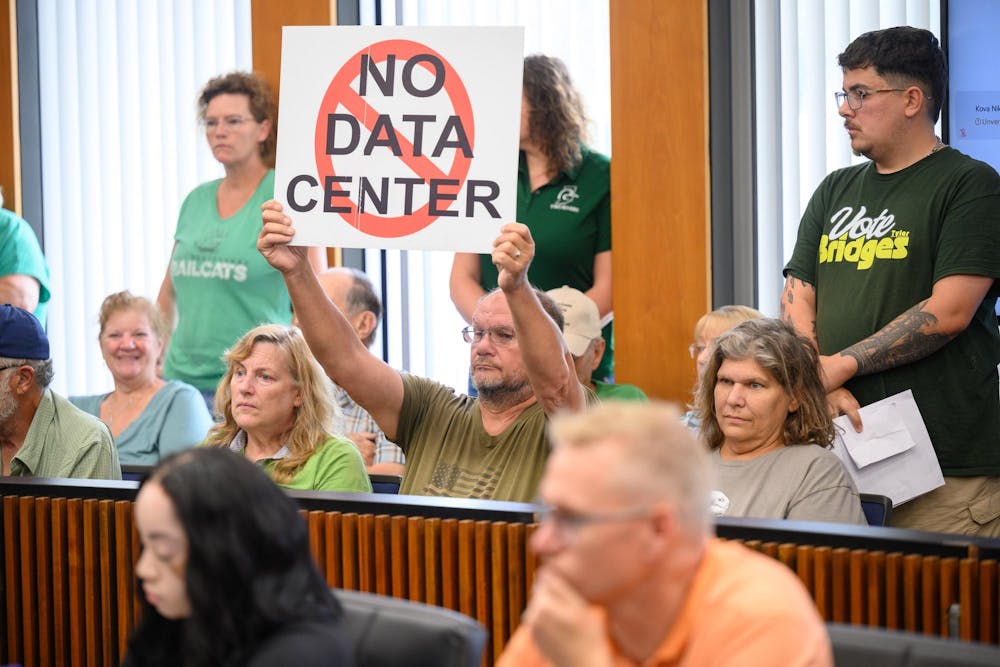
A third of the counties in Indiana have restricted or stalled data center development. These counties offer a look into the other possible timeline. In this future, AI is mobilizing community members to pour their efforts into resurrecting local politics.
In either timeline, it’s notable that the communities affected by data center developments are predominantly suburban or rural and east of the Mississippi. Data centers require abundant land and water. Hence, their threat to cities — where land is prohibitively expensive — and to the western United States — where the water supply is inadequate to support the chugging of their cooling systems — is comparatively miniscule. The threat they pose to rural communities like those in Morgan County, Indiana, where Google plans a 550-acre development, is not.
It’s also notable that data centers would not be sprouting so widely or rapidly if there were not such widespread demand for AI. Thus, communities seeking the source of their woes will find them in two groups which, probability suggests, also largely oppose these tech gargantuans’ expansion: city dwellers and college students.
Historically, centralized efforts to cap the negative effects of what a large segment of the population routinely enjoys have mixed rates of success — see Prohibition. Permanent solutions can more often be found in personal initiative — see the Second Great Awakening and the temperance movement that it influenced.
That said, some “dry” counties still maintain local prohibition ordinances across the country and many communities have succeeded in staving off data centers, judging by the Hoosier counties that have introduced their own moratoriums. But with an authoritarian president in office and democratic socialism ascending in the national Democratic Party, we must wait to see which political timeline the full force of the AI age will introduce.
Eric Cannon (he/him) is a junior studying philosophy and political science and currently serves as a member of IU Student Government.



