On the verge of tears, Kaynaw Ali spoke about the year 1991, when her family and 2 million other Kurds left their homes to flee from Saddam Hussein’s rule.
She said she remembers not having any food or water and seeing her sister die, because she was so sick.
“We all lost at least one person,” Ali said. “This is normal in my country. Some have lost more. I don’t want to remember.”
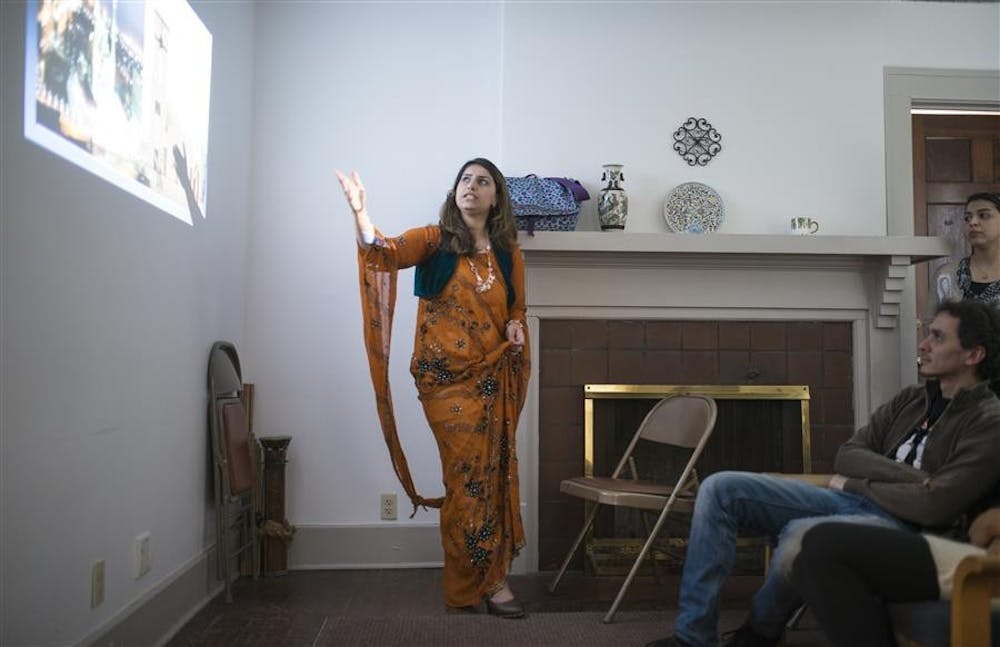
The Asian Cultural Center was host to Ali for her talk about the history of Kurdish people. Ali offered to deliver the speech and cook traditional Kurdish food when she realized the ACC didn’t have much information on Kurds.
“When they told me they didn’t have much information about my country, I wanted to present some to make it clear,” she said.
Ali presented a history of Kurdistan and its struggle for independence through the years. She said she hopes her presentation can help people better understand Kurdish people as their own ethnicity and nationality.
“Most people say that we are from Iraq,” Ali said. “They say, ‘You’re Arabic,’ but we are not Arabic. We are Kurdish, with our own traditions and our own language.”
The struggle to be recognized as such still continues today, even after the reign of leaders like Hussein. Kurds are spread between four countries: Turkey, Iran, Iraq and
Syria, but Ali said Kurds everywhere hope for one single country.
“It is not just my hope, but the hope of every Kurdish person born that we have our country,” Ali said. “Not just Kurdistan in Iraq, but to become independent so we can keep our rights.”
To share her culture beyond just telling her country’s history, Ali prepared a Kurdish dish called dolma. Dolma is made by combining rice, onion, garlic, dill, parsley and ground beef, wrapping it into a grape leaf, and boiling it on a stove. Dolma is prepared often in Kurdish homes, but is often eaten at picnics, Ali said.
Grant Pusinelli said he had never heard of Kurdistan until his Asian studies professor offered extra credit to anyone who attended the event. He had many events to choose from, but chose this one because he had never learned about Kurdish people or where they came from before.
“It seemed like the most interesting to me,” Pusinelli said. “I didn’t know about the history, and I didn’t know what to expect.”
In order to best write his extra credit paper, Pusinelli tried the dolma.
“I thought the food was good,” Pusinelli said. “I didn’t expect it to be as tasty as it was, but I thought I’d stick around to see what it was like.”
In the past three years since Sarah Moon has been working at the Student Outreach Coordinator at the ACC, she has never seen a Kurdish event.
“We were looking for events to host for Asian-American and Pacific Islander heritage month, and so when we heard (Ali) wanted to do this, we were for it,” she said.
Moon said she thinks people often think the ACC is limited to just East Asian events.
“People think the ACC is only for East Asians, but we really have loosely defined boundaries,” Moon said. “We are here to primarily serve students and then community members, and we like to have various events from different cultures.”
Moon said she hopes this event will encourage others to feel more open to visiting the ACC no matter their cultural background.
“I encourage anyone that has an event or idea to come give a presentation,” Moon said. “Everything we do is free and interesting and you don’t have to be Asian to come to our events.”
ACC hosts Kurdish speaker, provides traditional food
Get stories like this in your inbox
Subscribe