Researchers with NASA’s Mars Science Laboratory recently discovered geological evidence that Mars might have once supported life.
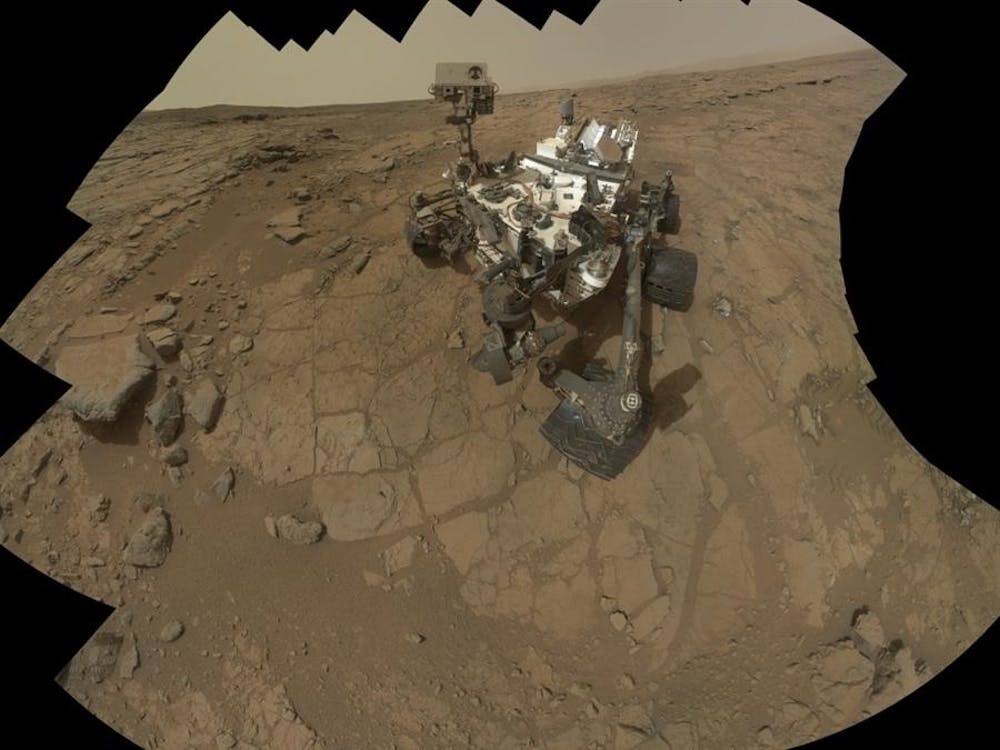
According to reports from NASA’s website, the Curiosity rover, which landed on Mars in August 2012, was able to provide vital insight about Mars’ past and its current environment.
Two IU professors, David Bish and Juergen Schieber, contributed to scholarly essays on the minerals and rock layers found on Mars that correlate with material found on Earth.
Curiosity has not only accomplished its primary goal of finding evidence for an ancient environment that could have supported life, but it has also provided evidence that habitable conditions existed on Mars more recently than scientists believed and likely persisted for millions of years.
The rover drilled two holes in the planet’s Yellowknife Bay and obtained samples of rock containing clay minerals.
“The mineral assemblage in these holes is consistent with their having been formed in water,” IU geologist and Mars team member Bish said.
Scott McLennan of Stony Brook University in Stony Brook, N.Y. found that chemical elements in the rocks indicate the particles were from a source area upstream to Yellowknife Bay, and that most chemical weathering occurred after they were deposited.
“The loss of elements that leach easily, such as calcium and sodium, would be noticeable if the weathering that turns some volcanic minerals into clay minerals had happened upstream,” McLennan said.
NASA scientists previously said four billion years ago, the environment on Mars wasn’t much different from that of modern-day Earth; although, no one would be able to live there now because Mars has become colder, drier and more irradiated.
Researchers say evidence indicates the clay minerals would have formed in a shallow lake almost four million years ago, around the time primitive life appeared on Earth.
Bish said the clay minerals, of which smectite is the dominant type, would have formed in water that was relatively benign with temperatures and pH-level moderate enough to support life.
“Smectite is the typical clay mineral in lake deposits,” Bish said. “You will find biologically rich environments where you find smectites on Earth.”
According to NASA researcher Dwayne Brown, Curiosity previously landed in Gale Crater on Mars in 2012 and found soil that was similar to basaltic minerals found in volcanoes.
Curiosity has been driving, recording numerous high-resolution images and using an ionizing laser to analyze rock materials since the latest samples were collected early this year. It is expected to reach Mount Sharp and collect more samples early next year.
— Anthony Broderick
Earthly minerals found on Mars
Get stories like this in your inbox
Subscribe