
Last week, the United States Department of Energy announced 2010 had the largest increase in global output of carbon dioxide on record, with 564 million more tons of the heat-trapping chemical pumped into the earth’s atmosphere than in 2009.
While the 6 percent increase in emissions is staggering — it represents a rate worse than the worst-case scenario outlined by the Intergovernmental Panel on Climate Change in 2007 — it’s nothing new. The last 235 years have seen a gradual increase in carbon dioxide emissions into the earth’s atmosphere.
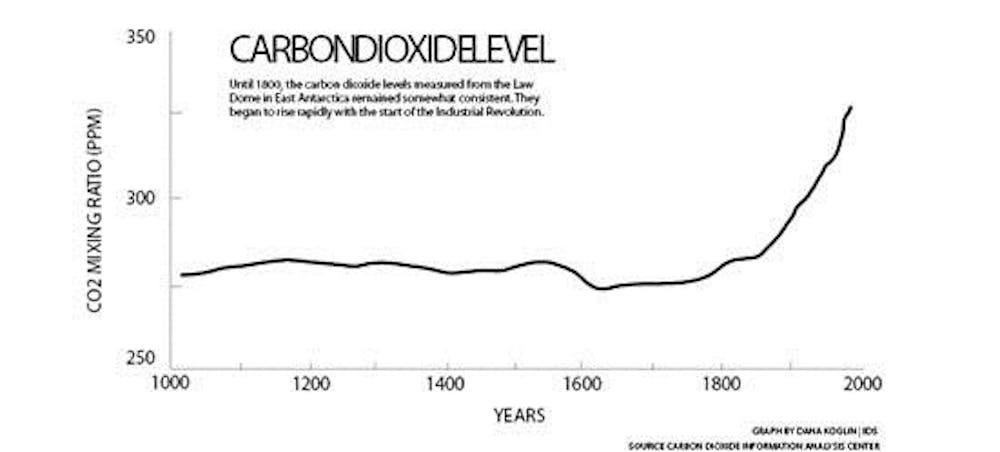
For about 765 years, from 1010 AD to 1775 AD, the world’s atmospheric carbon dioxide levels hovered at about 280 parts per minute. Starting in about 1776, those levels began increasing. In 1850, atmospheric carbon dioxide levels were at 285.2 ppm. By 1950, the levels were at 312 ppm. Today, they have risen to 388.92 ppm, a 39 percent increase since 1775.
It’s hard to believe anyone could look at these numbers and dates and conclude the increase in carbon dioxide levels is not a result of the Industrial Revolution, which began at about the time the levels started rising in the 18th century.
The Industrial Revolution saw new innovations in technology and transportation that were heavily dependent on the burning of fossil fuels, which releases global warming gases such as carbon dioxide into the air.
According to the U.S. Bureau of Mines, during the time of the Revolutionary War and the start of the Industrial Revolution, approximately 1,200 lbs of minerals, which include fossil fuels, were needed for each person in the country every year.
Today, roughly 250 years after the start of the Industrial Revolution, the average
person needs 38,052 lbs of minerals every year. However, while the Industrial Revolution did bring an increase in mineral usage and carbon dioxide emissions, it also brought a just-as-dramatic increase in the human condition.
In 1776, the average life expectancy in the U.S. was about 33 years, about the same as it was 75 years before and about eight years more than it was in ancient Rome. By 1900, life expectancy rose to 48.23 years, and today, the average person is expected to live until 78 years of age.
For roughly 1,776 years, the most affluent parts of the world saw only a 32 percent increase in life expectancy. In the 235 years since the beginning of the Industrial Revolution, the same demographic has seen an astonishing 136 percent increase.
A coincidence? I think not.
Infant mortality rates similarly dropped. In France in 1740, approximately 300 out of every 1,000 babies died before their first birthdays. Today, that ratio is 3.4 out of 1,000.
The Industrial Revolution greatly improved the quality and duration of human life, but it also threatened the very existence of that life. How can humanity reconcile its need for fossil fuels, which drive our dramatically improved lifestyle, with the ever-worsening prospect of environmental disaster?
Is it possible to control emissions without slowing, stopping or reversing the human progress those emissions are undoubtedly responsible for? After all, we need fossil fuels to heat our homes in the winter and cool them in the summer, to produce the plastics and metals that make up many of our favorite consumer goods and to cut the wood and smelt the metal that support the homes and skyscrapers we use as shelter.
We saw this question play out on Capitol Hill in 2009 in the Cap-and-Trade debate. In response to concerns from many of the world’s premier scientists about global greenhouse gas emissions, the Obama administration proposed a system that would cap emissions and allow those companies whose emissions are beneath the cap to trade or sell the remainder of their emissions to companies that wish to emit above the cap.
According to the Obama administration, the system’s aim was to “reduce greenhouse gas emissions approximately 14 percent below 2005 levels by 2020 and approximately 83 percent below 2005 levels by 2050.” However, the proposal was stopped in its tracks because of concerns regarding the impacts such a system would have on the nation and world’s economy.
By Obama’s own admission, costs of energy would “necessarily skyrocket” as a result of capping emission levels and, depending on whom you ask, the cost of such a proposal per household per year ranged from $800 to $3,100.
In the midst of a recession, a hike of that proportion could further cripple the economy, which, as we know, is dependent on burning fossil fuels. However, Obama and many environmentalists believe the benefits outweigh the costs.
They think that not acting to save the environment now could have dire consequences for generations to come as emissions of greenhouse gases continue to rise, leading to a dramatic increase in global temperatures. And they may have a point.
But so do their opponents. With the absence of cheap, viable alternative energy sources, the hamstringing of industry’s ability to manufacture goods cheaply and efficiently might necessarily slow human progress.
This leaves humanity in a dilemma. Act now and avoid potential disaster? Or wait, continue on the path we’re on and hope that scientific and technological innovations in producing clean, affordable energy come soon to save the day?
It is potentially the greatest quandary of our lifetime and one we unfortunately cannot avoid if we want to prevent more dramatic, year-to-year jumps in carbon dioxide emissions.
— nperrino@indiana.edu
The Industrial Revolution: our savior and our burden
Get stories like this in your inbox
Subscribe



