
Normally, I despise television, which makes this admission even more shameful.
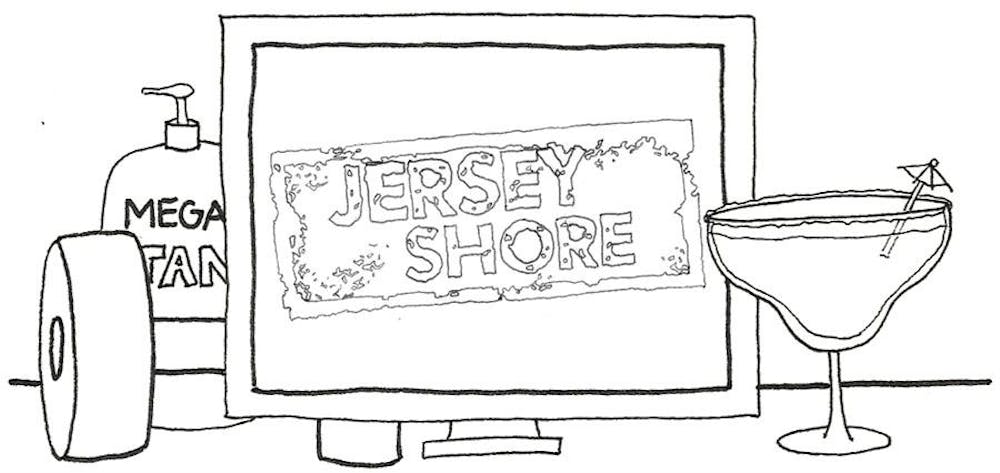
I adore “Jersey Shore.”
I have spent entire days comatose on the couch as a parade of hyper-tanned monsters strut across my screen.
There are two levels on which one can enjoy “Jersey Shore.” Sex and violence are the twin sides of the television coin, and they deliver both in bulk.
The female guidos constantly bemoan their inability to find a good man. Of course, their ideal mates are “juice-head gorillas,” meaning giant muscles with tans like burn victims.
The male guidos continually “creep” up and down the boardwalk in search of any woman at all, generally bringing the women back to their rooftop hot tub to seal the deal. Inevitably, the frustrated quest for sex morphs into guido-on-guido violence, with the help of gallons of liquor.
Females pull, scratch and bite one another. The men lose themselves in the hot grip of roid rage and destroy both property and human bodies.
Unfortunately, after a few hours of constant repetition, the cycle of sex and violence grows stale.
That’s when the second level of enjoyment emerges. It’s possible to use “Jersey Shore” as a distorted look into the heart of American sexism.
Now, the show stops seeming so funny. The guys belittle every woman they see because in their minds, women exist only for sex. Worse, very few women measure up to their standard of tanned, plastic beauty.
So the men will use their famous slang and write off the majority of women as “grenades,” meaning someone so ugly your friend has to jump on her to save you.
The guidos’ drunken energy exposes a sexist double standard many are quick to deny exists in America.
Once the overindulgence of sex and violence becomes boring and the cultural critique starts seeming obvious and sad, “Jersey Shore” completes the reality show life cycle, passing into complete irrelevance.
— atcrane@indiana.eduw
'Jersey Shore' and the reality show life cycle
Get stories like this in your inbox
Subscribe



