
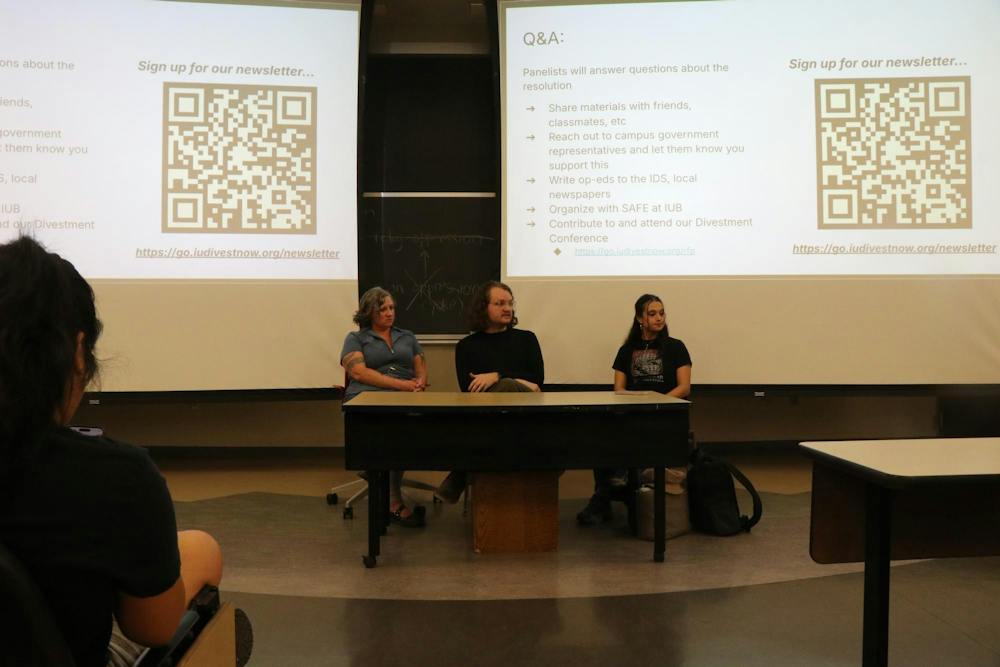
Three student-led organizations held a town hall Thursday evening in Ernie Pyle Hall supporting their efforts to get Indiana University to divest from all countries and companies alleged to have violated human rights.
The Palestine Solidarity Committee Bloomington, Students Allied for Freedom and Equality at IU Bloomington and Students for Justice in Palestine IU Bloomington organized the event attended by roughly 30 people, which the organizations described on Instagram as “an info session and Q&A about how IU’s democratic bodies can stand up against human rights abuses and keep IU accountable.”
According to the post, though IU changed its investment procedures in South Africa following student opposition to apartheid from 1978-1990, the university’s existing investment policy does not include a provision to prevent investments in other states accused of human rights abuses.
The push follows the 2024 encampment on Dunn Meadow, led by students and faculty who protested Israel’s actions in Gaza and called for IU to divest from the country. In 2025, protesters said the university did not meet their demands.
IU placed the PSC, which helped organize the encampment, on cease and desist for disorderly conduct Aug. 15, 2025. The cease and desist remains in effect.
The groups are asking IU to revise its investment policy by including a “prohibition of investing in states that commit serious violations of human rights” and “corporations that operate in or with the same states.”
The proposed changes would also require IU to check all pooled investments, such as mutual and index funds, for ties to states and companies that violate human rights and to regularly report on its progress in following the policy.
Tim Clark, an event organizer, said there are three countries where the resolution “would apply right now”: Israel, the United Arab Emirates and the Kingdom of Saudi Arabia. Each has been accused of violating human rights.
Organizers said records they obtained show IU holds debt tied to Israel, as well as corporate debt in companies tied to the UAE and Saudi Arabia, though they said they don’t know whether IU owns stock in any of the companies. Through a records request, members of the organizations said they received statements from 2022 and 2023 which includes approximately 50 pages of bonds and cash holdings with no amounts.
The IDS in 2025 independently replicated this records request, which asked for investment snapshots from IU, the IU Foundation, IU Ventures or other investment-holding entities affiliated with the university for the previous two available years.
The investments for 2022 and 2023 included a bond issued by the State of Israel, a fixed income investment in Saudi Arabian-owned Saudi Aramco and multiple purchases tied to First Abu Dhabi Bank in the UAE.
Other records requests of IU, organizers said, didn’t turn anything up.
“We’re not going to talk about any of it today, and the reason for that is because there’s absolutely no transparency,” Clark said Thursday.
The groups called on IUSG to consider the resolution and propose edits, meet with colleagues to gauge support and set a timeline for passing the resolution.
IU junior and IUSG Director of Student Life Connor Hatch said in an interview with the IDS that he plans to bring the proposal to the student government’s executive cabinet before it moves to the legislative branch.
“It would be a prideful moment for this current student government administration to have something like that on their record,” Hatch said. “It’s just about putting in the hard work to see something like this materialize.”
Elena Nissan Thomas, a senior at IU, said she hopes the resolution pushes IU toward responsibility on an international scale.
“We have an obligation to the people of the world, to the people in Palestine and Sudan and Yemen, and across a lot of the world as well,” Nissan Thomas said. “We should not be investing in human rights violations.”
Benjamin Robinson, an associate professor in the Department of Germanic Studies and former president of IU’s chapter of the American Association of University Professors, said the campaign’s focus on the past divestments was strategic.
“They looked at what happened at IU in 1978, and then again from ‘85 to ‘87,” Robinson said. “The issue of divestments is the same issue today.”
IU’s investments in South Africa under apartheid
Apartheid was a system of legally enforced racial separation in South Africa that lasted from 1948 until 1994. The system was built on earlier colonial-era segregation and was made official when the National Party took power in 1948.
Laws and regulations banned social contact between white citizens and people of other races while segregating public facilities, residences, jobs and health systems and stripping non-white citizens of rights.
Students began objecting to IU’s investment in South African companies in the 1970s. According to the IU Archives, in 1977, IU and the IU Foundation invested more than $5.7 million in companies with South African holdings.
Activist groups organized a petition for IU to divest in 1977. In June the next year, the IU Board of Trustees approved a new policy acknowledging the concerns of the campus community and committing IU to pressure South African corporations to adopt a code of conduct. Under the policy, if companies failed to do so, IU would divest and make no further investments until the companies took corrective steps.
In 1985, the IU Student Association — which later became IU Student Government — adopted a resolution denouncing apartheid. The Board of Trustees rejected students’ call to fully divest and set more specific expectations for South African companies.
Students continued expressing discontent with IU’s policy, holding an encampment from April to December 1986 in protest. Three years later, the IU Student Association and the IU Anti-Apartheid Committee submitted a report to the Board of Trustees detailing their problems with IU’s policy.
In 1990, the trustees approved another policy requiring companies to have a statement of principle for operating in South Africa and to not provide products or services that furthered apartheid.
Then-IU Student Association President Jerry Lee Knight, who helped draft the policy, told the Indiana Daily Student at the time that he was “almost afraid that it’ll open loopholes that trustees in the future can take advantage of.”
Apartheid officially ended in South Africa in 1994. In 2013, the board unanimously voted to revoke the 1985 South African investment policy and the 1990 amendment to it.


