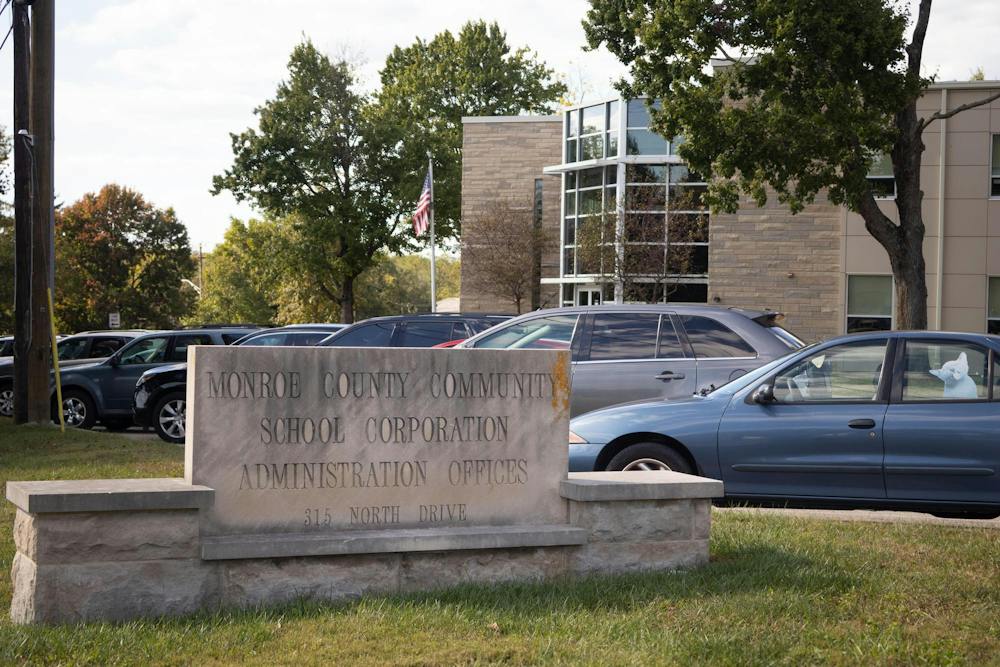
Students in Bloomington public schools can no longer access their phones during the school day after a new state law took effect in July.
Senate Enrolled Act 78, authored by Sen. Jeff Raatz, R-Richmond, and Sen. Greg Goode, R-Terre Haute, prohibited students at Indiana public schools from using any “wireless communication device” during the school day.
Bloomington High School South senior Ella Pizzo said she thought the ban had both benefits and drawbacks.
“It’s annoying because, like, I miss being able to like, listen to music while I'm doing homework and schoolwork and stuff,” Pizzo said. “But like, it's kind of nice to like, actually talk to people and like, I'm allowed to do more, like, board games, I guess, or just being able to get your work done.”
According to the Monroe County Community School Corporation, wireless devices include “cell phones, smartwatches, tablets, laptops, wireless headphones, and gaming devices.” The district includes 23 K-12 public schools.
The MCCSC website instructs students to have devices, “powered completely off (not silenced or on airplane mode),” and “stored out of sight in a location identified by your school’s principal.” The state legislation’s expressed goal is for wireless devices to be “inaccessible to the student.” Pizzo said students at Bloomington South cannot access their phones from 7:45 a.m. to 2:40 p.m — the school’s hours.
This type of ban is not new to Bloomington South students. According to MCCSC school board President Erin Cooperman, MCCSC already had policies banning phone use during instructional time.
The bill makes an exception for students with a medical condition, Individualized Education Program or 504 plan that indicates a need for phone use. An IEP provides students with disabilities an individual learning program to help them succeed. A 504 plan provides students with academic accommodations.
When SEA 78 was enacted, the MCCSC school board spoke over the summer about what the law would mean for students and parents, Cooperman said.
“But we hadn’t really received emails from the public, or especially parents, expressing concern about cellphones in our schools,” Cooperman said. “It wasn’t something that the teacher's union brought to us as a concern. So, it wasn’t something that we identified as a problem within MCCSC schools.”
Bloomington South senior Addie Racek, editor for the school’s student newspaper, said that last year her environmental science teacher constantly told students to get off their phones. This year, when she spoke with that teacher for an interview, Racek found that things were different.
“She was like, 'I don't really have to do that anymore.’ Sometimes it happens, but, like, most people aren't on their phones,” Racek said.
In a press release after the bill was enacted, Raatz cited research conducted by the National Center for Education Statistics that found 72% of public-school leaders thought that cell phone usage was one cause of poor mental health. Just over half of those surveyed also thought that phone usage at school impacted students’ grades.
Racek said the ban was a barrier for students to communicate with each other about clubs and extracurriculars, since students can no longer use GroupMe during the school day. She also said the ban impacts students’ ability to contact parents and guardians in the case of an emergency.
“I was, like, nervous about what was going to happen if I couldn't, like, communicate with my parents about something like that,” Racek said.
Some schools in Indiana have implemented phone holding cells to enforce the ban. At Bloomington South, Racek said that phone holding cells are not present, but most students do not access their phones during the school day.
“I'll see them in the hallways, but everyone's really nervous. Like they're always just, like, hiding it, and stuff.” Racek said. “I'd say, like, a majority of people do follow the ban.”