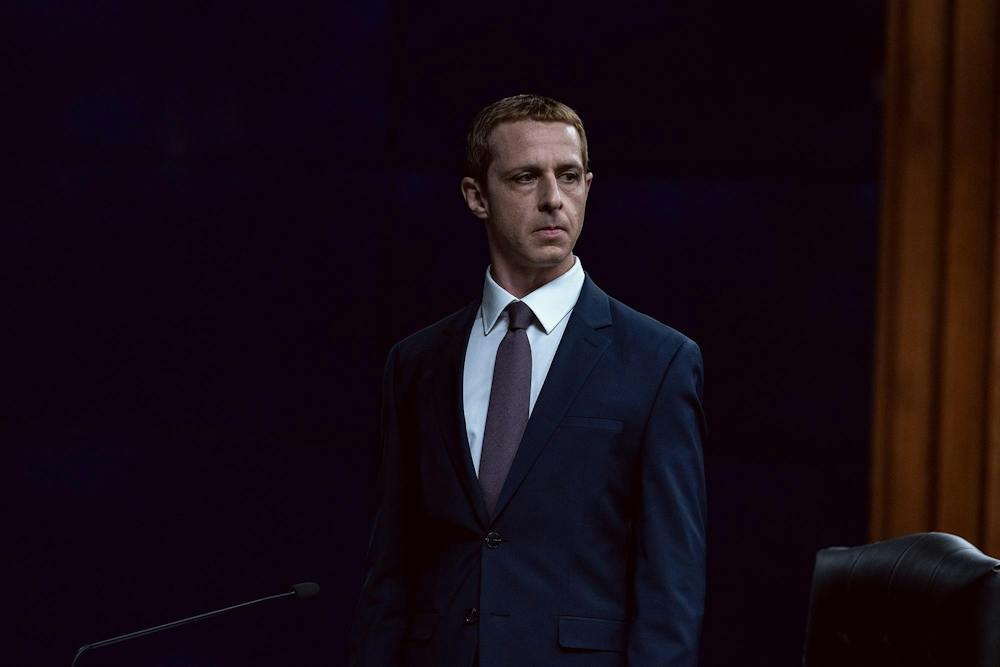
“The Social Network,” written by Aaron Sorkin and directed by David Fincher, released Oct. 1, 2010, and received exceptional feedback from both critics and audiences. Sorkin’s snappy dialogue coupled with Fincher’s sharp directorial style was a match made in heaven, bringing the story of Facebook’s conception to the big screen in dramatic fashion.
In 2011, the film won three Oscars for Best Adapted Screenplay, Best Original Score and Best Film Editing. Today, the movie is still highly regarded, rated a 3.9 out of 5 on Letterboxd, a 7.8 out of 10 on IMDb and a whopping 96% on Rotten Tomatoes with a critic consensus that stated the film is “impeccably scripted, beautifully directed, and filled with fine performances.”
Sixteen years later, Aaron Sorkin returns both in his writing position as well as serving as director in Fincher’s place, to create the sequel, “The Social Reckoning” and the movie is mildly disappointing.
“The Social Reckoning” picks up roughly 17 years after the events of “The Social Network,” — which took place around 2003 to 2004 — this time around focusing on the Frances Haugen whistleblower incident and the associated “Facebook files” published by the Wall Street Journal, in which Facebook was accused of intentionally polarizing users through its algorithm, contributing to mental health issues in teenagers, failing to curb dangerous content and more.
After the success of “The Social Network,” “The Social Reckoning” had a spectacular predecessor to live up to. But is it an adequate sequel or a lackluster imitation?
While the film poses many interesting ideas, more than anything it just made me want to go home and watch “The Social Network” again.
The two films share many elements.
Sorkin’s dialogue is always incredibly precise, witty and entertaining, and none of that is lost in the newest film. “The Social Reckoning” even shares the same plot structure as the original, playing out two separate timelines simultaneously to tell the story, and just like in “The Social Network,” it works.
However, what is noticeably lost between the two is Fincher’s directorial style.
The color palette, shot composition and general framing of “The Social Network” felt far more stylistic than it did in “The Social Reckoning,” and I believe that comes down to the different approaches of both Fincher and Sorkin as directors.
For example, “The Social Network” contains an excellent montage it calls the “Sean-a-Thon” in which the character Sean Parker (Justin Timberlake) is introduced. In this scene a collection of incredible camerawork and impeccable editing make his character and introduction unforgettable. Whereas “The Social Reckoning” lacks any form of creative shot sequences that are as unique or memorable as those present in its predecessor.
As far as acting goes, both films are spectacular.
Jesse Eisenberg as Mark Zuckerberg and Andrew Garfield as Eduardo Saverin in “The Social Network” both deliver career-best performances, filling the movie with a sense of heart and drama in what might otherwise be a rather dull film about people talking about Facebook. Similarly, Jeremy Allen White and Mikey Madison as Jeff Horwitz and Frances Haugen, respectively, also do a spectacular job in the lead roles for this film, and Jeremy Strong is solid in portraying Mark Zuckerberg in a slightly different light than how Eisenberg did in the original.
Another thing to note is that while the dynamics between protagonists are engaging in both films, I found that the dynamic between Zuckerberg and Saverin in “The Social Network” was very developed, relatable and emotional. Whereas the one between Haugen, a Facebook employee who served as the whistleblower in the incident detailed in the movie, and Horwitz, a reporter for The Wall Street Journal who works with Haugen to expose Facebook, in “The Social Reckoning” was far less so.
Many of the underlying tensions and plot devices used to develop Zuckerberg and Saverin in “The Social Network” feel absent, leading to Horwitz and Haugen’s relationship feeling much less nuanced.
While the relationship between Horwitz and Haugen is innately different, less competitive and more cooperative, I found there was little emotional backing between characters, worse characterization leading to their motives and conversations that felt generic and hollow despite the well-written dialogue.
Trent Reznor and Atticus Ross’ score in the original film was techno-focused — rhythmic, dark, eerie and precise — and contributed heavily to the film’s darker tone and mood as typical with Fincher films. “The Social Reckoning” utilizes a different approach in its score, created by Alexandre Desplat, which is still sufficient for the film it’s in, but doesn’t elevate the movie in the same way Reznor and Ross’ score did previously. It’s much more orchestral and dramatic but is ultimately unmemorable because of how similar it sounds to many other soundtracks in the drama genre.
Ultimately, “The Social Reckoning” falls short of “The Social Network” due to its lack of a distinct style that the original was so packed full of.
From Fincher’s meticulous direction to Reznor and Ross’ atmospheric score, “The Social Network” creates an experience that feels singular in its genre, whereas “The Social Reckoning,” while not bad, doesn’t prove to be exceptional or unique enough to serve its predecessor.
Most of the heavy lifting for “The Social Reckoning” comes in the form of its thematic significance, as the concept and situation it’s dealing with is extremely important and relative to things happening today such as political polarization, debates over censorship online, a social media mental health crisis and more that the movie explores. The premise is engaging, intriguing and thought provoking, but the strong narrative just isn’t backed by the film’s technical elements, which drag it down and make it more boring than the subject demands.
The film feels more like an attempt at mimicking a masterpiece, by utilizing the same narrative structure and dual-protagonist character dynamic it tries to copy what made the original so spectacular, but it doesn’t stick the landing.