
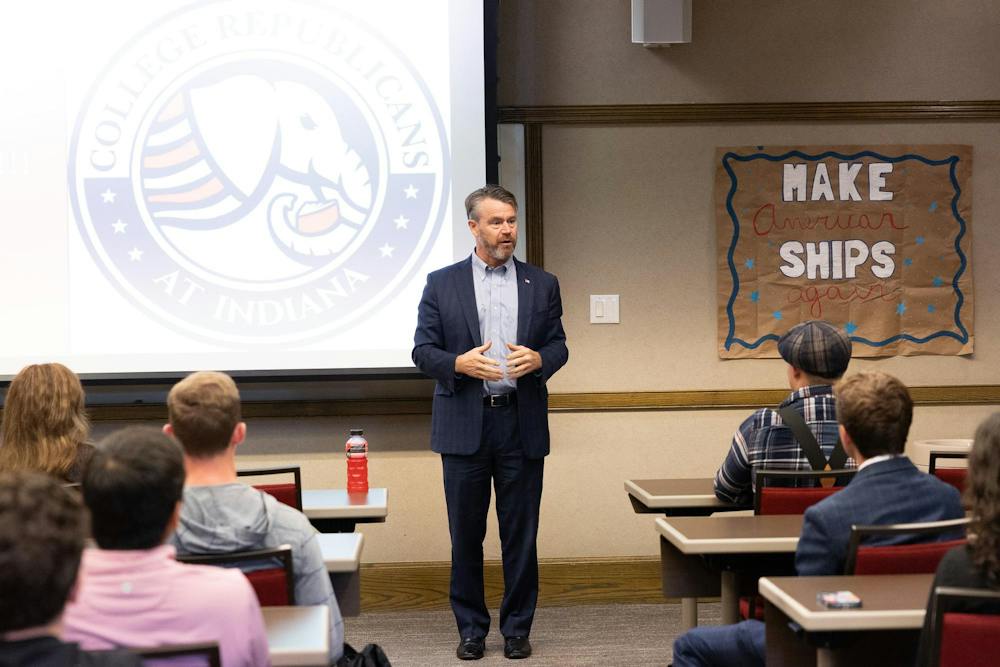
U.S. Sen. Todd Young, R-Ind., fielded questions about the national debt, foreign aid and welfare programs during a College Republicans at Indiana University roundtable Monday afternoon.
At the beginning of the meeting inside the Indiana Memorial Union, Young spoke about making a concerted effort to meet with young people and find out what issues they care about and what they wanted to see from a political party.
Here are some of the topics discussed:
National debt
The United States’ national debt, which is the amount of outstanding money the government has borrowed to cover its expenses, currently sits at $40.1 trillion, double its amount in 2010. Young asked the room who was concerned about the national debt, many raised their hands.
“People who are in retirement now aren’t going to feel the pinch from our fiscal situation as much as young people,” Young said. “Current debt is future taxes or future inflation.”
He said passing debt to future generations was unkind and constrained opportunity. Young said that since roughly 2011, when he was sworn into Congress, the body had cut discretionary spending nearly every year.
Discretionary spending is money Congress and the president approve during the budgeting process each year, which goes toward national defense, transportation, education, housing and other agencies. Young said talking about cutting programs like Medicare and Social Security has been politically “radioactive” because it’s people’s health care and pension money.
“We continue to focus on discretionary and not cutting it as much as maybe we should because there is not been the courage to come up with solutions or the meeting of minds across parties to come up with solutions to solve the really big stuff,” Young said.
Foreign aid
Several people asked about the United States sending money to Israel, which it has provided with $174 billion in missile defense funding and military financing since 1948, according to a May 2025 congressional report. One audience member asked how spending that money on Israel benefited families in Indiana.
“To have a stable Middle East, it benefits families in Indiana,” Young responded.
Young continued that rules against torture and in support of state sovereignty also benefited Hoosiers. He then referenced an unverified claim that militant group Hamas had burned babies in its Oct. 7, 2023, attack on Israel that killed around 1,200 people and saw 251 taken hostage. Israel’s ensuing retaliatory offensive has killed more than 73,821 Palestinians, according to the Gaza Health Ministry, a part of the Hamas-run government.
Young also spoke about U.S. spending in its war with Iran, which has reached $43.6 billion, while responding to a question about balancing short-term economic priorities with long-term fiscal burden.
Young said that the government should spend money on acute national security needs, such as building interceptors to shoot down missiles from Iran that are targeting allies and American soldiers.
“Nationally, you start with national security and homeland security, and sort of figure out things from there,” Young said.
Welfare
One audience member asked Young how he would market welfare reform to citizens. Young said people should not be disincentivized to work because they fear losing eligibility for government benefits if they make too much money.
He also said the government should give special benefits to veterans to take care of them mentally and physically, and to send a signal to younger generations that service is appreciated.
When asked about incentivizing retirement for citizens, he pointed to “Trump Accounts,” individual retirement accounts that contribute $1,000 for American children born between Jan. 1, 2025, and Dec. 31, 2028.
“At birth, we're going to seed an account so that young people, you know, when they get a little bit older, will have a nest egg,” Young said. “Be encouraged to build on that nest egg through their own efforts.”
Young said he believed there would be “some form” of social security around for Generation Z, but he believed it would be “a little less generous.”
Dillon Burns, the College Republicans at IU president, said it was the organization’s job to help students interact with their elected officials.
“We believe that the best way, you know, students can get involved at a young age is having that initial connection with an elected official,” Burns said. “And then hopefully from there that builds an interest in politics and policy and government.


