Editor’s Note: All opinions, columns and letters reflect the views of the individual writer and not necessarily those of the IDS or its staffers.
You are always being watched. From your phone to your laptop and even your TV, the devices we surround ourselves with are constantly collecting our data. Advertisers use this data to predict your next purchase, build a demographic profile and track you across both websites and devices. Invasive data tracking is a staple of modern American life, and recent years have seen an expansion beyond the digital domain.
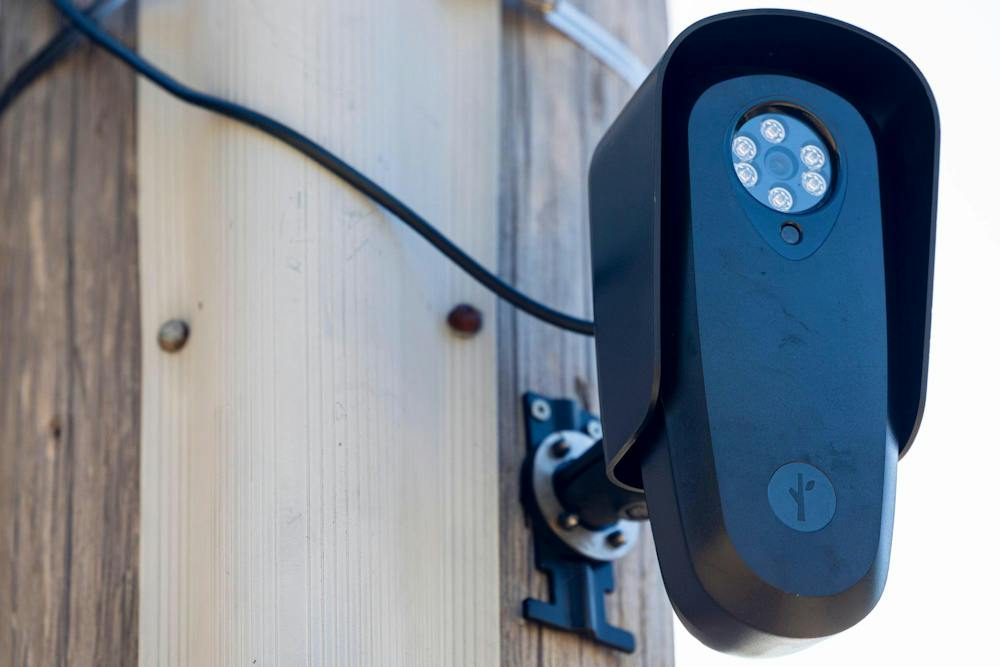
Case in point, nearly 150,000 AI-powered Flock cameras now dot the country. This surveillance network tracks vehicles across state lines and the movement of every car on the road, regardless of individual suspicion. Flock has naturally drawn a large public backlash, but it has been insufficient to dislodge Flock from American roadsides.
Flock Saftey is a company which both designs automated license plate readers and develops the network infrastructure necessary to operate them. Flock cameras are all connected within a single system; a police officer in California can watch swimmers in Florida, and doesn’t need a warrant to do so. The dashboard which makes this possible is incredibly simple to work, requiring roughly equivalent skill as a Google search. The result is reckless overuse of Flock’s database, as officers internally justify frivolous searches with “idk,” “TBD” and “hehe.”
My Indiana Daily Student colleague, Eric Cannon, recently published a defense of Flock, where he decried this backlash as “alarmism,” drawing a dichotomy between Flock and crime. He argues crime is also bad, so can’t Flock be used for good? However, this comparison misses the substance of the case against Flock entirely: that Flock’s surveillance network violates sacred civil liberties and can’t be allowed to continue.
According to Jeff Welty, professor of public law and government at the University of North Carolina, Flock camera usage could amount to a violation of the Fourth Amendment if it can comprehensively track an individual’s movements. Flock’s defense against this charge has focused on the fact that they track license plates, which are publicly identifiable. Flock cameras are also fixed and highly visible, so drivers presumably know they are being watched.
The problem with Flock’s defense is that roads do not move. Drivers may know a Flock camera is watching, but they still must go to school or work, regardless of a camera’s presence. This is part of Flock’s appeal to police departments: their own marketing material makes a point of the size of their network. The case against Flock has focused on this aspect, arguing that the scale and interconnectivity of the network constitutes an invasive search.
The question for the courts is whether the extent of Flock’s network has yet violated the Fourth Amendment. The more Flock expands its network, and the more useful Flock becomes to police departments, the closer Flock comes to infringing on our civil liberties.
It’s also unclear if Flock surveillance makes the police any better. In one Illinois town, police searched Flock’s database more than 1,200 times for loitering, curfew violations and the homeless. These are not serious offenses, but are easy to pursue with Flock’s assistance. The result is a diversion of resources from the difficult work of clearing cases and onto hyper-policing of marginalized groups.
Even as police budgets have ballooned, clearance rates for serious crimes have dropped sharply. For example, in California from 1990-1994, 52.5% of rape cases ended in an arrest, while in 2022, that number was 27.7%. Over the same period, real police budgets increased by 46% per capita. This is not to say that crime is an overwhelming problem. In fact, across almost every category, crime has reached historic lows.
When people defend Flock cameras as an antidote to crime, the logic is not self-evident. If the police were responsible for the decline in crime rates, that would show up in their clearance rates. If Flock were responsible, the decline would have accelerated in the past year. Neither seems to be the case.
The choice between low crime rates and the vigorous protection of civil liberties is a false one. Police have operated for decades without access to Flock cameras and only 40% of police departments maintain contracts with the company.
This technology is not inevitable, and public “alarmism” has played a key role in slowing adoption. DeFlock.org, the most prominent anti-Flock group, credits 153 cities with banning Flock cameras. Bloomington similarly opted to end its contract with Flock after intense backlash. Many more cities will soon follow, but only because local organizations have taken it upon themselves to reclaim their civil liberties.
Like their founding fathers before them, opponents of Flock maintain an American tradition of preventing government overreach. American civil liberties, the foundational freedoms laid out in the Constitution, are not self-affirming. It is the responsibility of citizens to organize and increase awareness when those principles are broken. I, for one, celebrate organized opposition to the expanding surveillance state.
There is nothing more American than fighting Flock.
Spencer Robinson (he/him) is a junior studying public policy analysis and law and public policy. His commentary can also be found on his Substack.