All opinions, columns and letters reflect the views of the individual writer and not necessarily those of the IDS or its staffers.
Every once in a while, we must remember that people tend to overreact. By the time the next most important election ever rolls around, I suspect we’ll have narrowly avoided no less than three more apocalypses. Among the ones we’ve escaped, you can count Y2K, which was supposed to usher in “the end of the world as we know it,” the end of net neutrality, which would “destroy everything that makes the internet great,” and, thus far, the timeline where AI “could kill us all.”
Maybe it’s the constant alarmism that has dulled my sense of cosmic danger, or maybe it’s the retrospective absurdity of some of the doomsaying, but lately, I’ve started feeling a tad, well, moderate about the state of the world — and even, dare I say, the slightest bit optimistic as I observe firsthand its newest technologies, like GrubHub’s delivery robots. Call me an atheist to the doomerism cult, but I don’t think Flock cameras are the worst, either.
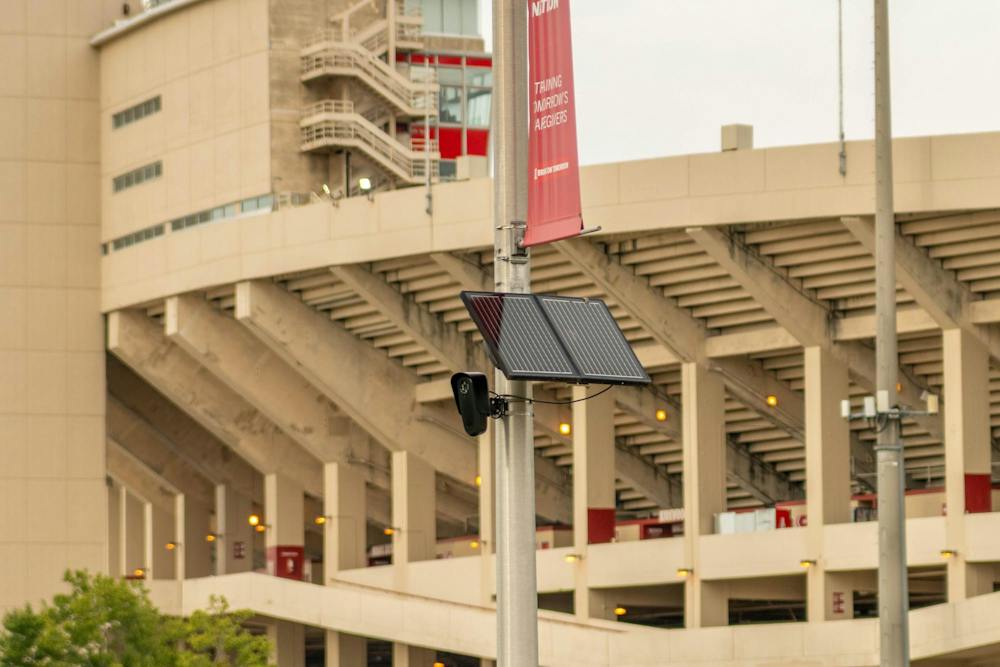
Only last year, Bloomington housed some of these AI-powered surveillance cameras, sold by the eponymous Flock Safety. They record and analyze passing vehicles’ distinctive features — makes, models, license plates, colors and dents or lack thereof. Importantly, they also have the ability to share their footage with a network of participating law enforcement agencies.
This ability stirred controversy when U.S. Immigration and Customs Enforcement asked state and local police departments to run searches for it. Instances of police officers using Flock’s database to stalk people have also hit headlines recently — rightly so, I agree. Yet, Flock cameras have been around since 2017, previously without much ado. And in a few years from now, I’m sure they’ll still be posted on street corners, again without ado.
You see, as a columnist of two years, I get the inkling that this pitiful state of public relations is not quite a natural course of events. It stems, at least partly, from the pens of my professional counterparts. Journalists, especially those who write opinion, thrive on bringing to the public’s attention the most sensational ideas our society can hold at that moment: for example, AI will lead to soaring poverty, high school should be abolished or Flock cameras will end our civil liberties.
A certain indulgence exists on readers’ part as well, I imagine, a scandalous delight in being among the elect, members of the few who have received word of the world’s impending end or its new beginning. Yes, organized religion is on the decline in the United States, but not the innate drive to seek and heed prophetic oracles.
With the appearance of Flock cameras, another not-so-rare opportunity has presented itself to evangelize the unconverted with the gloomy message of dystopia. Last year, hundreds of protestors gathered in Bloomington as part of a crusade for this creed. They triumphed: the city ended its Flock contract, and later, Monroe County followed suit.
But I shall reveal to you, dear reader, a middling world that belongs to a more realistic future. It exists beyond the fervor of the current news cycle, and it has made modest progress in stifling crime while overcoming Orwellian threats with a boring, but effective, defense.
Yes, it’s true, Flock cameras aren’t ideal. But neither is crime. Criminal activity exists, and notably, it shouldn’t. It’s something our politics should spend efforts fighting. And as it happens, an effective deterrent to crime is the ability to apprehend suspects — a task Flock cameras excel at.
Last year, police departments contracting Flock used the company’s cameras to assist in one out of every five solved cases — over one million cases. Among these, more than 10,000 missing persons, including abducted children, were found. In Bloomington, Flock cameras helped identify suspects in an armed robbery, two murders, a rape and several child abductions. Altogether, Flock cameras led to a 9.1% increase in the number of cases with arrests — not to mention the crimes they prevented. Across 216 jurisdictions operating cameras, car theft fell by 11%.
After all, why would police departments invest in the technology if it did not help? Since crimes are quite expensive, costing the United States $2.6 trillion a year, investment in Flock can lead to impressive savings, for law enforcement and would-be victims.
The problem is, of course, people don’t want Big Brother to watch them. Luckily, there is a compromise being worked out. In Waukesha, Wisconsin, a civic interest group sued to require law enforcement in the state to obtain a warrant before accessing Flock’s database.
The point should be obvious. We can enjoy our cake and eat it, too. It’s not recognized often enough that crime rates are drastically down since, well, ever. But they should be reduced further. Any means of accomplishing this, like Flock, is the next natural step to explore. If we can see it through while ensuring footage is accessed only with reasonable suspicion, why not?
The good news is that this is surely the way things will go. Just as crime rates have trended downward, the march of time is generally one defined by progress: net neutrality did not destroy the internet — on which you are probably reading this. Nor did Y2K unleash Armageddon.
The bad news is that people will continue to prophesy the end times. On the bright side, this will make public discourse more exciting in the meantime.
Eric Cannon (he/him) is a junior studying philosophy and political science and currently serves as a member of IU Student Government. His column appears Sundays and Wednesdays. Never miss them or his other opinionated musings on X.